

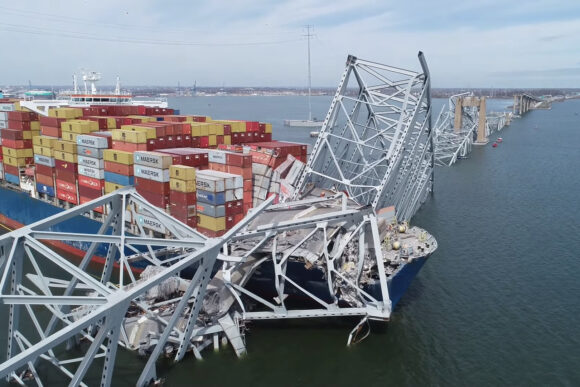
A federal judge has agreed with the owner and manager of the Dali cargo ship responsible for the collapse of Baltimore’s Key Bridge that the bulk of the remaining claims against them for economic damage are invalid.
On August 25, U.S. District Senior Judge James K. Bredar dismissed most of the economic damage claims by the city and county of Baltimore and eight consolidated claims by private entities including insurers.
Citing a 1927 Supreme Court opinion (Robins Dry Dock & Repair Co. v. Flint), Bredar found that the public and private entities that have sued are precluded from recovering economic losses resulting from physical damage to the Key Bridge because they had no proprietary interest in the bridge or other property.
Instead, Dali owner Grace Ocean Private Ltd. and operator Synergy Marine Group can only be held liable for economic losses if there was damage to property owned by the claimant.
In keeping with the Robins precedent, the city may pursue its claim related to alleged damage to the 72-inch water main below the river and the county may proceed to try to prove it has a proprietary interest in damaged waterways and shorelines. Also, four cargo damage claims may proceed.
Since most of the original 54 civil claims have already been settled or voluntarily dropped, the ruling actually dismissed a relatively small number of cases. None of the civil settlements contain an admission of wrongdoing by Grace Ocean or Synergy.
Ship Owner Seeks Dismissal of Economic Loss Claims From Baltimore Bridge Collapse
The Francis Scott Key Bridge collapsed in the early morning hours of March 26, 2024, after being struck by the Dali as the vessel departed the Port of Baltimore. The collapse killed six construction workers, obstructed a major shipping channel, and disrupted commerce and traffic in the region.
In addition to dismissing other claims by Baltimore city and county, the ruling throws out unsettled claims for private economic damages by longshoremen, energy, export, manufacturing, construction services, technology, sugar, molasses and publishing firms along with related insurers including Markel, Liberty Mutual, QBE, AXA XL, Evanston and Canopius. These parties had been seeking damages for losses due to business interruption, declines in advertisement and directory revenue, increased shipment costs, lost taxes and economic revenue, among other alleged losses.
The private entities, except for those pressing the four cargo damage claims, were judged to have no proprietary interest in any damaged property.
Limited Liability
On April 1, 2024, Grace Ocean and Synergy Marine filed a petition to limit their liability for the bridge collapse. They invoked the Limitation of Liability Act of 1851 to limit their liability to the value of the ship, about $44 million.
Since then, they have settled claims far exceeding that limit.
There have been civil settlements with the federal government ($102 million) for cleanup costs and the state of Maryland ($2.5 million) for environmental damage, lost toll revenue, and broader economic disruption. Also the families of the deceased workers settled for an undisclosed amount for wrongful death. Also Baltimore Gas and Electric Co. settled claims over infrastructure damage for an undisclosed amount.
There have been settlements for reimbursements of workers’ compensation payments made to employees killed and injured in the tragedy, Other settlements have been for cargo losses. Several claims have been dismissed.
Maryland Moves to Deny Liability Limit Sought by Ship Manager in Key Bridge Collapse
Soon after the tragedy, ACE American Insurance Co. (part of Chubb), the property insurer for the Francis Scott Key Bridge, settled a major claim with Grace Ocean Private Limited and Synergy Marine Group. by paying out its policy limit of $350 million.
Economic Losses
Grace Ocean and Synergy Marine told the court in their June motion to dismiss that since the economic loss claimants did not have an ownership interest in the Key Bridge and have failed to identify a recognizable interest in any other property that sustained physical damage as a result of the casualty, their claims “must all be dismissed as a matter of law.”
During the economic loss claims proceedings, the municipalities and private businesses argued in part that any ruling should be delayed until the overall limit of liability had been decided. But the judge said that was not necessary, especially given that so many claims have already been settled including claims for wrongful death, personal injury, and physical damage.
“The Robins rule is animated by policy concerns over the potential for boundless, indirect damage claims arising from maritime negligence and addresses those concerns by imposing a bar to recover for remote, purely economic harm, not flowing from damage to person or property,” Bredar wrote.
“In the final reckoning, the petitioners’ assertion that Robins would be transformative has borne out.”
Workers’ Families, Other Parties Settle Baltimore Bridge Tragedy Claims
In addition the city’s claim for damage to the submerged water main and the county’s claim for damage to waterways and shorelines — both of which may proceed— the government entities had also claimed other losses and costs including for replacing the bridge, disruption of city traffic, economic interruption, increased road repair and maintenance, first responders, public nuisance, lost tax revenue and fees, hazardous materials monitoring and removal, and other effects.
Baltimore argued unsuccessfully that it has had a “proprietary interest in the Key Bridge since the Key Bridge’s construction” and that it sought damages for the cost of replacement of the Key Bridge and its approaches.
The city has criticized what it maintains is the attempt of the ship owner and operator to “shift the costs” of alleged wrongdoing onto Baltimore residents and taxpayers.
In the 1927 case Robins Dry Dock, a dry-docking company damaged a propeller on a steamship, rendering the vessel unusable for two weeks longer than anticipated. The vessel’s time charterer sued the dry dock company to recover its lost profits resulting from the delay while the propeller was repaired. The Supreme Court denied recovery, rejecting the argument that the charterer was a third-party beneficiary of the dry dock contract and rejecting tort liability. The court held that the injury to the propeller did not harm the respondents but only those to whom it belonged.
The U.S. Department of Justice (DOJ) has brought criminal charges against Synergy for the tragedy. Synergy has called DOJ’s allegations in the indictment “baseless” and said they have “nothing to do with” the Dali’s allision with the Key Bridge.
Photo: Collapsed Francis Scott Key Bridge in Maryland with Cargo Ship Dali. NTSB photo.
Topics Legislation Claims
Was this article valuable?
Here are more articles you may enjoy.
 Uninsurable Future: Managing the Climate-Change-Fueled Home Insurance Crisis
  Starbucks Sued Over ‘Sugar-Free’ Claims for Protein Beverages
  McDonald’s Hit With Class Action Alleging AI-Powered Menu Price-Fixing
  Karen Clark Rolls Out Severe Convective Storm Model 5.0

