

Demand for ocean divers who specialize in barnacle scraping is soaring as ships stranded in the Persian Gulf for more than three months prepare to disembark.
The surge in orders for crews to clean ship hulls fouled by algae, slime and crustaceans has jumped more than 30-fold since US President Donald Trump announced an interim peace deal with Iran that will reopen the Strait of Hormuz, said Captain Manandeep Singh Kukreja, chief surveyor at Dubai-based Prominence Shipping Services LLC.
The rush has the potential to push the fees commanded by scraping crews for underwater work on a single vessel up as much as 60% to $8,000, he said during an interview. Just days ago, when Trump announced the agreement, crews were fetching $5,000 for such work.
“The next 30 days, it’s going to be for a diving company like they’ve struck gold,” Kukreja said. “Everyone wants to get out of Hormuz finally. Everyone wants to get back to earning money.”
Scrubbing barnacles from hulls is but one example of the challenges and costs big and small ships face as they wait for the US and Iran to finalize the peace deal so they can sail through the Strait of Hormuz. After months of war, they’ll need to make sure their insurance is in order, sort out who will oversee safe passage and take whatever measures are possible to avoid potential mines.
About 600 vessels remain trapped in the Persian Gulf, as the largest-ever disruption to global energy market drags toward its 16th week.
Read more: Shippers and Oil Giants Seek Clarity on US-Iran Peace Deal
Barnacles are the cousins of hard-shelled creatures like lobsters and crabs that attach themselves to ship bottoms with a self-made adhesive so hard that it’s been studied by scientists for potential use in dentistry. Most ports of call forbid barnacle-studded vessels from entry because of the threat of destructive, invasive species nestled inbetween the tightly packed barnacles.
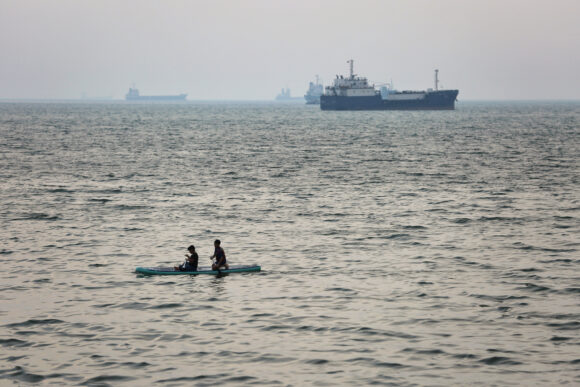
Hence the sudden rise in demand for scraping crews to tend to scores of vessels that have been idling in the bathwater-warm shallows of the Persian Gulf since the war erupted in late February.
“They’re going to make the best out of this opportunity,” Kukreja said of the divers. “It’s a no-brainer that they will hike their prices.”
To be sure, the hull-cleaning process is highly specific to each ship and the degree of marine life buildup. Raghu Sharma, a navigation officer and master mariner who has worked on oil tankers in the Persian Gulf, said that some vessels may only have accumulated slime, while others may be thoroughly encrusted, which requires more intense cleaning techniques.
Photograph: Ships are anchored near the shoreline of Bandar Abbas, Iran, in April 2026; photo credit: Getty Images
Was this article valuable?
Here are more articles you may enjoy.
 Florida Supreme Court Approves Board Certification in Insurance Law
  Kroger Plans to Slash 37% of Corporate Jobs in Next Three Years
  Eastern States’ Grocers Shut Online Systems After Cyberattack
  ‘Unusual’ Isaias Brings Winds, Downed Trees But Fewer Claims Than Expected

