

US forecasters say an El Niño is favored to emerge in the Pacific Ocean by September, threatening to drive global temperatures higher and disrupt crops in the months ahead.
Scientists at the US Climate Prediction Center project a 62% chance that an ocean-heating El Niño would emerge during the Northern Hemisphere’s summer, with odds climbing higher into the fall. The phenomenon is poised to add extra warmth to a planet that’s rapidly heating due to human-caused climate change.
El Niño’s impact on global weather patterns tends to be far-reaching and can last a year or more. Wildfire risk often rises as drought develops across countries including Australia, Indonesia and South Africa, said Nat Johnson, a meteorologist for the National Oceanic and Atmospheric Administration. In the US, El Niño is associated with heavy rains in the Southeast and above-average temperatures in northern states.
Signals for an oncoming El Niño are “unusually strong,” according to Johnson. But US forecasters are less certain about its intensity, noting conflicting results in underlying models.
“We’re not ruling out the possibility that this becomes a really strong event,” Johnson said. “It’s just too early to be confident of this assessment.”
Past events have been linked to both intense rains and drought, hurting coffee harvests in Vietnam, degrading soybean crops in Brazil and creating challenges for cocoa growers across Africa.
As global seas grow warmer, ocean fisheries suffer and coral reefs may experience harmful bleaching. El Niño also puts a noticeable damper on the Atlantic hurricane season, which officially begins June 1. In the eastern Pacific Ocean, however, the pattern has the opposite effect, amplifying storm activity.
Some scientists have predicted an unusually powerful El Niño, tied to greater warming in the pocket of the Pacific Ocean that produces the phenomenon and its cooling counterpart, La Niña. Current US government forecasts are more conservative, Johnson said, calling for a 1-in-3 chance of a strong event with starker global impacts by the end of 2026.
El Niño is part of a cyclical warming and cooling pattern known as the the El Niño–Southern Oscillation. The system produced a weak La Niña in 2025 that drove repeated outbreaks of Arctic cold throughout winter and above-average snowfall in parts of the US. Deadly flooding in southern Africa also bore La Nina’s signature.
The Western US, meanwhile, has sweltered as record-breaking warmth and scarce snowfall raise concerns about the region’s water supplies heading into the summer months.
The last remnants of La Niña will likely fade away by April, according to the Climate Prediction Center.
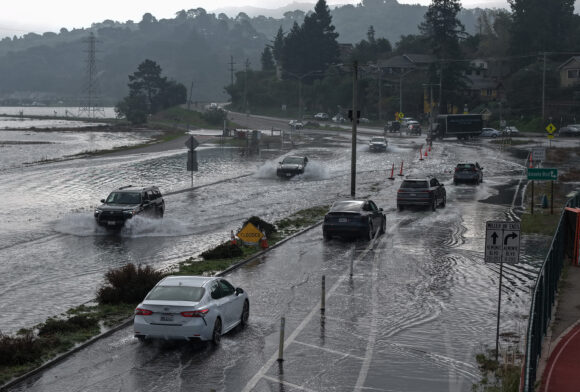
Photo: Cars drive along a street flooded with seawater in Mill Valley, California. Photographer: Justin Sullivan/Getty Images
Topics USA
Was this article valuable?
Here are more articles you may enjoy.
 How Federal Ban on Intoxicating Hemp Products Will Reshape Risk, Coverage
  Florida AG Says His Office Investigating ‘Anti-Public Adjuster’ Endorsements in Policies
  Viewpoint: Beware These Commercial Auto Endorsements!
  Insurer Rolls Out Policy to Protect Data Centers Against Growing Backlash

