

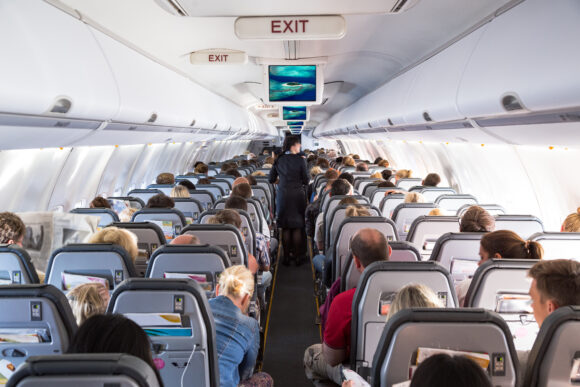
When passengers step onto an airplane, they’re accustomed to turbulence, seat kicking and lengthy tarmac delays. Those are the predictable annoyances of air travel.
But a far more serious risk to the safety of flyers has received heightened attention in recent months: toxic fume events. These incidents, where passengers and crew breathe in toxic chemicals from jet engine lubricants, can lead to short-term symptoms like headaches and dizziness to long-lasting injuries including chronic impairment, respiratory illnesses, and mood disorders.
A toxic fume event is caused when engine oil or hydraulic fluid enters a plane’s air supply, often because of faulty seals or maintenance issues. On most commercial jets, about half of the air that passengers and crew breathe is pulled directly from the engine through a process known as “bleed air.”
Fume events are a long known and rare occurrence, but the number of reported incidents has substantially risen over the past decade, according to data compiled by the Wall Street Journal.
Rising awareness of the severity of fume events has caught the attention of plaintiffs’ attorneys, who are actively advertising to people who may have been exposed to toxic fumes on flights.
“I think when society starts looking closely at health issues, there can be a cascading effect where more and more people become aware of it, and that results in more litigation,” said Noel Paul, an insurance recovery partner at Honigman.
While lawsuits alleging injuries from fume events have long been limited to airline employees and settled through workers’ compensation, that may be changing.
In late 2025 a law professor sued Boeing for $40 million after allegedly developing a long-term illness from exposure to toxic fumes on a 2024 flight operated by Delta Airlines.
The plaintiff, Temple professor Jonathan Harris, alleged the cabin of the 737 plane was filled with a dirty sock-like odor during a 45-minute delay on the LAX tarmac. Harris experienced trouble breathing as toxic fumes seeped into the cabin, the lawsuit alleges.
Harris claims he suffers from balance and motor skill issues, tremors and memory loss, and cognitive defects. The case is awaiting a hearing.
Airplane manufacturers are likely to be the primary target of lawsuits brought by passengers, while airlines may face litigation that falls outside of traditional workers’ comp claims, according to Paul.
“I think it’s very likely that (insurers) are going to have a lot of interest in what the manufacturers and the airlines are aware of in terms of claims and what steps they’re taking to address the issue,” Paul said.
The Causation Factor
Plaintiffs who believe they’ve been the victim of a toxic fume event would face a high bar in proving their symptoms were caused by a specific incident or multiple fume events, as opposed to some other underlying health issue or incident, according to Paul.
“Causation I think is really the key issue with these incidents,” Paul said. “Certainly it would be argued by defendants in these suits, and I think is argued now, that there’s no proof that these fume events are causing the symptoms that many of these people are alleging.”
Establishing causation for toxic fume injuries isn’t without precedent.
In 2020 the Oregon Workers’ Compensation Board ruled in favor of a JetBlue pilot who was denied disability for a career-ending exposure to vaporized engine oil.
During a January 2017 maintenance check in Portland, Captain Andrew Myers was exposed to a “choking, burning odor” while performing routine maintenance on an Airbus 320. The incident left him with toxic encephalopathy—a neurological disorder that manifested as tremors so severe he couldn’t hold a glass of water, alongside memory loss and vision problems.
JetBlue and its insurer AIG repeatedly denied compensability for Myers’ toxic encephalopathy on the grounds that the “condition did not exist and, if it did, the industrial injury was not a material contributing cause of that condition.”
Administrative law judge Darren Otto ruled there was a causal link between the toxic fumes and Myers’ brain damage and ordered JetBlue to pay hundreds of thousands of dollars in attorney fees. JetBlue was hit with a 25% penalty for unreasonably denying Myers’ claim.
Otto critiqued JetBlue’s safety culture, writing that “airlines appear to be more concerned about keeping planes in the air than worker safety.”
What’s On The Horizon?
Litigation involving toxic fume events has so far mostly been driven by individual plaintiffs. As lawmakers and the public grow more interested in the issue, there is a likelihood of class-action lawsuits.
Attorneys at Moran and Lewis, a law firm with a specialized aviation practice, wrote in January that the plaintiffs’ bar may be looking toward “larger class and mass filings, potentially based on failure-to-warn theories that do not depend on individualized proof of personal injury.”
Earlier this week Lowey Dannenberg launched an investigation into whether Jet Blue officers and directors breached their fiduciary duties by failing to disclose the systemic risks of toxic fumes to shareholders.
The investigation follows a February lawsuit brought forth in North Carolina by a Jet Blue flight attendant who claims the airline concealed and downplayed the risks associated with exposure to the toxic fumes. Jet Blue didn’t respond to a request for comment.
“I think if there’s regulatory pronouncements or court pronouncements that are in favor of plaintiffs and claimants trying to establish liability, then that could certainly lead to a surge in these types of claims and lawsuits by both crew members and passengers,” Paul said.
A lawsuit brought by individuals alleging they suffered injuries from a fume event could potentially trigger years if not decades of insurance coverage, Paul said, comparing it with asbestos litigation.
“I see that as one key distinction that really could make insurance quite important if people start saying, ‘Oh, I was on a flight back in the 80s and I was part of a fume event. I didn’t realize it at the time, but I was and it caused me serious injury that’s affected my whole life,'” Paul said.
Topics Aviation
Was this article valuable?
Here are more articles you may enjoy.
 A Timeline of Developments in AI Safety Since the Attack on Hugging Face
  Viewpoint: The ‘Unbundled’ Insurer Emerges in Age of AI as Value Chain Fragments
  Friend of Suspected FBI Data Thief: ‘Crazy’ Teen Warned Not to Hack Bureau
  AI’s Water Strain Includes Surging Demand From Electricity Use