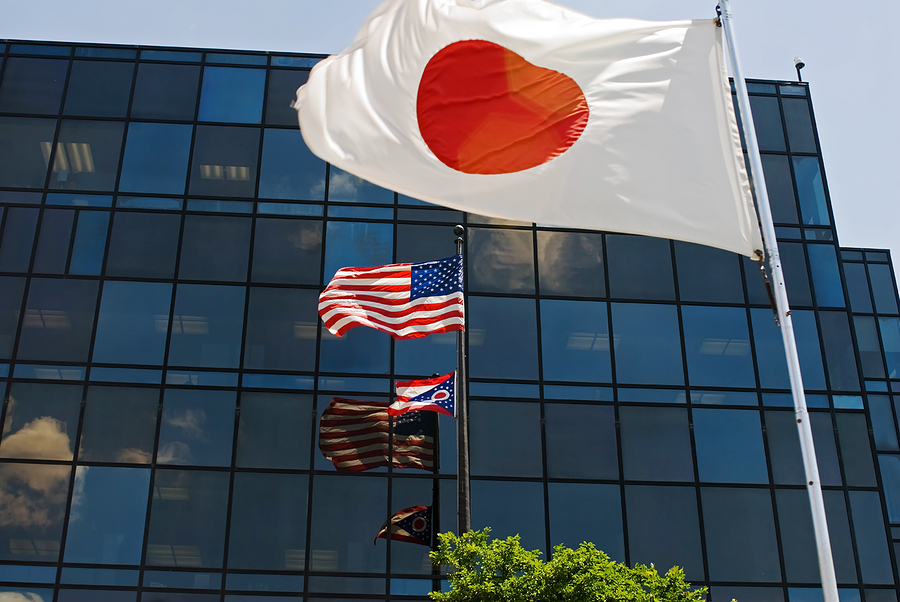
Five hundred and fifty billion dollars. That is the figure at the center of the landmark strategic investment agreement the United States and Japan concluded on July 22, 2025. A commitment by Japan to direct capital into American industries on a scale rarely seen in the history of bilateral economic relations between the two countries. For the US insurance market, it represents one of the most significant new business opportunities in a generation, and one that will demand more from brokers and carriers.
The program has now begun. On February 17, 2026, the first tranche of projects was announced: $36 billion committed across three investments, including a $33 billion gas-fired power generation project in Ohio to supply electricity for AI data centers, a $2.1 billion crude oil export infrastructure facility in Texas, and a $600 million synthetic industrial diamond manufacturing plant in Georgia. A second tranche has since been confirmed, directing $73 billion toward energy infrastructure, with small modular reactor construction and gas generation projects among the headline commitments. The full $550 billion is intended to be deployed by January 2029, with the Japanese government identifying four primary investment sectors: energy including small modular reactors, power generation for AI-related uses, AI infrastructure including data centers, and critical minerals.
Japan is the largest single source of foreign direct investment into the United States and has been among the most consistent. Toyota’s battery plant in North Carolina, now under construction at a cost of several billion dollars, is an example of how that investment translates into insurable risk: construction programs, operational property, workers’ compensation, and liability all require coverage across the full commercial lines spectrum. Multiply that across dozens of large-scale projects simultaneously, in sectors ranging from energy to advanced manufacturing to nuclear, and the scale of what the insurance market will be asked to support becomes clear.
Many areas of the US P/C market are entering a softening cycle after several years of hard market conditions, with increased competition and downward pressure on rates across several commercial lines, while casualty lines continue to face their own distinct pressures. New sources of complex, high-value risk are not easy to find in that environment. The infrastructure and manufacturing programs flowing from this investment commitment represent exactly the kind of large-account, multi-line opportunity that the market will be looking for.
Cross-Class Opportunities
The cascade of risk from this investment will move through the market in phases. During construction, the dominant exposures will be builders’ risk and construction liability. As facilities become operational, property, workers’ compensation, umbrella, and general liability placements follow. For the Japanese multinationals acting as operators or contractors on these projects, directors’ and officers’ cover, political risk, and trade credit will also come into scope as their US operational footprint expands.
Based on how Japanese companies have structured large-scale overseas investments in the past, the risk allocation picture is reasonably consistent. Country and political risks are typically addressed through public-sector frameworks, in this case institutions such as the Japan Bank for International Cooperation and Nippon Export and Investment Insurance. Commercial risks, covering construction, operational property, and liability, are where the private insurance and reinsurance markets come in. Programs of this scale are not single-insurer placements; they operate through multi-insurer panels, with capacity distributed across the market according to risk appetite and specialist expertise. The US market has participated in this structure before, supporting Japanese company investments in manufacturing and energy projects, but not at anywhere near the scale now being contemplated.
A Risk-Reflective Approach
Beyond securing the business, the key question is whether the programs built around this investment will be genuinely risk-reflective. Large infrastructure projects have a history of attracting insurance that functions primarily as a financing requirement. Given the duration of this commitment and the operating environment these projects will face, the market has both an opportunity and a responsibility to do better.
A couple of decades ago, catastrophe underwriting was anchored around primary perils. The industry continues to see large nat cats, but the picture has been shifting significantly. Secondary perils, from severe convective storms to inland flooding and wildfires, now generate losses that consistently rival significant primary events. Infrastructure built today, whether gas power plants, critical minerals processing facilities, AI data centers, or next-generation nuclear reactors, will be operating for decades. The risk environment those assets will face over their lifetime is not the one modeled ten years ago, and insurance programs need to reflect that.
There is also a broader evolution underway in how the most forward-thinking insurers are approaching complex risks. Moving beyond pure risk transfer toward a model that integrates risk mitigation and prevention, helping clients understand and reduce their exposures before losses occur, is where the industry creates lasting value on long-horizon infrastructure programs. For projects of this scale, engaging at the design stage and bringing risk engineering expertise to the table before ground is broken is not just good practice. It is what Japanese corporate clients, with their culture of long-term planning and disciplined capital stewardship, will increasingly expect from their insurance partners.
Looking to the Future
This year marks fifty years since Tokio Marine America (formerly TMM – Tokio Marine Management) established its US presence, although the Group’s history in this market stretches back to 1890. Across that time, the consistent lesson has been that the carriers and brokers who build relationships with Japanese corporate clients ahead of major investment cycles are the ones who earn the right to support those clients when the programs go live.
The second tranche, now confirmed, focuses heavily on nuclear and gas generation, sectors that will require deep specialist expertise and risk engineering capabilities that sit well outside standard commercial lines. SMR technology in particular represents a relatively novel challenge for the market: the risk profiles for next-generation reactor designs are still being modelled, and the programs that emerge will need to be built from the ground up. For the broader market, the opportunity lies in the wider cascade of associated risks these programs will generate, spanning construction, property, liability, and workers’ compensation. The capital is starting to move. The time to prepare is now.
Was this article valuable?
Here are more articles you may enjoy.
 Gulf Coast on Alert for First Hurricane of 2026
  Viewpoint: The ‘Unbundled’ Insurer Emerges in Age of AI as Value Chain Fragments
  McKinsey Rebukes Partner Who Questioned Challenges Facing Women CEOs
  Hackers Breached Propulsion System of US-Bound Oil Tanker