

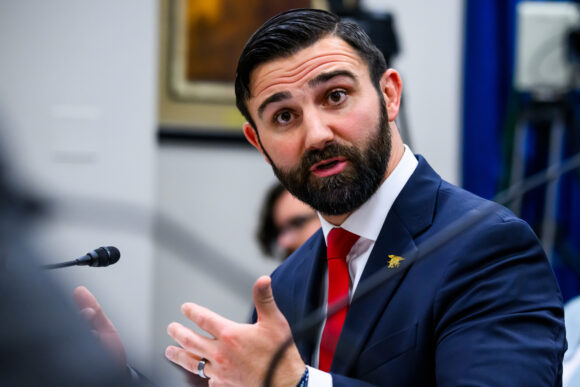
President Donald Trump’s pick to lead the Federal Emergency Management Agency wrote a memo last spring laying out how to kill the disaster agency.
At the time, Cameron Hamilton was FEMA’s interim chief — a role that didn’t last long. When called before Congress, he endorsed keeping the agency, not ending it as outlined in his own memo, titled “Abolishing FEMA.” That publicly put him at odds with his two bosses, Trump and Kristi Noem, then Homeland Security secretary. Hamilton, a former Navy SEAL, was pushed out of the administration within a day.
Now, Hamilton is on the verge of a surprising comeback: The White House nominated him Monday to serve as FEMA administrator. All it took was an opportunity created by Trump’s ouster of Noem in March as well as a months-long campaign by Hamilton to convince the president that he’s best suited for the job, according to people familiar with the matter who weren’t authorized to speak publicly.
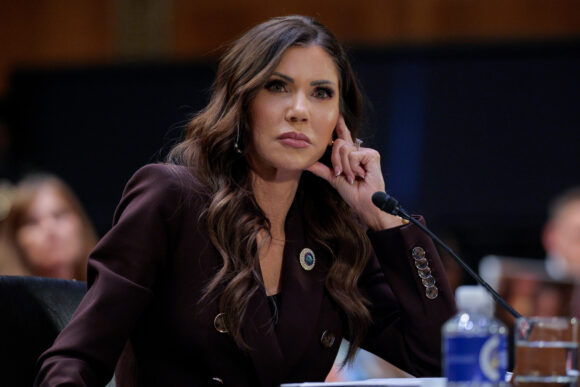
Given that Hamilton has recently been on both sides of the question over whether FEMA should exist, his nomination comes with extraordinary ambiguity. Will he seek to continue the deep cuts to federal disaster programs initiated by Elon Musk’s Department of Government Efficiency? Or will he rebuild and stabilize an agency he has since urged Republicans to preserve, warning they would “absolutely” lose elections otherwise?
FEMA skeptics and supporters alike will now seek to interpret Hamilton’s position. While he declined to comment for this story, Hamilton told Bloomberg News in an interview last fall that he saw FEMA as necessary to protect American lives. But he also envisioned an overhaul that would shrink its scope and functions.
“I had a vision to downsize the agency pretty radically,” he said at the time, with up to half of FEMA’s headcount leaving in a months-long transition. “My focus, though, was to do it intentionally, and to be very, very methodical about what responsibilities we push across to other agencies. This wasn’t just cut for the sake of cutting.”
The stakes are high: The Atlantic hurricane season that officially starts June 1 and runs through November is typically the agency’s busiest time of year, colliding with peak wildfire season in the western US. As increasingly volatile weather wreaks havoc on communities nationwide, the demand for FEMA’s help has skyrocketed. The agency provided more than $181 billion in disaster aid over the last five years — more than five times what it spent over the same period a decade ago.
Climate change is a big reason these costs are going up, which FEMA has failed to address under Trump. Meanwhile, the administration has restricted climate work, taken down tools and data, and rolled back bedrock policies designed to curb global-warming emissions.
If confirmed, Hamilton will face a summer of climate-fueled threats from floods, fires and heat waves while “inheriting an agency that is grossly understaffed, where the morale is probably underwater,” said Pete Gaynor, a veteran emergency manager from Rhode Island who served as Trump’s first-term FEMA chief. “It’s a significant problem.”
FEMA spokesperson Victoria Barton said in a statement that the agency “remains focused on its mission and readiness for hurricane season” as it supports Hamilton through his nomination process.
“Under new leadership, FEMA is addressing outstanding personnel actions to ensure workforce stability and a strong, deployable surge force for upcoming national events and potential disasters,” Barton said.
Read More: Trump’s Ex-FEMA Chief Says Killing Agency Puts Public at ‘Extreme Risk’
In interviews with Bloomberg News, Hamilton said his views as a “strong constitutional conservative” first attracted the attention of Trump’s transition team. Hamilton, a Republican, had previously failed in his 2024 bid for a Virginia congressional seat and occasionally appeared on Fox News to discuss Israel’s military capabilities amid its war in Gaza.
After leaving the Navy, Hamilton had worked supporting crisis teams at the State Department. He also had experience at the Department of Homeland Security, which oversees FEMA, where he assisted with disaster planning for terror attacks.
In his spare time, Hamilton has coached high school wrestling. The sport is a shared interest with new DHS Secretary Markwayne Mullin, a former collegiate wrestler who Hamilton counts as a friend, according to people familiar with Hamilton.
Leading up to his hiring as interim chief in January 2025, Hamilton’s social media accounts recirculated misinformation about FEMA’s storm responses, including the false claim that the agency had diverted disaster aid to help Mexican immigrants, according to reporting by Politico. But when Hamilton joined FEMA, emergency managers found that he approached the job with curiosity and collegiality, winning over some veteran disaster experts.
The agency’s fate was never fully in his hands, former FEMA employees and some experts say. Days after taking office, Trump launched an independent FEMA review task force to recommend reforms. Musk’s DOGE, meanwhile, slashed the agency’s budgets and programming.
In March 2025, Noem directed Hamilton to deliver a roadmap to scale back FEMA’s role — or eliminate the agency altogether. The resulting 7-page memo outlined how the executive branch could shrink FEMA, and detailed further reforms that would require Congressional action.
After details from an internal meeting tied to the memo leaked, DHS ordered lie detector tests for Hamilton and other FEMA staff. Even though he passed a polygraph in late March, he told the Disaster Tough podcast “it became a very hostile relationship, and I knew that the inevitable was at some point I’m going to be asked to step aside.”
Within weeks, in April 2025, FEMA canceled its largest resiliency grant program, a multibillion-dollar initiative called Building Resilient Infrastructure and Communities. In a press release announcing the decision, Noem took credit for “eliminating waste, fraud, and abuse,” though the cuts were later reversed by a federal court.
Hamilton, however, struck a more measured note when he testified before Congress about a month later. “Communities look to FEMA in their greatest times of need,” he said. “It’s imperative that we remain ready to respond to those challenges.”
His defense of the agency earned him the respect of some FEMA experts, including MaryAnn Tierney, a longtime official who served as his second-in-command. “I saw firsthand how he came to fully grasp the importance of FEMA’s mission and the commitment of its workforce,” said Tierney, who left the agency a few weeks after Hamilton.
In the following months, Noem ramped up her oversight and continued pressing for cuts at the agency. In June, she authored a memo requiring her team’s signoff on all spending over $100,000. (A congressional investigation later linked the policy to delays in fielding calls from storm survivors in the wake of the Texas floods.)
In late August, nearly 200 people, including a mix of existing and former staffers, signed an open letter to Congress criticizing Trump’s FEMA cuts, saying they put the nation at risk of experiencing a disaster on the scale of Hurricane Katrina in 2005.
Hamilton, who took a job at a disaster response contractor, began speaking out against Noem’s policies late last summer. In November, he said her continued advocacy for eliminating FEMA would be “highly politically consequential” and “reflect extremely poorly on the president.”
“Survivors are not going to get the help they need and I can’t live with that, knowing we turned a blind eye, and pretend it didn’t happen,” Hamilton said.
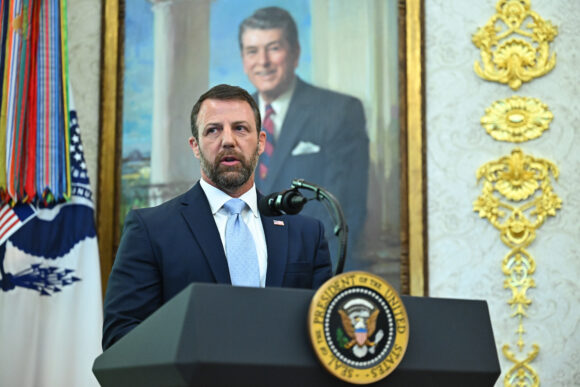
In the spring, Trump ousted Noem, in part for her handling of FEMA. Since taking over her job, Mullin has canceled Noem’s FEMA spending policy and allowed the agency to start bringing back some fired disaster workers and others who had been placed on administrative leave for publicly sharing concerns about agency cuts.
At his confirmation hearing, Mullin said he intended to pick a permanent FEMA leader instead of relying on temporary stewards as Noem had done. “I’m going to find somebody that is capable of doing the job, that is smarter than me at doing the job, that has experience doing the job,” he said, urging senators to give that person “a fair shake” in the confirmation process.
Picking Hamilton is another signal that Mullin is breaking away from Noem’s vision for the agency. Still, experts told Bloomberg News that an extensive downsizing is likely still on the table with his return.
Trump’s taskforce for evaluating FEMA’s future last week recommended the agency assess its staffing needs, suggesting more cuts were on the way, along with other changes that would scale back the agency’s work if implemented.
For all the supporters Hamilton has gained over the past year, he still has many critics. Samantha Montano, a disaster researcher at Massachusetts Maritime Academy, said she doesn’t think Hamilton’s five-month stint at FEMA and previous work in the federal government satisfies job requirements set by Congress. They include at least five years of executive leadership and management in either the public or private sector.
“It’s pretty easy for people to imagine what happens when you have an inexperienced, uneducated, untrained emergency manager leading FEMA, because that is what happened during Katrina,” Montano said.
Among experienced emergency managers, there’s widespread awareness that preparing communities to withstand natural disasters before they hit is as crucial for FEMA as responding to an emergency and its aftermath.
Former agency official Daniel Kaniewski, who managed disaster declarations during George W. Bush’s administration, said promoting resilience should be “job one” for Hamilton.
“I realize we’re entering hurricane season and that’s a more immediate priority, but the next administrator will have to balance the immediate with the future,” Kaniewski said. “That’s the tension.”
Top Photo: Trumps FEMA nominee Cameron Hamilton Photographer: Pete Kiehart/Bloomberg
Was this article valuable?
Here are more articles you may enjoy.
 Uninsurable Future: Managing the Climate-Change-Fueled Home Insurance Crisis
  Large Commercial Property Rates Drop 14.5% in Q2 to Highlight Latest Willis Report
  Florida Commissioner Suspends A-Cap’s Atlantic Coast Life Over Surplus Issues
  Gronkowski Now Pitchman for eMaxx, a Reciprocal With a Different Playbook

