

When Mitesh Parikh, a headhunter at UK recruiter Selby Jennings, started looking for an ILS modeler for a large US hedge fund this year, the pool of qualified candidates was disconcertingly small.
“It was a tough search,” says Parikh, who specializes in roles focused on risk.
ILS — which stands for insurance-linked securities — is “a relatively new and emerging area among hedge funds,” he said. “And they’re all looking for the same talent.”
Experts in ILS have traditionally focused on things like modeling the probability that a hurricane might hit an urban area, and how that would feed into insurance risk. Such analyses have long been relevant for investors in catastrophe bonds, which make up a niche corner of capital markets worth nearly $70 billion in total.
Now, some of the world’s biggest hedge funds and banks want to incorporate the expertise of catastrophe-risk professionals across a broader chunk of the finance sector, as the skills required to model natural disasters become increasingly relevant for asset values in a hotter, more turbulent world. For hedge funds, the challenge is finding ILS experts who also have a nous for finance and investing.
It took a couple of months before Parikh was able to find the right candidate for his US hedge-fund client, whose identity he declined to disclose. The standard compensation package for such hires tends to be around $400,000 to $670,000, he said.
It’s part of an emerging pattern among banks and hedge funds, as they try to adapt their businesses to a world shaped by a rise in violent, destabilizing weather cycles. Knowing how to model everything from wildfires to floods and even civil unrest is now more important than ever.
And with the possibility of a so-called super El Niño cycle affecting weather patterns this year, investors, banks and insurers are particularly keen to ensure they’re not caught flat-footed.
JPMorgan Chase & Co. is among firms looking for people to help the bank deal with such threats. It’s in the process of hiring an executive director to lead the implementation of catastrophe modeling for climate risk, as well as an analyst to go alongside the role in New York, according to a Linkedin post published by Catherine Ansell, JPMorgan’s executive director of Climate, Nature and Social.
Jane Street, one of the world’s most profitable quantitative trading firms, has been looking for a London-based senior weather analyst. It’s also trying to fill a similar position at its commodities trading desk in New York.
Others have already built out such teams. Bloomberg has previously reported that Millennium Management and Squarepoint Capital are among firms hiring, with some paying as much as $1 million for the right weather modeler. At Citadel, there are about two-dozen weather experts helping drive its trades in oil, gas, and other commodities.
Qube Research & Technologies brought in John Ery, a certified extreme-event modeler, in November. In his role as an ILS quantitative trader at Qube, Ery is part of a roster that includes Daniel Ineichen, a catastrophe-bond veteran who previously worked at Schroders Capital.
Howden Capital Markets & Advisory, an insurance-focused investment banking group, recently hired in Adil Imani, who used to oversee risk analytics and transaction support for catastrophe bond issuance at Verisk Analytics Inc.
And while modeling catastrophe risk is still mostly associated with weather-related shocks, hedge funds and other investors are increasingly drawn to the idea of having a framework that helps them estimate tail-risk probabilities across areas such as cybersecurity, civil unrest and even war.
Jason Sykes, an adviser at specialist ILS recruitment firm 20Twenty Search, says the pool of ILS experts globally is probably no larger than about 2,000. But thanks to the pay packages most hedge funds are now willing to offer, they’re able to lure the very best in the industry, he says.
“When these new entrants come in they can pick out perhaps the No. 2 in ILS, or a very talented quant who’s sitting there covering cat bonds,” said Sykes.
For ILS specialists used to limited upward mobility within their traditional fields, their sudden popularity is having a profound effect on their earnings potential. Over the past two years, demand from hedge funds has led to ILS professionals getting pay bumps that are “exponentially higher” than their previous salaries, according to Sykes.
Artificial intelligence is helping improve the power of catastrophe modelers’ algorithms, but banks and hedge funds still want qualified experts to interpret the results AI spits out.
What’s more, most AI methods aren’t designed to model high-impact tail-risk events, and need “careful evaluation and validation” to be meaningful, according to Firas Saleh, director of product management at Moody’s.
There are also signs that financial firms are hiring catastrophe modelers to help manage their own risks.
JPMorgan, which says it has had people focused on physical risk for more than five years, said the person filling the executive role will be expected to help the bank transition to a low-carbon economy and ensure it’s resilient to physical climate risks.
Ansell, who’s worked at JPMorgan since 2021 after stints at the World Bank Group and Willis Towers Watson, said the Wall Street bank expects the right candidate to have at least 10 years of experience in catastrophe modeling to be considered.
As banks and hedge funds bring in more ILS and weather experts, they’re increasingly feeding an entire ecosystem of related businesses.
ICEYE, a satellite-imagery firm, recently began offering banks impact data on floods, storms and other extreme weather events that have the potential to hit property values and trigger mortgage defaults. The firm says its 72 satellites can see through the dark, as well as through clouds and smoke, capturing granular data at the level of individual homes.
“Banks are looking at our data and their catastrophe models in a kind of combination,” said Paul Sowden, sales director for banking at ICEYE. It’s a match-up that helps them “understand and reduce their exposure, and to price it more accurately.”
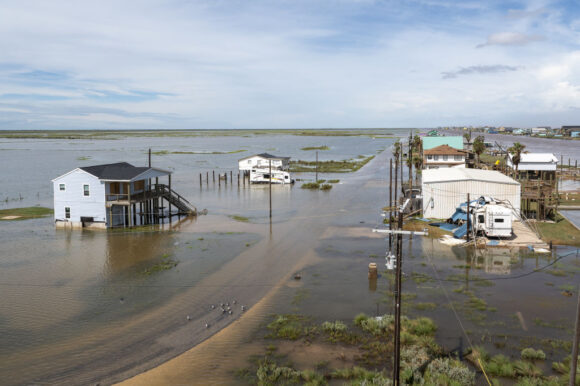
Photo: Homes surrounded by flood waters after Hurricane Beryl made landfall in Sargent, Texas on July 8, 2024. Photo credit: Eddie Seal/Bloomberg
Topics Catastrophe Profit Loss
Was this article valuable?
Here are more articles you may enjoy.
 Large Commercial Property Rates Drop 14.5% in Q2 to Highlight Latest Willis Report
  AXA XL Launches Insurance Company, AXA XL E&S
  McDonald’s Hit With Class Action Alleging AI-Powered Menu Price-Fixing
  Gulf Coast on Alert for First Hurricane of 2026

