

Analysts at insurance rating firm AM Best said there are “warning signs” for the directors & offers liability market, leading to shrinking underwriting margins and a tighter environment for buyers in 2026.
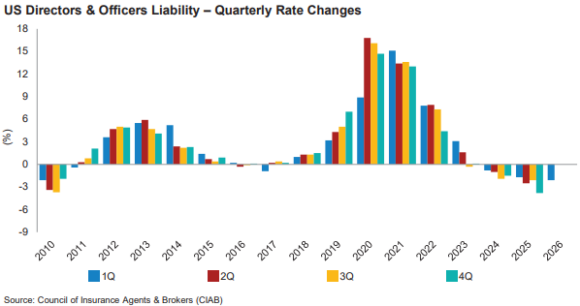
In a new report, AM Best said 2025 marked the fourth straight year of premium decline in the D&O liability line. Nevertheless, insurers have generated favorable direct underwriting results the last few years while insureds have enjoyed competitive renewal terms and new offerings in a market that has maintained abundant capacity.
However, in 2025 premium decreases were lower on average at renewal, with some seeing flat or slightly upward adjustments.
The recent trend of premium decline could be explained by a decrease in demand, especially for transactional risk coverage as initial public offerings fell. The IPO market rebounded in 2025 and has since leveled off somewhat due to economic uncertainty related to the Iran conflict, AM Best said.
AM Best noted a direct loss ratio of 54.5 in 2025—five percentage points higher compared with 2024. In addition, reserve levels for accident years 2023 and 2024 were inadequate in 2025. In fact, claims-closure rates for years 2023 and 2024 were slower than accident years 2018 and 2019, which caused adverse development last decade, and price increases.
“This might indicate an underlying deficiency that could lead to a downturn in D&O liability underwriting results over the near term,” said David Blades, associate director, AM Best. As claims remain open longer, profitable underwriting margins might start to disappear, AM Best added.
The line of business also faces headwinds related to geopolitical and economic uncertainties, technology, and regulatory scrutiny. AM Best noted discipline among insurers with policy terms and conditions.
“Insurers will need to conduct expert due diligence in determining which industries and business segments they want to pursue in providing D&O insurance,” AM Best said, as corporate leaders face criticism over how they interpreted and handled fluid risks such as trade policies, supply chains, overseas conflicts, financial reporting changes, cyber, and regulatory shifts such as with environment social governance (ESG) and diversity equity and inclusion (DEI).
Additionally, enterprises face risks associated with disclosure and oversight of the use of artificial intelligence. AM Best said some companies may struggle to connect investments in AI with returns. The industry could influence the AI-related regulation, but “disclosure management is going to be vital to successful AI use no matter the industry,” AM Best added.
Topics AM Best
Was this article valuable?
Here are more articles you may enjoy.
 Zurich Insurance Completes Acquisition of Beazley, Names New Beazley CEO
  McDonald’s Hit With Class Action Alleging AI-Powered Menu Price-Fixing
  Sedgwick: Property Claims Face Delays, Are Growing More Complex
  AI Bubble Risks Worst S&P 500 Crash Since 2008, Strategist Says