

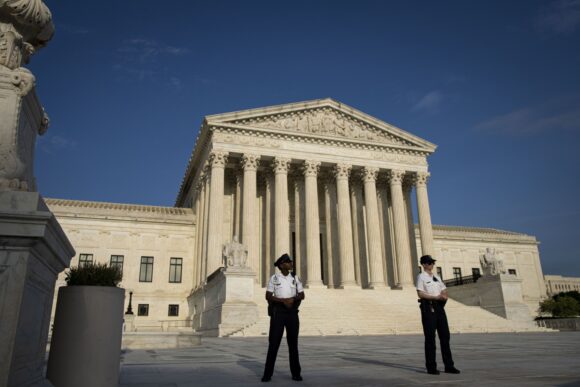
The US Supreme Court reinforced the Securities and Exchange Commission’s power to recover illegal profits in a case that centered on one of the agency’s most potent enforcement tools.
The justices ruled unanimously Thursday that SEC doesn’t have to show identifiable investor harm in order to win “disgorgement” from people and firms found to have violated federal securities laws.
The ruling will shape a panoply of SEC cases in which victims aren’t easy to pinpoint, from low-profile record-keeping violations to major insider trading allegations. The SEC used disgorgement to secure orders for more than $6 billion in fiscal 2024 and almost $11 billion last year.
The decision ends a losing streak for the SEC at the Supreme Court, which had curbed the commission’s powers three times over the past decade.
Disgorgement is distinct from civil penalties, which the agency can use as punishment if it can meet the legal requirements. The Supreme Court said in 2024 that defendants have a constitutional right to a jury trial in federal court when the commission asks for civil penalties.
The SEC said it should be able to win disgorgement without having to show identifiable investor harm, known to lawyers as “pecuniary” harm. Lawyers challenging the SEC said that approach would eliminate the distinction between disgorgement and civil penalties.
Writing for the court, Justice Neil Gorsuch said disgorgement traditionally has focused on depriving wrongdoers of money they made illegally.
Under those traditional principles, “a victim seeking disgorgement of a defendant’s unlawful gains does not need to prove he has suffered a corresponding loss or, indeed, any loss,” Gorsuch wrote.
SEC General Counsel Russell McGranahan said the ruling will help the commission maintain a consistent approach in its enforcement efforts.
“This remedy will remain an important part of the commission’s renewed emphasis on combating fraud, and we are gratified the Supreme Court agreed with the agency’s position in this case,” McGranahan said in a statement.
The case involved Ongkaruck Sripetch, who was accused by the SEC of engaging in a variety of fraudulent schemes tied to at least 20 penny stock companies. The SEC said Sripetch, who controlled a website called Stockpalooza.com, joined with associates to promote shares and then dump them before the price cratered. The schemes generated $6.6 million in illicit profits, the SEC said.
Sripetch has separately pleaded guilty to one count of selling unregistered securities and was sentenced to 21 months in prison.
Sripetch’s lawyer didn’t immediately respond to a request for comment.
The case is Sripetch v. Securities and Exchange Commission, 25-466.
Photo: Photographer: Al Drago/Bloomberg
Was this article valuable?
Here are more articles you may enjoy.
 Agency Duties – Legal vs. Ethical
  Uninsurable Future: Managing the Climate-Change-Fueled Home Insurance Crisis
  Harbor Emerges From Stealth with $10M Funding to Handle AI-Agent Risk
  Hordes of Teens on E-Bikes Force Suburbs to Rewrite Road Rules

