

A federal judge ruled President Donald Trump can proceed with his $15 billion defamation lawsuit against the New York Times, giving a boost to his ongoing cases against the press.
US District Judge Steven Merryday in Tampa, Florida, on Thursday denied a request by one of the world’s most prominent news organizations to dismiss the case, which the president filed last year. Trump accused the news outlet of tarnishing his reputation with false stories about his business acumen before the 2024 presidential election.
The judge dismissed two claims in the suit and narrowed four others. The surviving claims relate to statements accusing Trump of tax fraud, tax evasion, money laundering or related criminal conduct.
Merryday, appointed by former President George H.W. Bush, ruled Trump sufficiently alleged that the Times had acted with “actual malice,” meaning its journalists knew the statements were false or acted with “reckless disregard for the truth.” The actual malice standard — a high bar that must be met by public figures who sue for defamation — was established by the Supreme Court decades ago to protect press freedoms.
However, Thursday’s ruling significantly narrows the case by eliminating more than two dozen challenged statements, mostly from Times articles.
The ruling does not find that the New York Times defamed Trump, but it holds that the allegations are sufficient to survive the newspaper’s motion to dismiss. The decision means the case is now on track for a potential trial.
Merryday held that the disputed Times statements accuse the president of tax crimes without an “explicit opinion from a qualified source after a thorough examination of pertinent facts.”
“Knowing of the necessity for that opinion but failing to procure that opinion is a fine example of the purposeful avoidance of the truth,” the judge said.
The New York Times did not immediately respond to a message seeking comment. A representative of Trump’s legal team also did not immediately respond.
The lawsuit is one of several filed by Trump against the media since the start of his second term. A $10 billion defamation suit Trump filed against the Wall Street Journal was thrown out by a different judge in a ruling that barred him from refiling it. The British Broadcasting Corp. lost its move to dismiss a $10 billion suit brought by Trump.
The Times could appeal the ruling. For now, the decision sets up the case for a potential trial in which opposing views of the First Amendment’s press protections are expected to feature heavily.
Trump sued in September 2025, alleging the Times tarnished his reputation with three articles and a book written by its journalists. The suit also named Penguin Random House LLC for publishing the book, titled Lucky Loser: How Donald Trump Squandered His Father’s Fortune and Created the Illusion of Success. The Times argued the reporting was accurate.
In seeking to dismiss the suit, the Times had argued that Trump had filed a frivolous lawsuit aimed at “scoring political points” against the press rather than “identifying facts to support a viable legal claim.” The newspaper also said that Trump had failed to explain exactly how dozens of disputed statements in the book and news articles at the center of the case were false.
The suit, filed by Trump’s personal attorney Alejandro Brito, claimed Trump’s reputation was harmed by the articles and the book in the run-up to the 2024 presidential election, which he won. The president also alleged the Times generally has acted as a “mouthpiece” for Democrats, which it denies.
Brito’s complaint highlighted what he described as Trump’s “hard-earned, sterling reputation” and described the president as a “globally celebrated businessman” who “possesses a unique charisma,” pointing to elements of Trump’s reputation that had allegedly been damaged.
The suit also raised numerous disputes with the Times that were not alleged to be defamatory but which Trump disagreed with, including what he called the newspaper’s “deranged” endorsement of his 2024 opponent, ex-Vice President Kamala Harris.
Merryday tossed the first version of Trump’s suit just a few days after it was filed in September 2025, finding Brito failed to follow court rules requiring “short, plain, direct” claims. He shortly refiled a streamlined version that stripped out what the judge called “repetitive,” “superfluous” and “florid” allegations and details.
Trump is waging an aggressive legal campaign against news outlets that he claims have defamed him. He sued the BBC in December over an allegedly misleading edit of a speech he gave to supporters before they attacked the US Capitol on Jan. 6, 2021. The suit against the Journal disputed a story that said Trump had sent a “bawdy” birthday note to the late, disgraced financier Jeffrey Epstein decades ago.
The case is Trump v. New York Times Co., 8:25-cv-02487, US District Court, Middle District of Florida (Tampa).
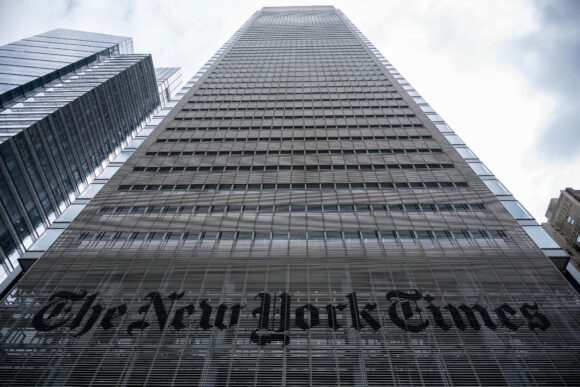
Photo: The New York Times headquarters in New York. Photographer: Victor J. Blue/Bloomberg
Topics Lawsuits Legislation New York
Was this article valuable?
Here are more articles you may enjoy.
 Commercial Property Premium Decreases of 6.2% Drive Overall Soft Q3: CIAB
 Microsoft Races to Fix Outlook in One of Its Longest Outages
 New Hampshire Touts Auto, Home Insurance Rate Reductions in 2026
 Viewpoint: The Cyber Insurance Industry’s AI Blind Spot


