

Unconditional payments – payments made without condition or reservation of rights, such as settlement offers – restart the clock on the standard two-year prescriptive period for Louisiana first-party insurance claims, the state high court ruled last week.
The prescriptive period is interrupted by unconditional payments even if an insurer goes insolvent and the claim is transferred to the Louisiana Insurance Guaranty Association (LIGA), Justice Cade R. Cole ordered.
In the underlying case, Southern Fidelity Insurance Company (SFIC) made an unconditional tender on a Hurricane Ida property damage claim in March 2022. In June, a Florida court placed SFIC in receivership, and the insurer became insolvent.
On August 28, 2023, plaintiffs filed a petition for damages and breach of contract, incorrectly naming Louisiana Citizens as defendant. On October 24, 2023, more than two years after Hurricane Ida struck, plaintiffs filed an amended petition substituting LIGA for Louisiana Citziens.
LIGA argued that the two-year deadline to file action against the association had expired. Because there was no relationship between LIGA and Louisiana Citizens, the plaintiffs’ amended petition did not relate back to the original filing, making the claim prescribed, LIGA said.
A trial court denied LIGA’s exception. The Louisiana 4th Circuit Court of Appeal heard LIGA’s petition, but a five-judge panel held that the two-year deadline for suit against LIGA commenced on the date of SFIC’s liquidation.
One judge dissented, arguing that prescription should run from the date of loss irrespective of insolvency.
Reviewing the case, the Louisiana Supreme Court affirmed the court of appeal’s denial of LIGA’s exception of prescription but on different grounds.
Under Louisiana law, LIGA receives all the rights of the insolvent insurer as if the insurer had not become insolvent. One of those rights is the SFIC’s two-year limitation period to bring a lawsuit.
“[W]ithout any suspension or interruption of prescription, a suit against LIGA in this case would have had to be filed within two years of Hurricane Ida’s landfall, and this suit would be deemed untimely,” Justice Cole wrote.
The story doesn’t end there, however. To determine the timeliness of the plaintiffs’ petition, the court also looked at whether the prescriptive period was interrupted or suspended.
For guidance, the court turned to previous rulings involving third-party damage claims and claims made pursuant to uninsured/underinsured motorist insurance policies. In both instances, the court held that ‘an unconditional payment of a claim constitutes an ‘acknowledgment sufficient to interrupt prescription.’
“Many federal courts have already extended these holdings to also find an unconditional payment interrupts prescription in a first-party insurance claim,” the court noted.
Because SFIC made an unconditional payment on the Hurricane Ida claim in March 2022, the insurer interrupted the two-year period set forth in the policy, making the plaintiffs’ amended petition, filed on October 24, 2023, timely.
The court specified that the holding is limited to unconditional payments. A payment made in settlement of a claim would not interrupt prescription, nor would a partial payment under protest, the court held.
On a separate matter, the court acknowledged LIGA’s issue of whether the plaintiffs, as children of the named insured, have a right of action against LIGA under the SFIC policy. The court directed those questions to be addressed by the trial court.
The full opinion can be found here.
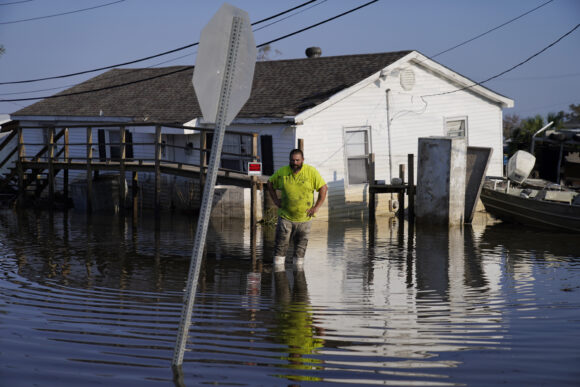
Photo: Nathan Fabre checks on his home and boat destroyed by Hurricane Ida, Sunday, Sept. 5, 2021, in Lafitte, La. AP Photo/John Locher
Was this article valuable?
Here are more articles you may enjoy.
 All in the Family: Husband, Wife and Daughter Indicted for Insurance Fraud and Bribery
  Florida AG Says His Office Investigating ‘Anti-Public Adjuster’ Endorsements in Policies
  Broad AI Exclusions in Insurance Policies Could Create Uncertainty, Marsh CEO Says
  How One Hacker Used AI Agents, a Few Thousand Dollars to Break Into Websites