

As drought tightens its grip on South Texas, city leaders in Corpus Christi are expected to deliver what could be the most sobering update yet on the region’s water supply outlook.
At Tuesday’s city council meeting, officials are expected to present new modeling that outlines a range of potential futures for the city’s water supply — including scenarios that could push the city closer to a Level 1 water emergency sooner than previously anticipated. That would force water customers to reduce their overall water use by 25% or face extra fees, according to the city’s March 2025 drought contingency plan.
The meeting comes after a week of escalating political tension and conflicting messages about just how close the region may be to a serious water shortage.
The city’s water supply could drop below expected demand as soon as June 2027, according to one model, at which point the system could no longer move water to customers.
Corpus Christi has seen virtually no rainfall in months and is facing one of the worst droughts in its history, according to Peter Zanoni, Corpus Christi’s city manager.
“We’ve had chances for rain, but we’ve missed every one,” he said during a press conference Friday.
Because of that trend, some of the city’s newest models assume no rainfall for the rest of the year and higher evaporation rates from reservoirs. Originally, one city model predicted a water emergency would come in November, but some scenarios now show it arriving as early as May.
The city’s working on refining its drought plan for reducing consumption during a water emergency, which Zanoni said would include how water rates will increase and how water reductions will be enforced. The current plan, he said at the press conference, is to use the “honor system” to encourage people to reduce their use. The city would not shut off people’s water, he added.
Zanoni pushed back on the suggestions that the city’s water supply is on the verge of collapse and said they are confident that several water projects the city has launched will deliver increased water supply.
“We are not there yet,” he said. “We’re not running out of water. This is no time to panic.”
Reservoirs have fallen below 10% of capacity
The water system serving Corpus Christi supplies roughly 500,000 people across seven counties, along with one of the nation’s largest petrochemical corridors and the country’s top port for crude oil exports at the Port of Corpus Christi.
Industrial users alone account for over 50% of the system’s demand, according to city officials.
For decades, Zanoni explained, the city has relied on surface water, some of it stored in reservoirs such as Lake Corpus Christi and Choke Canyon Reservoir. As of Monday, their storage levels have fallen to 8.6%.
As the drought continues, leaders say they have been working on a long-term strategy for three years. Instead of depending on one type of source, the city is attempting to diversify its water supply portfolio with groundwater, wastewater reuse and desalination.
Officials say the city has advanced roughly $1 billion in water projects, which together could generate 76 million gallons of new water per day. Zanoni said this would mark the first significant expansion in decades.
What led to the water crisis?
Since 2015, city leaders have aggressively recruited petrochemical plants, steel mills, and liquefied natural gas export facilities with assurances that enough water would be available.
While the city’s population grew by just 12,000 people over the past decade, to about 318,000 residents, overall water demand continued to climb, driven largely by industrial use, according to Jim Klein, president of the local Sierra Club and a former city council member.
To expand its water supply amid that growth, in 2017 Corpus Christi proposed its most ambitious water project yet: a seawater desalination plant designed to produce roughly 30 million gallons of water per day by 2028. Most of the water would have gone to industrial users, according to the Texas Chemistry Council, with enough to also supply 100,000 households.
But opposition to the plant grew along with the estimated cost of the project: from nearly $760 million to more than $1.2 billion. And environmental groups raised alarms about the plant discharging super-salty brine into the bay that could increase salinity levels and create “dead zones” potentially harming the sensitive, mostly enclosed coastal ecosystem.
In a pivotal vote last year, council members killed the desalination plan, which had already secured permits and some state funding through the Texas Water Development Board.
Bob Paulison, executive director of Coastal Bend Industry Association, said that move upended the area’s long-term water planning.
“We now need to find another 30 million gallons a day of supply and there are very few projects that can deliver that scale in the needed time frame,” Paulison said.
How the city’s trying to grow its water supply
The city has increased the production of its main pipeline, which draws water from Lake Texana and the Colorado River, by 24 million gallons a day.
Other city water projects won’t come online until later this year or next year.
The city is drilling groundwater wells in rural Nueces County, which are expected to produce 26 million gallons per day. One field is completed and another has some wells ready to operate but is awaiting a permit. A third drilling project in neighboring San Patricio County is projected to produce about 24 million gallons per day and could come online by 2028. That project faces opposition that has slowed progress.
The city is also exploring recycling wastewater so that industrial users like Valero and Flint Hills Resources can use treated wastewater instead of drinking water for their operations. Zanoni said about 16 million gallons of drinking water per day will be freed up by late this year or early next year.
Several projects cannot move forward without approval from the Texas Commission on Environmental Quality and the San Patricio County Groundwater Conservation District.
The district initially approved the city’s well permits in San Patricio County, but the permit faced a hurdle when the city of Sinton and two other parties contested them. No date has been set for a hearing on the permit.
Corpus Christi officials say the delays could push the city toward a water emergency sooner.
“The only thing holding us up is a piece of paper,” Zanoni said.
Meanwhile, the city council is expected to reconsider the Inner Harbor desalination plant, the same project that was nixed last year, during an emergency April 9 meeting called by Mayor Paulette M. Guajardo.
The emergency meeting announcement came after Gov. Greg Abbott sharply criticized city leaders last week, saying the city has “squandered” more than $750 million in state money earmarked for the desalination plant. The city has received $757 million in low interest loans for the project from the Texas Water Development Board.
“Corpus Christi is a victim not because of lack of water,” Abbott said. “They’re a victim because of a lack of ability to make a decision.”
Three city council members have since requested to put the mayor’s removal from office on the agenda for the March 24 council meeting as concerns over water supply intensify.
Two other desalination plants are also in the works: a project near Harbor Island by the Nueces River Authority that could supply 50 million gallons to the city, with a target operation date of 2029, and another spearheaded by the city with a nearby power plant.
Disclosure: Valero has been a financial supporter of The Texas Tribune, a nonprofit, nonpartisan news organization that is funded in part by donations from members, foundations and corporate sponsors. Financial supporters play no role in the Tribune’s journalism. Find a complete list of them here.
This article first appeared on The Texas Tribune.
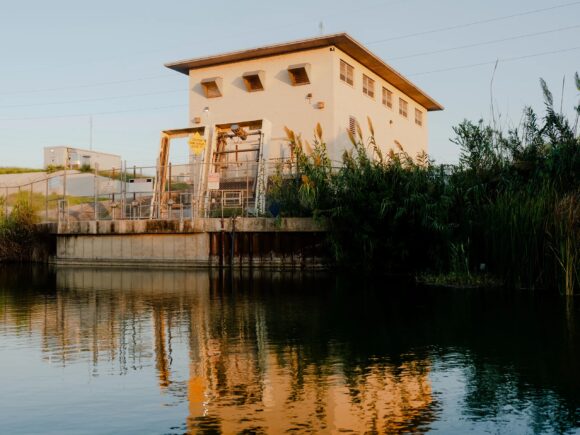
Photo: A Corpus Christi water intake plant on the Nueces River on Oct. 20, 2025. Brenda Bazan for The Texas Tribune
Related: After a Decade of Missteps, Corpus Christi Careens Toward Water Catastrophe
Was this article valuable?
Here are more articles you may enjoy.
 World’s Largest Retirement Community Set to Borrow $180 Million for More Homes
  ‘Unusual’ Isaias Brings Winds, Downed Trees But Fewer Claims Than Expected
  All in the Family: Husband, Wife and Daughter Indicted for Insurance Fraud and Bribery
  AI’s Water Strain Includes Surging Demand From Electricity Use

