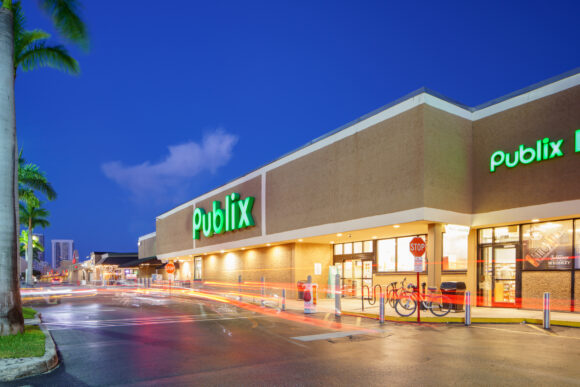
Even in an age of frequent mass shootings in public places, a shooting can be unforeseeable and a supermarket has no duty to protect customers from random acts of violence, a Florida appeals court decided in a major win for businesses and liability insurers.
“…While events giving rise to this case are undeniably tragic, the law imposed no duty on Publix to protect against this unforeseeable criminal act,” a three-judge panel of Florida’s 4th District Court of Appeals wrote in its March 18 opinion.
The opinion upheld a Palm Beach Circuit Court decision in a lawsuit brought by the family of a toddler and his grandmother who were killed in a 2021 shooting at a Publix grocery store in Royal Palm Beach, Florida. The plaintiffs presented data showing almost 450 gun incidents and 137 gun deaths at national grocery chains from 2020 to 2022, including five deaths at Publix stores, the opinion explained.
The family’s attorneys also argued that Publix had implemented annual active shooter training for employees at all stores, and that showed that the company was aware of the potential for shootings. Publix’ lawyers countered that no major incidents had occurred at the Crossroads store and that national statistics do not prove impending danger at a specific locale.
The trial court in 2024 granted summary judgment for Publix, finding the supermarket owed no legal duty to protect against unforeseen criminal acts. The appellate court this week agreed.
“The general framework for determination of whether a duty exists confirms no duty existed here,” appeals court Judge Cory Ciklin wrote in the opinion. “Publix has a duty to guard against criminal attacks by third parties only insofar as those attacks are reasonably foreseeable. Here, no evidence was presented of prior batteries against a person, let alone shootings, within the Publix at the Crossroads.”
The plaintiffs’ argument that active shooter training was evidence of foreseeability was not convincing, the judges noted.
“Publix’s active shooter training did not create a foreseeable zone of risk,” the court wrote. “It merely showed that Publix was aware of the possibility of an active shooter event somewhere at one of its stores across the country at some point.”
In a concurring opinion, appeals court Judge Spencer Levine noted that foreseeability in all circumstances would be impractical and would require expensive armed guards everywhere, even at “mom and pop” stores.
“At some point, video surveillance would be required, and then, not long afterwards, active monitoring of those cameras in all stores—whether large or small,” Levine wrote. “A security guard at the door would potentially develop into having an armed guard. And the ubiquitous guard would potentially be in every commercial establishment regardless of its size.”
Even armed guards would not have been enough to stop the shooter in this case: The man carried his gun inside a fanny pack, concealed from view, explained William Large, of the Florida Justice Reform Institute, who helped write a friend-of-the-court brief in the appeal, in support of Publix. And even if the store had installed metal detectors at all entrances, that may have done little to stop a sociopathic shooter because Florida law allows concealed carry of a weapon, without a permit.
Large said the decision is an important win with statewide implications. It shows, as Levine noted in his opinion—quoting U.S. Supreme Court Justice Oliver Wendell Holmes from 1897—that siding with the plaintiffs would have resulted in huge costs, costs that would be ultimately borne by society.
“Accepting Appellants’ invitation to expand Publix’s duty to encompass liability in these circumstances would turn all Florida retail businesses into guarantors of their patrons’ safety, which this Court has declined to do and should continue declining to do,” the Justice Reform Institute’s amicus brief reads.
Attorneys for Florida-headquartered Publix in the case declined to comment, and the supermarket chain’s representatives could not be immediately reached for comment Thursday. The court file did not indicate what insurance coverage the store may have held.
The decision is the second significant appellate court win this year for the largely self-insured Publix Supermarkets. In February, Florida’s 1st District Court of Appeals found that physician dispensing of medications is not allowed by the state’s workers’ compensation statutes. That ruling handed a victory to employers and insurers, potentially ending an insurer-versus-physician regulatory debate that has simmered for more than a decade.
Topics Florida
Was this article valuable?
Here are more articles you may enjoy.
 Industry Reacts to Senators’ Letter for Claims Data and Recent Reports
  ‘Unusual’ Isaias Brings Winds, Downed Trees But Fewer Claims Than Expected
  Surplus Lines Leaders Remain Bullish on Outlook in a Shifting Market
  Two Past Hurricanes, OIR Data Give Idea of What to Expect From Isaias in Florida