

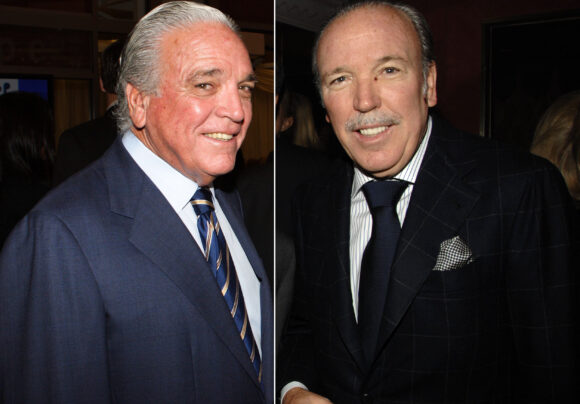
Sugar tycoons Jose “Pepe” Fanjul and Alfonso “Alfy” Fanjul Jr. have a plan to dig up thousands of acres of the Florida Everglades for rock that the state needs to build roads. One of the brothers’ billionaire neighbors in Palm Beach leads a group who want to stop them.
The Fanjuls fled Cuba after Fidel Castro’s takeover and built a sugar empire with colossal political might, amassing a fortune of more than $6 billion, according to the Bloomberg Billionaires Index. Pepe Fanjul, 81, Alfy Fanjul, 88, and their family own sugar refineries in several countries, along with brands like Domino Foods, a luxury resort in the Caribbean, and about 190,000 acres of sugarcane plantations in South Florida, mostly in the Everglades.
Now, their latest venture has the blessing of Florida officials. In February, the state approved the first phase of a plan to eventually convert up to 8,632 acres of sugarcane fields owned by the Fanjuls and a competitor, US Sugar, into a mine. Excavators will strip away the rich top soil and extract limestone, which will then be processed into gravel, sand and other so-called aggregate materials used to build roads.
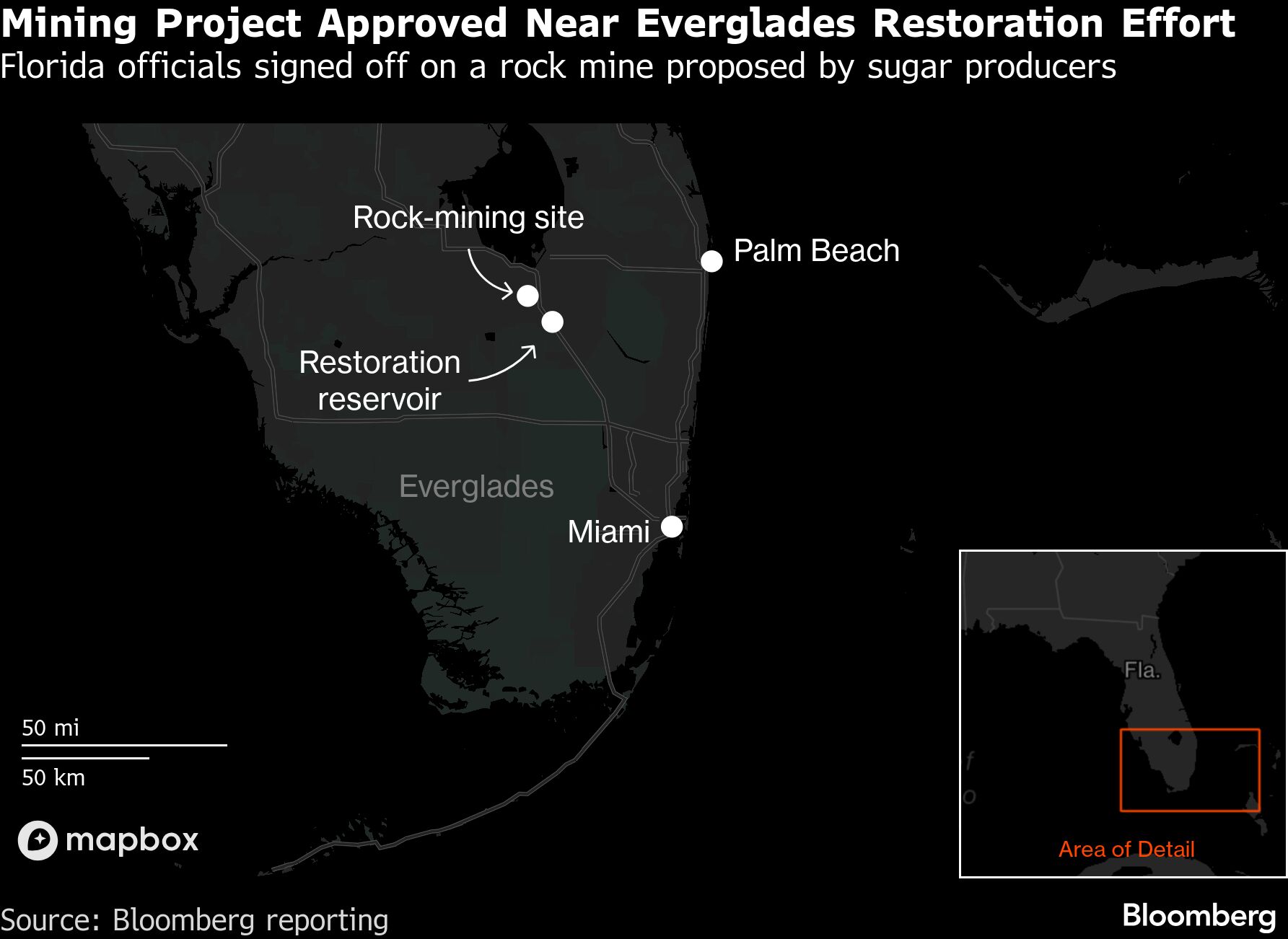
The mine would be located about 60 miles west of Palm Beach, atop an L-shaped patchwork of lush cane fields. The site is also about 1,000 feet from a roughly $4 billion reservoir that the US Army Corps of Engineers and the South Florida Water Management District, an agency responsible for protecting water resources in the region, is building to clean the waters that feed the Everglades.
The Everglades, which cover thousands of square miles in Florida, are a vital source of water and a habitat for thousands of species of plants and animals, including dozens that are threatened or endangered. For decades, the Fanjul brothers, who each own mansions in Palm Beach, have come under fire from environmentalists who blame sugar farms for polluting the region’s air and water.
Conservationists fear that the mine could disrupt the Comprehensive Everglades Restoration Plan, a 25-year, $27 billion federal and state effort to clean up and rewild the famous wetlands. They worry that untreated water from the mine could seep into the reservoir and nearby marshes, setting back the costly, long-term effort to repair and protect one of Florida’s most treasured assets. Pepe Fanjul Jr., co-president of Florida Crystals, said in a statement that the company has supported the reservoir and is “extremely proud” of the role it played in facilitating its construction.
Among the mine’s opponents is the Everglades Foundation, a charity founded and funded by some of the Fanjuls’ wealthy neighbors. The group, formed in 1993 by investor Paul Tudor Jones II and late real estate developer George Barley, has been instrumental in securing federal and state funding for Everglades restoration. Jones, worth $5.9 billion, according to the Bloomberg Billionaires Index, is considered a pioneer in the hedge fund industry in part for correctly calling the stock market crash of 1987.
“There will always be development pressure from well-funded agricultural and commercial interests that threaten the Everglades,” Jones, 71, said in an emailed response to questions. “Floridians and Americans need to stand up for what is their natural heritage and just say no.”
Jones and Barley started the Everglades Foundation after seeing seagrass kills while fishing in Florida Bay. The nonprofit is a favorite charity among South Florida elites, raising millions at a glitzy annual fundraiser at the Breakers resort in Palm Beach. This year, the Counting Crows crooned for a crowd of 600 supporters and Florida Governor Ron DeSantis was presented with a lifetime achievement award.
With a board that includes golf legend Jack Nicklaus, department-store heir Marshall Field V and financiers Gary Wendt, former head of Conseco, a financial services firm with insurance subsidiaries, and John Hilton Jr., the Everglades Foundation has considerable stature among Florida environmental activists and donors. And the fight over the mine has ratcheted up a long-running feud between the Foundation and the Fanjuls.
“The facts simply don’t fit the Everglades Foundation’s narrative,” Marianne Martinez, vice president for corporate communications at Florida Crystals, the sugarcane-refining company owned by the Fanjuls, said in an email to Bloomberg. The company has worked for decades to help the government clean up the Everglades, including paying special state agriculture taxes, Martinez said.
“Florida Crystals has played an active role in Everglades restoration over the last 30 years, consistently making land available for Everglades projects, because we believe the long-term success of sustainable agriculture in South Florida and the wellbeing of the Everglades go hand in hand,” Martinez said.
Sugar producers have considerable influence in US politics. In the 2024 election, the sugar industry as a whole contributed $10.6 million to politicians from both parties, including donations to hundreds of congressional candidates, according to nonpartisan researcher Open Secrets. The industry spent even more on lobbying that year, some $16.5 million.
Pepe Fanjul has been a major Republican donor and supporter of President Donald Trump, and the Fanjuls have secured big gains under the Trump administration. They won an end to a ban on importing sugar from the Dominican Republic over forced-labor allegations that a company they partly own repeatedly denied and increased price support in Trump’s tax bill. The family has also cannily bridged the partisan divide, with Alfy Fanjul cultivating deep ties with Democrats.
DeSantis has at times been critical of the sugar industry. When he served in Congress, he opposed sugar subsidies and sugar-friendly tariffs. Since becoming governor in 2019, he’s secured nearly $8 billion for Everglades restoration and water-quality improvement projects, more than four times the amount his predecessor, Republican US Senator Rick Scott, delivered.
DeSantis also has to tend to a booming state economy, and needs limestone aggregate to build more roads. The material has been in short supply in Florida, which is why the mine proposal appealed to the state, according to a person familiar with the matter who asked not to be identified discussing private deliberations.
Aggregate production has been falling across the US for years, plagued by rising costs and environmental hurdles. DeSantis created a $100 million aggregate grant program in 2024 to help boost output and offset transport costs.
The approved first phase will allow the mine’s developer, Knoxville, Tennessee-based engineering firm Phillips & Jordan, to excavate about 1,300 acres to produce aggregate. Output could expand pending further approvals, according to planning documents.
Representatives for DeSantis didn’t respond to requests for comment.
Sugar became a big business in the Everglades in the 1920s, after the US government drained land to plant sugarcane, with the goal of making America self-sufficient in sugar production. But decades of farming left behind water contamination government officials are trying to clean up.
The centerpiece of that mitigation effort sits among expanses of degraded sugarcane fields 90 minutes northwest of Miami, where the Army Corps of Engineers and the water-management district are building a reservoir roughly the size of Manhattan.
Large excavators, including one called the “chainsaw” that can dig a trench 25 feet deep, are working on the project, which will involve restoring marshlands and planting cattails, bullrush and pickerel weed to remove phosphorus and other contaminants from the waters and replenish the Everglades.
In May, Eric Eikenberg, the Everglades Foundation’s chief executive officer, sent a letter to the South Florida Water Management District, arguing that the mine could imperil the restoration effort and contaminate the reservoir.
“The Everglades Foundation has concerns regarding the potential for this rock mine to harm Everglades restoration and undermine billions of dollars in state and federal investments,” Eikenberg wrote.
Two months later, the Army Corp of Engineers warned against going ahead with the mine in a letter to Florida US Representative Brian Mast, a Republican who represents the region, citing “concerns about the proposed project’s impacts on Everglades restoration.”
The Fanjuls and their partners hope to eventually transform the pit that will be left behind after the mine is exhausted into a “water resource” that could feed into canals leading to cities including Miami and Palm Beach. Local water utilities bought a nearby reservoir created by a rock mine that Phillips & Jordan helped develop.
Matt Edison, a senior vice president of Phillips & Jordan, said the mine project would greatly increase the region’s water-storage capacity and “restore and protect the health and long-term sustainability of our water resources for the benefit of all Floridians.”
The Fanjuls say they are doing their part to save the Everglades. Over many years, sugar farmers led by the Fanjuls have given up 100,000 acres of cane fields for restoration projects, including the reservoir and its cleansing marshes. Everglades farming taxes have raised $350 million for restoration efforts, according to the company.
In February, a legal challenge to Florida’s approval of the mine by the Tropical Audubon Society, which has ties to the Everglades Foundation, yielded a deal. The mine’s developers committed in writing to carry out impact studies as the project expands beyond its initial phase.
Ansley Samson, the lead Tropical Audubon Society lawyer in the case, called the pact a “real win” for conservation efforts. Ethan Loeb, a lawyer for the developer, said the deal merely put in writing steps that are mandated by law.
Jones, meanwhile, expects to continue his campaign to clean up the Everglades.
“We need another 10 years and a few billion dollars,” the investor said in an email, “but we can finish the job.”
–With assistance from Devon Pendleton, Vivien Ngo and Ilena Peng.
Top photo: Alfonso “Alfy” Fanjul Jr., left, and Jose “Pepe” Fanjul. (Patrick McMullan/Getty Images/Bloomberg)
Was this article valuable?
Here are more articles you may enjoy.
 NY City Accuses Law Firm of Running Injury Claims Fraud Operation
  Agency Duties – Legal vs. Ethical
  AI Bubble Risks Worst S&P 500 Crash Since 2008, Strategist Says
  Surplus Lines Leaders Remain Bullish on Outlook in a Shifting Market

