


Cost savings from automation are broadly falling short of projections, according to a new Bain & Co. global survey of large companies.
The missed targets “should be making executives uncomfortable,” especially since many of them are approving increased spending for artificial intelligence on the basis of expected savings, the consulting firm said in a report shared exclusively with Bloomberg News.
“Self-funding the next wave from past returns sounds like discipline. In reality, it is a circular bet with a structural leak,” the report said.
The survey, completed in April, was based on responses from executives at 951 companies with more than $100 million in revenue, across nine sectors: retail, technology, advanced manufacturing, healthcare, consumer products, energy, financial services, telecom/media/entertainment and insurance.
Among companies measuring their AI cost savings, the largest share (40%) realized reductions of 10% or less. Most had been expecting to see more meaningful improvement.
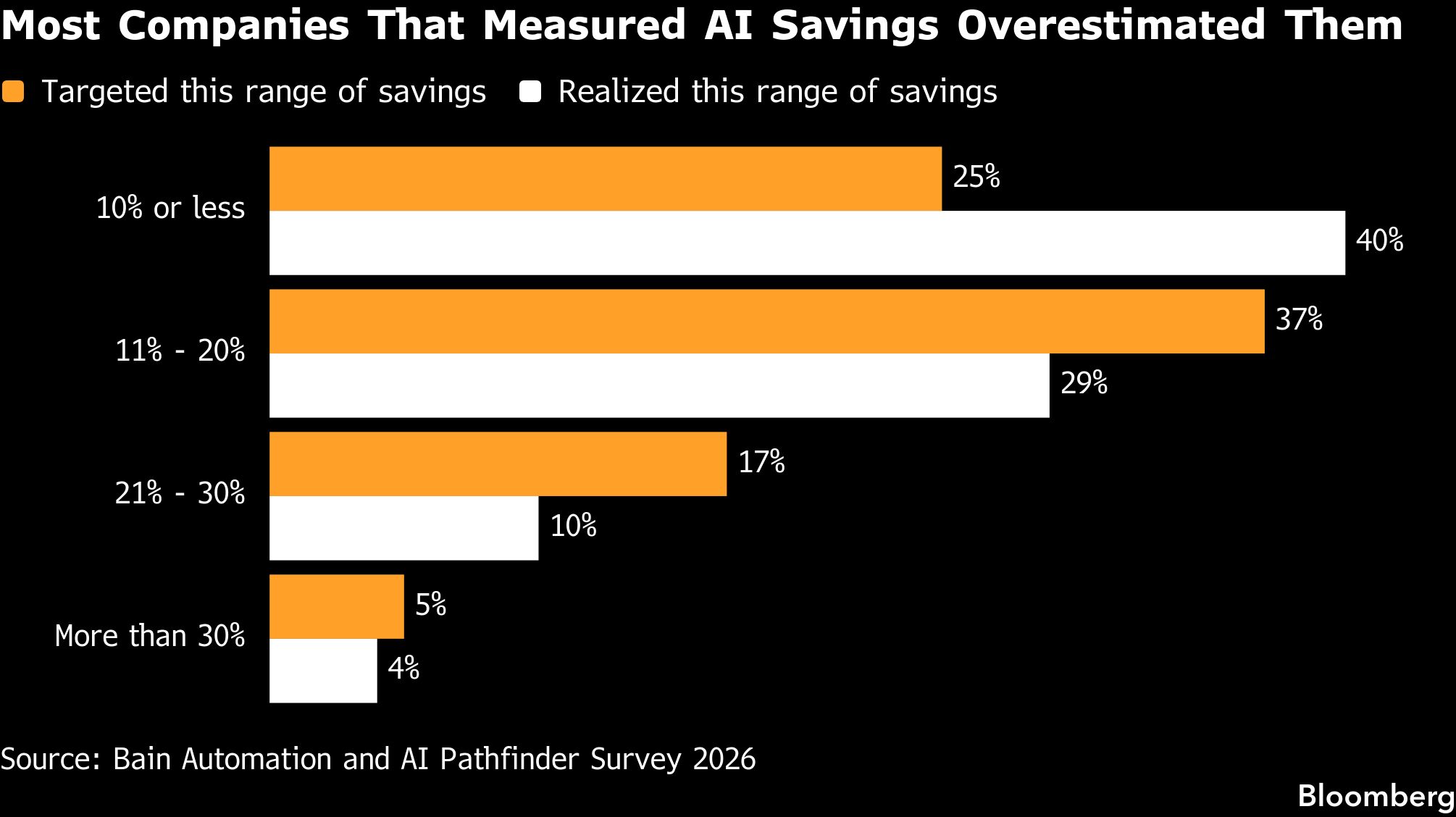
“The prior wave underdelivered. The savings pool is smaller than assumed,” Bain warned. “And the investment case for the current wave was sized against projections rather than actuals.”
While some companies are funding fresh investment in generative and agentic AI with realized savings, the largest share (44%) cited targeted savings among their top sources of funding for the next wave of outlays, according to the report.
In a similarly cautionary report last year showing 95% of corporate AI pilots fall flat, an MIT research group concluded that the “primary factor keeping organizations on the wrong side of the GenAI Divide is the learning gap, tools that don’t learn, integrate poorly, or match workflows.”
The Bain report isolated a different problem.
“Despite a decade of investments in data modernization running well into hundreds of billions of dollars globally, the No. 1 reason AI programs underperform is that companies cannot reliably get access to their own data,” Bain said.
Its prescription: Instead of waiting to structure all of their data to make it ingestible by AI, companies should start with what’s available to feed into the models — and then use AI to help sort out how to structure the rest.
Companies that were meeting their savings targets reported running into barriers with data structure and accessibility at even higher rates than those missing their targets, but they were less likely to report organizational challenges such as insufficient budgets or competing priorities.
Photo: Photographer: Angel Garcia/Bloomberg
Was this article valuable?
Here are more articles you may enjoy.
 Hellman & Friedman Explores Sale of Applied Systems at Up to $10B, Sources Say
  How Insurers Can Gain the Most Value From Their AI Investments: Accenture
  Zurich Insurance Completes Acquisition of Beazley
  Independent Agencies Total About 37,000 in 2026, a Decrease From 2024

