

More than a decade after announcing plans for a large real estate development in Miami’s Little Haiti neighborhood, technology investor Bob Zangrillo is reviving the project, now pitching it as a home for the city’s growing roster of AI companies.
The 7.8 million square foot (724,644 square meter) development will center around an office complex aiming to attract tenants in artificial intelligence, asset management and venture capital, said Zangrillo, head of investment firm Dragon Global. Plans also call for residential towers with more than 2,600 units, a hotel and retail space. The construction cost is expected to top $3 billion.
The development’s first phase will include an office campus focused on AI anchored by Dragon Global and a 25-story tower with 349 rental apartments. As more finance and tech companies move to Miami, Zangrillo said he sees this as an ideal time to move ahead with the project, which he calls the Magic City Innovation District.
“We really envision this being a campus to match both leading AI companies with leading asset management firms and building an evolved community,” said Zangrillo, whose firm is teaming up with local developer Plaza Equity Partners.
Earlier this year, AI-powered software firm Palantir Technologies Inc. relocated its headquarters to Miami while Apple Inc. and Amazon.com Inc. have opened or expanded offices in recent years. Gemini, the cryptocurrency firm backed by the billionaire Winklevoss twins, also has a presence in South Florida.
Zangrillo, an early investor in companies such as Uber Technologies Inc., Anthropic PBC and SpaceX, started his career in California’s Silicon Valley then moved to New York in the 1990s to start the e-commerce software firm Interworld. When searching for the next place where global tech and finance firms could come together, he landed on Miami.
“I had a vision about 14 years ago that Miami was going to be the capital, or the future New York City, for technology companies and asset managers from around the world to converge,” he said
The idea has spent a long time in the incubator. Zangrillo first revealed plans for a Little Haiti project in 2012, when he bought land in the neighborhood. He then assembled parcels over the next five years and got approval in 2019 from the Miami City Commission.
That same year, the effort stalled as Zangrillo got swept up in the college admissions scandal known as Operation Varsity Blues, along with more than 50 other people including top finance executives and Hollywood celebrities. Zangrillo was accused of conspiring to bribe officials at the University of Southern California to help his daughter get in.
While Zangrillo denies any wrongdoing, he was pardoned by President Donald Trump on the final day of his first term in 2021. His pardon was supported by billionaire Len Blavatnik, former Meta Platforms Inc. President Sean Parker and Thomas Barrack Jr., a longtime Trump friend. Trump called Zangrillo “a well-respected businessman and philanthropist.”
“There was really no case at the end of the day,” Zangrillo said. “They were trying to attack rich parents.”
Zangrillo has also faced local challenges over the Little Haiti project, with community activists and residents citing concerns over gentrification and displacement of working-class people that have lived in the neighborhood for years. He said his team has committed $31 million to Miami’s Little Haiti revitalization trust, which promotes economic development and facilitates building affordable housing in the area.
“We didn’t buy any property that would demand us relocating existing residential tenants,” Zangrillo said.
Little Haiti has emerged as one of the neighborhoods that’s being gentrified quickest in Miami, with a budding culinary scene and projects to develop more upscale housing, retail and commercial space.
The site has a Special Area Plan designation, a tool that’s allowed developers to build large-scale projects like Brickell City Centre and Mana Wynwood. It’s also located within a federally designated Opportunity Zone, a program launched in 2017 that provides generous tax breaks in exchange for investing in low-income communities.
Anthony Orso, president of capital markets strategies at brokerage firm Newmark, will market the district.
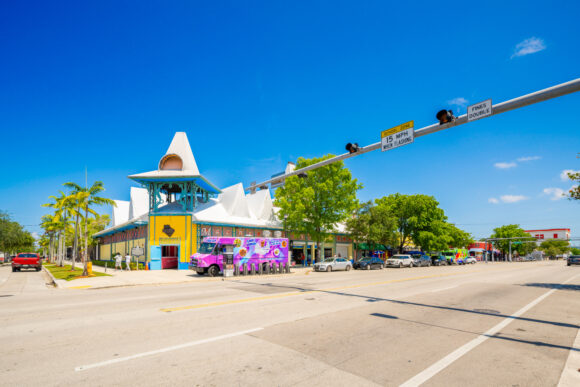
Photo: Part of Little Haiti, two blocks from the proposed development site. (AdobeStock)
Was this article valuable?
Here are more articles you may enjoy.
 TSMC Mulls Multibillion-Dollar Texas Site for More AI Chips
  Alliant Insurance Acquires New Hampshire’s Melcher & Prescott
  Harbor Emerges From Stealth with $10M Funding to Handle AI-Agent Risk
  McKinsey Rebukes Partner Who Questioned Challenges Facing Women CEOs

