

As California’s wildfire insurance crisis drives homeowners to the state’s insurer of last resort, wealthy areas such as Beverly Hills, Malibu and Bel Air make up an increasingly large portion of the liability exposure — a dynamic that experts fear could bankrupt the program and undermine the private market.
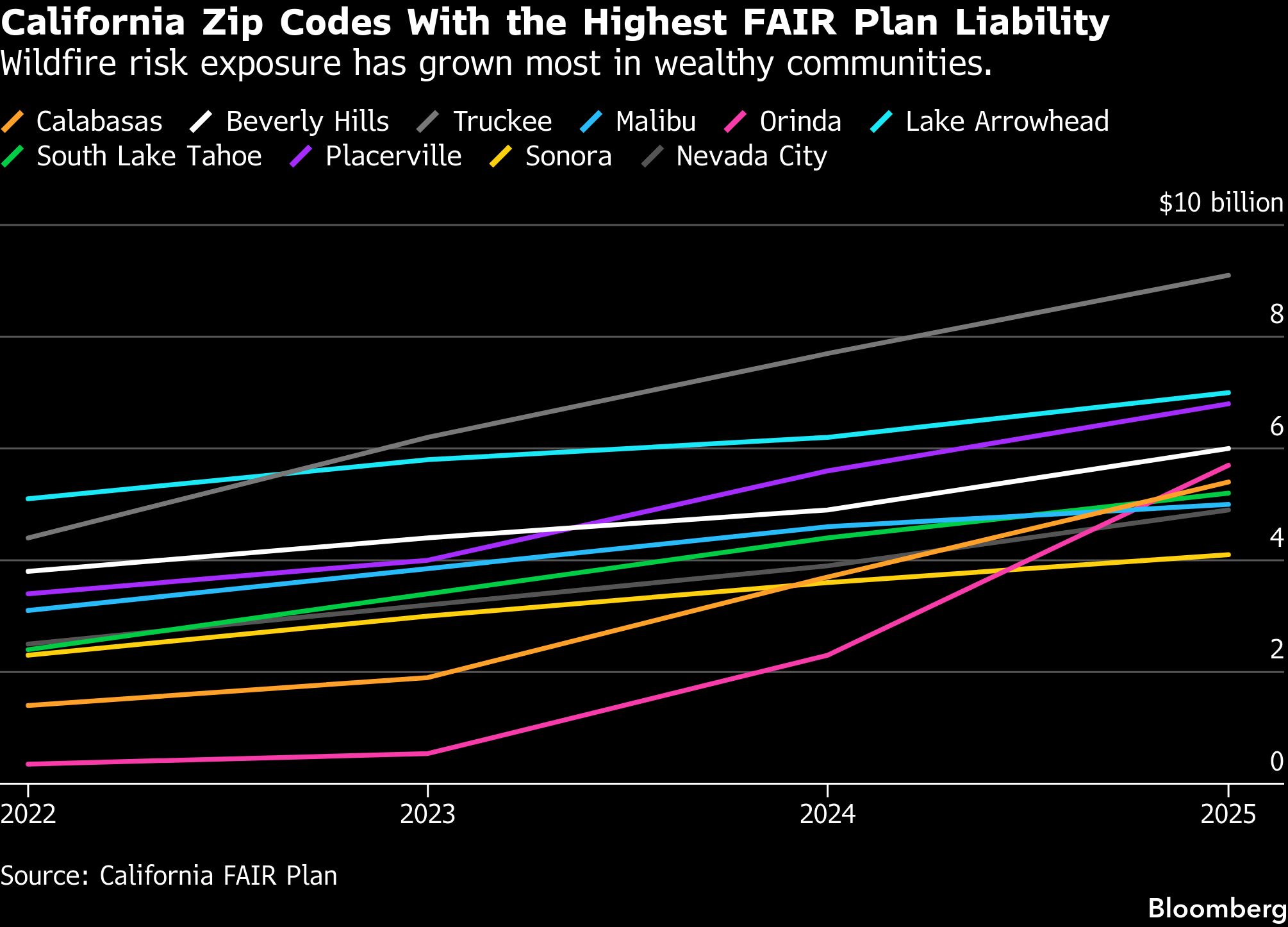
Nine zip codes out of more than 1,700 in the state account for about 7% of the FAIR Plan’s liability exposure, or $44 billion as of September 2025, according to a Bloomberg News analysis of the latest available data. That’s a 135% increase in monetary exposure since 2022 for the insurer in those neighborhoods. A single affluent Lake Tahoe zip code where about half of the dwellings are second homes now comprises $9 billion in risk.
Related: California Rivals Have Starkly Different Plans to Remake Home Insurance
Well-off communities as determined by median income and home values comprise five of the top 10 highest liability zip codes. A sixth is the mountain resort community of Lake Arrowhead, where about 60% of dwellings are second homes and FAIR exposure is $7 billion, the second highest in the state.
California is one of 34 U.S. states that offer last-resort insurance plans. The Golden State stands out, though, for the magnitude of residential liability and the frequency and intensity of wildfires that increasingly push into urban areas. This month, the state’s largest utility, PG&E Corp, warned it would cut power in 10 counties as high temperatures and gusty winds raised fire threats.
“As more risk accumulates in a small number of communities, a single disaster can generate significant losses and increase the likelihood of assessments that ultimately affect the broader insurance market,” Karen Collins, vice president for property and environmental at the industry advocacy group American Property Casualty Insurance Association, said in an email.
A March study from the University of California at Berkeley determined that the FAIR Plan’s exposure risk is “disproportionately tied to higher-income, high-asset communities.” That’s driven up costs for all FAIR policyholders with premium burdens falling “more heavily on middle-income households” even in moderate-risk areas.
That means they’re effectively subsidizing wildfire losses for high-value homes. “It is a real challenge in terms of how to undo this escalation of liability that we’re seeing,” said Nancy Wallace, the paper’s author and a professor of finance and real estate at UC Berkeley’s Haas School of Business.
A spokesperson for the FAIR Plan declined to comment.
California legislators established the FAIR Plan in 1968 after insurers pulled out of devastated minority neighborhoods following the Watts uprising in Los Angeles. But as commercial insurers this decade have fled the state in the wake of destructive climate-triggered wildfires, FAIR has become the insurer of first resort for owners of multimillion-dollar properties in exclusive but fire-prone communities.
Since the plan is funded by the state’s insurers, which can pass on certain expenses to their customers, some of the liability for insuring high-end properties is ultimately borne by all private policyholders.
That was the case after the 2025 Los Angeles firestorms, when FAIR faced a potential $3 billion liability just for the wealthy Pacific Palisades neighborhood.
The California Department of Insurance in response authorized the FAIR Plan to collect $1 billion from the state’s insurers to bolster its reserves. But the department allowed insurers to recoup up to half of that levy by raising premiums for all their customers in the state between $11 and $176 annually for two years.
The FAIR Plan only covers fire losses and homeowners must obtain an additional policy elsewhere for other damages. Still, the number of FAIR residential policies increased 151% between September 2022 and March 2026 while risk exposure jumped 234% to $700 billion. In the six months up to March, policies grew 6.1% while exposure risk rose 8.3%, according to FAIR data.
The numbers are significantly higher in places like Calabasas, the LA celebrity enclave that’s home to the Kardashians, where FAIR liability exposure spiked 46% between 2024 and 2025. In Orinda, an affluent Bay Area town, that risk jumped 142% to $5.6 billion during that time.
Michael Soller, a spokesperson for the California Department of Insurance, said that overall FAIR Plan growth has slowed recently in response to reforms that promise quicker reviews of insurers’ rate hike requests in exchange for commitments to expand coverage in high-risk areas
“We are seeing initial signs of market stabilization and recovery,” he said in an email.
By law, the FAIR Plan must accept any homeowner unable to obtain insurance in the private market, regardless of their property’s value. But Soller noted that the insurance department limits FAIR liability for high-value homes by capping policy payouts at $3 million.
That’s still too much, according to Michael Wara, director of the climate and energy policy program at Stanford University, noting the cap is four times the median California home value.
Wara said one way to limit FAIR’s exposure risk is to exclude second homes from the plan and force those homeowners to seek coverage from lightly-regulated insurers in what is known as the “non-admitted” market, which has been expanding as climate change makes properties increasingly uninsurable.
“If you can afford to have a house in Tahoe, then you should not be reliant on what is essentially a subsidy from the rest of the state for your homeowner’s insurance,” he said.
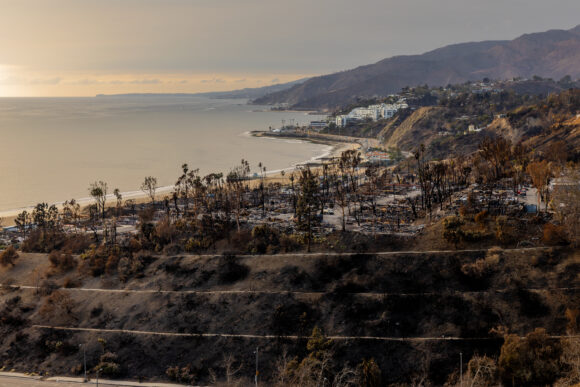
Top photo: Ravaged homes by the Palisades Fire in the Pacific Palisades area of Los Angeles, California, on Jan. 30, 2025. Photographer: Roger Kisby/Bloomberg.
Topics California
Was this article valuable?
Here are more articles you may enjoy.
 Industry Reacts to Senators’ Letter for Claims Data and Recent Reports
  Large Commercial Property Rates Drop 14.5% in Q2 to Highlight Latest Willis Report
  Warren, Hawley Press Insurers Over Closed, Unpaid Claims
  Hordes of Teens on E-Bikes Force Suburbs to Rewrite Road Rules

