

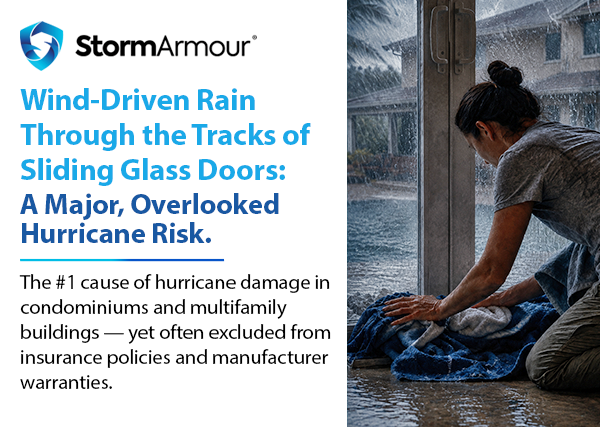
MIAMI, FL — As Florida enters another active hurricane season, StormArmour®, a Florida-based resiliency company focused on mitigating wind-driven rain water intrusion through the tracks of sliding glass doors, is raising concerns about what industry experts describe as one of the leading yet least addressed causes of hurricane-related property damage in condominiums and multifamily buildings.
Following Hurricanes Helene and Milton, thousands of Florida property owners experienced catastrophic interior water damage caused by wind-driven rain entering through the tracks of sliding glass doors. Many later discovered that the resulting damage was excluded from both their property insurance policies and sliding glass door manufacturer warranties.
According to the Hilb Group, a leading Florida insurance brokerage, approximately 80–85% of more than 2,000 condominium and multifamily claims received following the storms were tied to this single issue.
“Most homeowners and condominium owners have no idea this exclusion exists until after a storm causes catastrophic damage,” said Mark Fisher, Co-Founder of StormArmour. “By that point, it is too late. They are often left facing uncovered losses, litigation, and significant special assessments.”
The issue is particularly significant in condominium and multifamily buildings, where water intrusion originating from a single sliding glass door system can spread into adjacent and lower units, damaging drywall, flooring, electrical systems, and personal property throughout the building.
In condominiums, co-ops, and shared residential spaces, this also raises broader questions surrounding liability and negligence exposure, particularly in situations where some unit owners implement mitigation measures while neighboring units remain unprotected. Because water intrusion can spread between units and floors, damage originating from a single unprotected unit may impact multiple residences throughout a building.
Despite growing awareness surrounding wind-driven rain water intrusion losses, StormArmour argues that Florida’s Department of Financial Services has yet to take meaningful proactive steps to address consumer disclosure or large-scale mitigation requirements tied to the issue.
The company notes that many policies, including Citizens Property Insurance Corporation’s HO-3 and HO-6 policies, exclude coverage for certain forms of wind-driven rain water intrusion through the tracks of sliding glass doors. Furthermore, all sliding glass door manufacturer warranties specifically exclude wind driven rain through the tracks of sliding glass doors.
StormArmour argues that while these exclusions exist within policy and warranty language, many consumers remain unaware of the exposure before a storm occurs and often only discover these coverage gaps after catastrophic damage has already taken place.
In its 2023 advisory report, FEMA identified wind-driven rain water intrusion as a major source of hurricane damage, specifically noting water infiltration through the tracks of sliding glass doors as the main contributor to interior property losses.
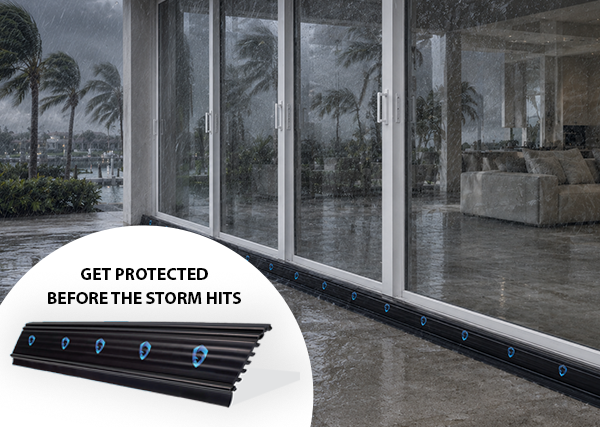
The issue has also gained attention among Florida policymakers and emergency management officials. During a 2025 hurricane preparedness press conference held at Home Depot in Jupiter, FL, Governor Ron DeSantis and Florida Division of Emergency Management Director Kevin Guthrie discussed the importance of mitigation technologies designed to reduce wind-driven rain water intrusion in residential buildings.
Recently, Director Guthrie stated that if StormArmour had been more widely deployed during Hurricanes Helene and Milton, tens of thousands of Floridians may not have been displaced from their homes.
During Florida’s 2026 Legislative Session, StormArmour advocated for increased consumer disclosure requirements and broader resiliency-focused mitigation efforts tied to wind-driven rain water intrusion losses. Proposed concepts included requiring clearer disclosure of wind-driven rain exclusions within Citizens Property Insurance Corporation policies and encouraging mitigation-focused standards for future construction.
According to StormArmour, despite growing awareness surrounding the issue among policymakers, emergency management officials, and the insurance industry, no major statewide disclosure or mitigation requirements addressing wind-driven rain water intrusion through the tracks of sliding glass doors were ultimately implemented during the 2026 Session.
The company also pointed to ongoing challenges surrounding Florida’s My Safe Florida Condo Program, which was intended to support condominium mitigation and resiliency efforts statewide. Although the program received a $30 million legislative appropriation, StormArmour notes that condominium associations have yet to see meaningful mitigation funding deployed for large-scale resiliency improvements tied to issues such as wind-driven rain intrusion.
Meanwhile, Miami-Dade County, whose Notice of Acceptance (NOA) system is widely regarded as the gold standard for building product approvals, has approved StormArmour’s mitigation technology for a series of sliding glass door systems and recently agreed to streamline pathways for additional manufacturer adoption through engineering review and certification.
StormArmour’s system is designed to prevent up to 99% of wind-driven rain water intrusion through the tracks of sliding glass doors under hurricane-force wind and rain conditions, including Category 5 conditions. The technology has received both Miami-Dade Notices of Acceptance (NOAs) and Florida Building Code approvals, following engineering review and testing conducted under stringent hurricane-performance standards.
“Florida has spent years strengthening roofs, windows, and structural systems, but this vulnerability continues to affect tens of thousands of properties throughout Florida and other hurricane-prone states across the Southeast,” Fisher said. “When homeowners only discover these exclusions after catastrophic damage has already occurred, it undermines public trust and leaves families facing unexpected financial losses. Consumers deserve clear and upfront disclosure about these risks before the next storm strikes, not after. It is not a matter of if a catastrophic storm will hit, but only a matter of when.”
For more information, visit StormArmour.
Topics Profit Loss Manufacturing
Was this article valuable?
Here are more articles you may enjoy.
 World’s Largest Retirement Community Set to Borrow $180 Million for More Homes
  How One Hacker Used AI Agents, a Few Thousand Dollars to Break Into Websites
  Reuters: DXC in Advanced Talks to Sell Insurance Software Unit for $2.4 Billion
  Florida AG Says His Office Investigating ‘Anti-Public Adjuster’ Endorsements in Policies

