
Whether your client owns a multi-million dollar home overlooking the Pacific Ocean or a small bungalow tucked away a mile from the beach, it is your responsibility to find the right homeowners insurance coverage that will protect him or her should disaster strike.
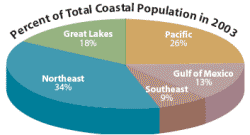
The need for homeowners insurance for the coastal property market is growing, particularly on the West Coast. According to a report by the National Oceanic and Atmospheric Administration, the Pacific region, which includes the coastlines of California, Oregon, Washington, Alaska and the entire state of Hawaii, is the second most populated coastal region in the United States (see pie chart).
In 2003, the Pacific region’s population reached 39.4 million people, or 26 percent of the nation’s total coastal population. From 2003 to 2008, the Pacific region is expected to accommodate an additional 2.2 million people (a growth in coastal population of about 6 percent). Coastal counties, which make up 57 percent of the region’s total land area, hold 84 percent of the region’s population. Hot growth spots include San Diego, San Bernardino, Orange and Riverside counties in California.
Given a population that is increasingly moving to the coast, the recent mudslide disaster in La Conchita, California that killed 10 people, and the heavy rains that have been pounding the West Coast, it is more important than ever for agents and brokers to understand the importance of securing the right homeowners coverage for coastal properties.
Market availability
Homeowners insurance for coastal homes is usually written through the surplus lines market, according to Timothy Sullivan, team leader for Willis Program’s VIP HomeGuard, a program for high-value homeowners who have homes in coastal, mountain, lakeside and other high-risk locations.
“More often than not, coastal properties are written through surplus lines carriers,” Sullivan said. “If that percentage is a liquid number, it has increased over the past two or three years because of losses from hurricanes mostly on the Florida and Georgia coasts and because of the overexposure or an over saturation by a particular insurance company, which applies in California. Companies like Fireman’s Fund and to a lesser degree Chubb have realized a larger market share than the reinsurers are comfortable with in California. But it’s not difficult to find homeowners in the West. There are plenty of markets.”
John Moran, vice president and personal lines executive at Lexington Insurance Company, which writes homeowners in California, Oregon and Washington, said that many admitted market companies still write coastal properties, especially on the West Coast where the hurricane exposure is not as great. But the surplus lines market is able to step in and provide coverage when the admitted market contracts due to catastrophic losses, he said.
“Depending on the area where they live and on the admitted markets’ appetite, it can be difficult to find a market,” he said. “Right after the wildfires of 2003 the market kind of contracted a little bit. It’s opened up pretty readily once again, but a lot of the admitted markets have widened their underwriting appetites and are actively writing business again.”
Exposures
Landslides and mudslides are major exposures when it comes to insuring coastal homes, according to Sullivan. He said that shoreline erosion can be a factor depending on where a home is located, but wind plays a more important role. “The biggest concern historically has been wind and wind driven rain,” Sullivan said. “Wet weather damage is the leading cause of loss across the board.”
Moran agreed. “With the mudslides you’re looking at roof leaks and any kind of water intrusion that could cause water damage to the home, which is the most significant peril that causes damage [to] most homeowners.”
Moran also emphasized the risk of earthquakes and wildfires, especially for Californians. “The biggest two risks that most people are concerned with are the wild fire exposure and the earthquake exposure. For the most part when you’re writing a coastal property, [it’s] up in Malibu and areas like that overlooking cliffs. You are more concerned if you’re providing earthquake coverage and how the home is stabilized in the ground. That tends to be more of the underwriting concern as well as the brush exposure, if they’re on areas with extreme slopes where the fires will go right up them quickly. Mudslides and the extreme wet weather that they’ve had this year go right along with [these risks].”
Sullivan said that wind and earthquake are often excluded on homeowners policies, but consumers can still find the right coverage they need if they are willing to pay the price. “I think the important thing to remember is that there are very few absolute exclusions,” he said. “An exclusion exists to a policy as it comes right out of the manual. Any exclusion can be removed for a price. In the vernacular, some people say there’s no such thing as uninsurable. But the question is how much will it cost?”
Rates
It appears that homeowners insurance rates nationally are trending upward only slightly. The Insurance Information Institute projected that the cost of insuring homes will rise by only 2.5 percent in 2005, the smallest increase in six years. The average cost for homeowners insurance in 2005 will be $677, up from $660 in 2004. But Moran said that rates are definitely higher or lower in certain states compared to others. He said that California rates tend to be lower than usual because of the lack of a hurricane exposure and a lack of claims, which are more prominent on the East Coast and in the Gulf states.
Sullivan said that, excluding earthquake, rates in the West are just as competitive as anywhere else in the nation. He reminded agents and brokers that the make up of a homeowners rate does not just include the property damage exposure. “The two components that determine the rate is number one, the property exposure (what’s going to happen to that building),” he said. “But the other piece that has to be factored in is liability. The legal environment, how cases are tried and what types of judgments are historically handed down all go into rate makeup.”
Loyalty
Sullivan’s advice for agents and brokers selling homeowners to coastal property owners is to remain loyal to a particular carrier.
“The market has become more volatile over the past couple of years,” he said. “Despite the reputation that sometimes insurers get for being impersonal and callous, there is some appreciation for loyalty over a period of time. [Don’t] jump from one carrier to another year after year. You’re going to get to the point where everybody’s going to exclude something and you’re going to be looking for the next new carrier to do something for you and there won’t be one. I think if you’re always shopping for price, it may be pennywise and pound foolish, but if you find the right carrier, the right coverage and the right limits and deductibles and the service is good, over the long haul price becomes, not secondary, but it takes care of itself.”
Topics California Catastrophe Carriers Agencies Property Homeowners
Was this article valuable?
Here are more articles you may enjoy.
 Broad AI Exclusions in Insurance Policies Could Create Uncertainty, Marsh CEO Says
  World’s Largest Retirement Community Set to Borrow $180 Million for More Homes
  Travelers Reports Solid Underwriting, Record Investment Income for Q3
  Report: Auto Insurance Total Loss Frequency Climbs, More Drivers Pay Repairs
 From This Issue