

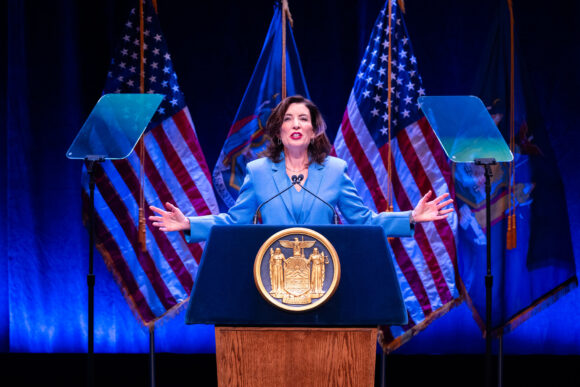
New York small businesses, big businesses, rideshare companies, police and fire unions, insurers, insurance agents, truckers, bus companies, auto repair shops, university professors, district attorneys, mayors, immigrant and minority groups and others have come out in support of Gov. Kathy Hochul’s auto insurance reforms that are intended to lower costs for drivers by fighting fraud and discouraging excess litigation and excess insurer profits.
Even faith leaders have joined the campaign. Following an endorsement from the Reverend Al Sharpton, 50 clergy and faith leaders from Buffalo to Brooklyn sent a letter to lawmakers urging them to take action on auto insurance to address the “unjust burden” of high insurance premiums on working families.
Despite the major public relations drive, and even though they support lowering auto insurance premiums and oppose fraud, excess litigation and excess profits, elected lawmakers in Albany are not on board, at least not yet. Neither the New York State Assembly nor Senate included Hochul’s reform proposals in their recommended budgets for the coming year as the governor had hoped.
The apparent snub by lawmakers does not mean the reforms are dead. The state’s final budget is still a work in progress. The deadline for the budget negotiations is April 1.
Hochul told CBS she believes there’s still time to “negotiate it back in” with legislative leaders. If they do not make it into the state’s final budget, the proposals can still be considered separately.
Big I New York President and CEO Lisa Lounsbury wrote that her group’s independent agents’ are “deeply disappointed and frankly surprised” that neither chamber mentioned the governor’s proposed auto insurance reforms.
“[T]he State Legislature sidestepped meaningful action to address staged accident fraud and excessive litigation costs,” Lounsbury stated. “By remaining silent on this issue, they are ignoring one of the most significant drivers of insurance affordability in New York: runaway legal costs that have helped earn our state the troubling designation of a ‘judicial hellhole.'”
No Summary Judgment
During the budget hearings last month, a number of lawmakers seemed reluctant to fully embrace the reforms as written and without further debate. They preferred that the promises being made and the effects on consumers’ rates and accident victims’ compensation be examined more fully.
Assembly Member Landon C. Dais suggested the stakes for getting the reforms right are high and the issues deserve a full airing. “I would argue that we as a legislature are probably on trial right now along with the insurance industry and the trial lawyers. The people of New York are the jury and they’re looking for us to for a verdict of affordability while the parties point fingers,” offered Dais.
He suggested that insurers, lawyers and lawmakers share responsibility for high costs and “no party is entitled to summary judgment in the court of public opinion.”
State Senate Majority Leader Andrea Stewart-Cousins told Streetsblog: “The reason why we omitted [the insurance proposal from the budget] is because it is a broader conversation.”
Hochul’s Answer
For Hochul the key question is: why do New Yorkers pay so much?
“Not because New Yorkers are doing anything wrong, but because rampant fraud and runaway litigation costs are jacking up prices,” is Hochul’s answer.
The Democratic governor has insisted New Yorkers “should not pay more for the same coverage” and vowed this is the year, the state does “something about it.”
Hochul and many others argue that car insurance rates are being driven up by fraud, litigation, legal loopholes, and enforcement gaps, with staged crashes and associated insurance fraud inflating everyone’s premiums.
Hochul’s 2026 proposals attempt to address staged accidents by creating new liability for criminals orchestrating fraud, not just drivers; curtail “jackpot” lawsuits by changing the no-fault threshold by tightening the definition of serious injury; change comparative fault rules to limit non-economic damages for drivers who are “mostly” at fault; mandate that insurers offer discounts for safe driving apps/devices; and discourage excess profits by requiring insurers to return profits over a certain threshold to policyholders.
Numbers Questions
The budget hearings indicated that winning acceptance by lawmakers of the reforms may depend on the perceived credibility and adequacy of the numbers behind the claimed crisis and the proposed reforms. Lawmakers asked for proof of the factors driving high insurance costs, how reforms would produce savings for consumers, and whether those savings would be meaningful.
A panel of five insurance representatives — and one trial lawyer— fielded lawmakers’ questions as part of the budget process. Panelists included Cassandra Anderson of the New York Insurance Association (NYIA); Sean McLaughlin of the National Association of Mutual Insurance Companies (NAMIC); Kristina Baldwin of the American Property Casualty Insurance Association (APCIA); Travis Wattie of the Big I; and Brad Lachut of the Professional Insurance Agents of New York (PIANY).
Senator Jamaal T. Bailey had a list of questions to which he requested written responses. He wanted to know how much fraud impacts premiums for various coverages and whether any cost savings would be sustainable or just a “one-time bump post legislation.”
He was told much of the data exists and additional data would take time to produce.
Senator Andrew S. Gounardes, who complained that his auto insurer wanted $8,000 in premium for his family’s two cars that included a 2012 Subaru Outback, asked what percentage of auto premiums can be attributed to the problem of excess litigation and awards as cited by the industry. “Is it 5%, 30%, 80%?” he asked, before maintaining that there needs to be “a bigger unpacking of all of the drivers of these costs.”
“I’m not looking to go after innocent victims and their recoveries but what I am trying to do is give lawyers and doctors a good name by rooting out some bad actors,” said Assembly Member David Weprin, seeking data on how much of a problem fraud really is in auto insurance in the state.
Assembly Member Philip Palmesano noted both the industry and the government are claiming the reforms will reduce costs and have cited some data showing how reforms helped lower costs in Florida. But he contended they have yet to show any “formal, actual analysis” that verifies that claim for New York.
“I just hope one year from now we’re seeing significant reductions,” added Senator Bill Weber.
Bad Faith
The New York State Trial Lawyers Association (NYSTLA) represents the main obstacle in the legislature. NYTSLA has argued that Hochul’s savings would pad insurers’ profits while restricting consumers’ rights to sue and the damages they can be awarded.
Bailey wanted trial lawyers to answer whether they support “increased transparency around verdict data and settlements” and whether they are willing to work with all parties in order to get to the heart of the matter “which is affordability.”
Andrew Finkelstein, NYSTLA president, told lawmakers his members “represent the same people” who are their constituents. He said his members are concerned about affordability but believe the solution is not what has been put forth.
“Insurance profits must not come at the expense of justice, accountability, or the rights of injured New Yorkers,” Finkelstein stated. “These proposals weaken individual rights, limit access to care, and severely reduce the accountability of insurance companies with absolutely no proof one New Yorker’s car insurance will be lowered as a result. Curtailing legal remedies does not reduce the cost of car insurance, it simply shifts the financial burden of the loss from the wrongdoers directly onto the backs of the victims and the taxpayers.”
Asked what the trial lawyers think should be done to lower costs for drivers, Finkelstein recommended bad faith legislation, claiming that no-fault works better in other states such as Massachusetts and Pennsylvania where they have strong bad faith laws that discourage insurers from challenging as many claims and driving up litigation costs.
Finkelstein was not asked for proof of his contention. There is research showing bad faith laws may increase litigation and claims costs.
Political Numbers
Among the numbers lawmakers have been asked to consider are some from a poll. Three-quarters (75%) of New Yorkers maintain that auto insurance costs are a financial burden on their household and even more (86%) support Hochul’s legislation, according to a statewide survey of voters commissioned by an Uber-backed group.
The poll of 1,0004 voters, conducted by political polling firm Beacon Research, found support for Hochul’s proposals by more than 80% of Democrats, Republicans and independents, and similarly high support across every region of the state. The survey found that 60% of voters believe auto insurance fraud is common, including staged crashes and fraudulent claims.
The survey results have been touted by the group Citizens for Affordable Rates (CAR) which has been advocating for the reforms. The CAR organization, which is backed by Uber, is running a $7 million ad campaign in support of Hochul’s proposals.
Number of Claims
The conversation thus far over the drivers of insurance costs and the promise of Hochul’s reforms has produced various numbers about cost drivers and savings. Some of the clams by reform advocates include:
Hochul: New York drivers pay more than $4,000 a year on average for car insurance – nearly double the national average, with premiums reaching $5,000 to $7,000 in some areas. Staged crashes and associated insurance fraud are inflating everyone’s premiums by as much as $300 per year on average. Her reforms could save drivers 15% to 20% on premiums.
New York State Department of Financial Services (DFS): There were nearly 39,000 reports for suspected no-fault fraud cases and nearly 42,000 suspected healthcare fraud reports in 2024, nearly double the number of reports in 2020. “Deceptive healthcare providers” cost New York drivers “hundreds of millions of dollars.”
Bankrate: On average, New Yorkers pay $341 per month for full coverage auto insurance and $148 per month for state minimum insurance—about twice the national average. Compounding the burden, New York drivers faced a 13.5% premium increase in 2025, the fourth-highest in the country.
Triple I: New York households paid an estimated $1,935 on average for personal auto insurance in 2024, according New York Personal Auto Insurance Premium and Cost Drivers, by the industry organization. This was an increase from $1,753 in 2023, which was 37% more than the national average ($1,282) and 18% more than drivers in other no-fault states ($1,492).
Triple I: New York is one of only 12 no-fault states requiring insurers to pay personal injury protection (PIP) benefits of up to $50,000 regardless of fault. Since 2021, bodily injury (BI) claims in New York have been rising faster than the national average, even as property damage (PD) claims have tracked the U.S. broadly. The BI-to-PD claims ratio, a measure of excessive litigation, has climbed sharply for New York while remaining flat for the multi-state comparison group.
Triple I: Hochul’s proposed measures target auto claim fraud and litigation costs. The three largest components of New York’s $1,753 average expenditure, bodily injury ($388), PIP/medical payments ($343), and uninsured/underinsured motorist ($64), are what the governor’s proposed reforms are designed to address.
American Tort Reform Association (ATLA): A Perryman Group study concluded that claims abuse and excessive tort costs wipe out billions of dollars of economic activity annually. New York residents pay a “tort tax” of $2,534.85, the third-highest in the country, and 427,794 jobs are lost each year, according to the Perryman study.
Trucking Association of New York: Commercial auto liability costs have effectively doubled over the past five years. Policies that previously cost $5,000–$6,000 now commonly range from $10,000–$12,000 per unit. The situation is particularly acute in the New York City region, with motor carriers reporting quotes as high as $50,000 per truck. There is also a growing challenge in securing adequate coverage. Market capacity has tightened significantly, with insurers limiting excess coverage and forcing operators to assemble layered policies across multiple carriers.
New York Civil Justice Institute: Compared with other no-fault states New Jersey and Massachusetts, New York’s personal injury protection insurance costs were more than 200% higher than New Jersey and over 500% higher than Massachusetts.
Metropolitan Transportation Authority (MTA): Reforms would deliver $48 million in annual recurring savings for the authority by preventing the MTA from having to pay “jackpot” settlements for crashes in which their buses were not primarily to blame. The reforms would generate additional annual savings of as much as $25 million for the more than 130 transit agencies that operate outside the MTA region in urban, suburban and rural communities across the state.
American Tort Reform Association: A surge in ads by trial lawyers across New York is fueling fraud. In 2025, plaintiffs’ attorneys poured nearly $179 million into local legal service ads across New York — an 84% increase since 2023. Last year, 33 law firms spent more than $1 million each on ads. The largest individual spender, Morgan & Morgan, doubled its ad budget year-over-year, totaling $27.5 million in 2025. Andrew Finkelstein, current president of the New York State Trial Lawyers Association, is managing partner of several different law firms that spent at least $3.7 million on more than 20,274 ads in 2025.
Citizens for Affordable Rates (CAR): Florida data showing declining auto insurance rates following recent legislative reforms show the potential savings under New York’s reforms. In Florida, the five largest auto insurance groups – Progressive, GEICO, State Farm, Allstate, and USAA – are delivering an average rate decrease of 8% for 2026, covering about 78% of Florida’s market. The reductions an average 7.4% rate reduction for 2025. CAR says states that have tackled the root causes of rising auto insurance premiums are seeing real results.
Berkeley Research Group: Uber Technologies Inc. and Lyft Inc. retained BRG to study New York’s $1.25 million uninsured/underinsured motorist (UM/UIM) coverage requirement for transportation network companies (TNCs). BRG found the requirement exceeds what is necessary in most accident scenarios—raising costs for riders and limiting earnings for drivers across the state. According to data provided by Uber’s insurance partner in New York, excluding New York City, the vast majority of personal (non-TNC) UM/UIM claims in the state resolve well below $100,000, and most TNC UM/UIM claims settle under $25,000 per person ($50,000 per accident). BRG found that New York’s excessive coverage makes TNCs a target for increased litigation and the losses incurred under the UM/UIM coverage in New York are substantially higher than in comparable states with lower UM/UIM policy limits, like Connecticut and Illinois. New York has low rates of uninsured motorists and is one of the safest states in which to drive—yet it mandates among the highest TNC insurance coverage in the country. There is no statistical evidence that reducing UM/UIM coverage to $25,000 per person ($50,000 per accident)—the state mandate for personal vehicles—would expose riders or drivers to unreasonable financial risk. Rather, a reduced requirement would preserve strong protections while making transportation more affordable for millions of New Yorkers.
Top Photo: New York Gov. Kathy Hochul
Topics Auto Legislation New York
Was this article valuable?
Here are more articles you may enjoy.
 Hordes of Teens on E-Bikes Force Suburbs to Rewrite Road Rules
  McDonald’s Hit With Class Action Alleging AI-Powered Menu Price-Fixing
  McKinsey Rebukes Partner Who Questioned Challenges Facing Women CEOs
  Agency Network SIAA Acquires MGA Canopy Specialty Insurance

