

The builder of the Dali cargo ship and Baltimore city officials are welcoming the U.S. government’s bringing of criminal charges against the ship’s manager for the deadly and costly collapse of the Francis Scott Key Bridge in 2024.
Shipbuilder Hyundai Heavy Industries (HHI) contends the criminal charges brought by the Department of Justice (DOJ) last week against Synergy Marine Group correctly assign responsibility and are consistent with findings of the investigation by the National Transportation Safety Board (NTSB).
The NTSB concluded a loose wire was to blame for power outages that eventually led to the allision. HHI maintains the loose wire should have been detected through regular maintenance and is not related to the original design of the ship built more than 10 years ago.
Synergy has disavowed responsibility for the wire. Synergy and the ship’s owner Grace Ocean have sued HHI, alleging that its “defectively designed” switchboard led to the power loss and subsequent collision.
US Brings Criminal Charges Over Bridge Crash; Ship Operator Objects
The shipbuilder HHI also argues that the criminal charges reflect narratives in civil lawsuits that Synergy and Grace Ocean have settled, including last week’s $2.5 billion settlement with the state of Maryland. In 2024, they settled with the federal government for $102 million.
However, those civil settlements contain no admission of wrongdoing by Grace Ocean or Synergy.
Also, the same NTSB report says shipbuilder HHI bears some fault for the accident.
When Maryland Attorney General Anthony Brown announced the state’s $2.5 billion settlement with the owner and manager, he also indicated that the state’s “pursuit of justice” was not finished. “We will continue to press our claims against the shipbuilder whose fault helped bring this bridge down,” Brown stated.
The criminal charges are allegations, and Synergy has not been convicted of any crime.
HHI Response
HHI insists that the settlements show that the owner and manager “understand that they bear responsibility” for the tragic incident.
“Their capitulation reflects their awareness of their many failures – including serious misuse of the ship’s fuel supply systems in violation of class rules and poor maintenance and operation of the ship, which put their safety and the safety of others in jeopardy,” HHI said in a statement to Insurance Journal.
Maryland Announces $2.5 Billion Settlement Over Bridge Collapse
HHI said the DOJ’s criminal indictment also “shows that Synergy attempted to conceal evidence of its wrongdoing, obstructing the NTSB’s investigation into the matter.”
According to HHI, when it delivered the ship nearly 10 years before the allision, there was no indication that any wire was loose. Also, the Dali was built with “automated redundancies” so the vessel could quickly recover from a power loss, features that were in keeping with accepted engineering practices at the time.
Even if a wire were to become loose over the course of a decade, the operator and owner should have detected that through normal maintenance, according to HHI. “More importantly, as the DOJ said in its criminal indictment, if the Dali had used the proper fuel supply and booster pumps, it would have regained power in time to safely navigate under the Key Bridge,” HHI stated.
Baltimore Response
Baltimore officials reacted similarly, asserting that the criminal allegations reinforce the city’s claims in its ongoing civil litigation and further undermine the attempts by the ship owner and manager to limit their liability under the Limitation of Liability Act of 1851.
Grace Ocean and Synergy have invoked that maritime law to limit their liability to the current value of the ship, about $44 million, an amount far exceeded by other settlements already. Maryland, Baltimore and the estates of the six deceased construction workers have opposed the limit for Synergy on the basis it is not the shipowner.
However, Synergy recently won a ruling allowing it to proceed for now in the lawsuits against it under the law that limits liability. The issue was one of the factors Maryland weighed in deciding to settle. The next legal proceeding on that issue is set for June 1, although there may be a delay to give Synergy time to deal with the criminal charges. Synergy has asked for time to secure immunity or other protection for its employees who it told the court are hesitant to come to the U.S. to testify.
The city of Baltimore’s own suit against Grace Ocean and Synergy is still active, as are lawsuits by the families of the six construction workers killed in the bridge collapse.
“This indictment supports what Baltimore has alleged from the beginning: this tragedy was not some unavoidable accident, but the result of horrendous corporate conduct, the consequences of which the people of Baltimore have been forced to endure,” said Mayor Brandon M. Scott.
Adam Levitt, counsel for the city of Baltimore, said the federal charges substantially reinforce the factual record developed in the city’s civil litigation.
“The indictment alleges an extraordinary pattern of concealment, falsification, and disregard for public safety that confirms and expands upon what the City and other claimants have been uncovering through discovery,” said Levitt.
DOJ Indictment
Last week, DOJ charged Synergy Marine, based in Singapore, and Synergy Maritime, based in Chennai, India, along with an Indian national technical superintendent for the Dali. with causing the death of six construction workers and $5 billion in economic losses.
The three have been charged with conspiracy, willfully failing to immediately inform the U.S. Coast Guard of a known hazardous condition, obstruction of an agency proceeding, and false statements.
In announcing the indictment, Acting U.S. Attorney General Todd Blanche said the collapse of the bridge was a “preventable tragedy of enormous consequence” and the indictment is a “critical step toward holding accountable those whose reckless disregard for maritime safety regulations caused this disaster.”
Single Loose Wire Led to Blackout That Caused Dali Crash Into Bridge
According to the DOJ criminal indictment and the NTSB report, the Dali lost power twice as it navigated out to sea from the Port of Baltimore, causing it to crash into the bridge. The indictment alleges that a loose wire in a switchboard likely caused the first power loss, which is a finding made by the NTSB as part of its investigation.
Shortly after the vessel regained power, it lost power again, according to NTSB and the indictment, and Synergy allegedly relied on a flushing pump to supply fuel. However, the indictment says the flushing pump was not designed to automatically restart following a blackout, and the Dali’s generators could not operate without a fuel supply, so the ship ultimately experienced a second blackout.
The indictment alleges that had the Dali used the proper fuel supply pumps, the vessel would have regained power in time to safely navigate under the bridge.
The NTSB report found that Synergy’s “operational oversight was inadequate” because it did not discontinue crews’ ongoing use of the flushing pump as a service pump for the diesel generators.
The NTSB report noted that if infrared thermal imaging had been used to inspect wire connections before the accident as part of maintenance program, the loose signal wire may have been identified.
Maryland Could Have Reduced Risk of Key Bridge Collapse: NTSB
The NTSB report also noted that configuration of the Dali’s main engine to automatically shut down due to low cooling water pressure met classification standards at the time the vessel was constructed; however, it prevented the main engine from being available following the initial underway blackout, thus reducing the vessel’s maneuverability.
DOJ has not replied to a request for information over whether it plans further charges, civil or criminal, against any parties in the bridge collapse.
Synergy Defense
Synergy has accused DOJ of “criminalising” what it says was a tragic accident “that should be assessed through the full factual, technical and regulatory record” rather than through a criminal indictment.
Synergy called DOJ’s allegations in the indictment “baseless” and said they have “nothing to do with the Dali’s allision” with the Key Bridge. Synergy also said the loose wire was in “no way attributable to Synergy’s operation of the vessel.”
Also, the DOJ’s reference to the vessel’s use of the flushing pump is “wholly irrelevant to the cause of the allision” and contrary to the NTSB’s conclusions, the ship operator stressed in a statement to Insurance Journal.
Owners of Ship That Crashed Into Bridge Sue Vessel’s Builder Hyundai
The NTSB investigators found that an improperly placed label prevented the wire from being fully inserted into a gate, causing an inadequate connection. Grace Ocean and Synergy claim that the switchboard was defectively designed such that wiring connections were not secure.
Synergy said it would “vigorously defend” itself. The company contends that the Dali was not out of compliance with any code, law, regulation or rule governing her operation, or with the builder’s recommendations, and that the Dali and other vessels managed by Synergy, also had a “near-flawless Port State Control record” in the U.S.
Dali’s owner Grace Ocean had previously argued that state officials bear “significant liability and fault” in light of “decades of records” showing the state failed to properly protect the bridge, which was built in the 1970s with minimal pier protection.
In a prior report, the NTSB suggested that had the Maryland Transportation Authority conducted a vulnerability assessment as recommended in 1991 and 2009, it would have been aware that the bridge was above the threshold of risk for catastrophic collapse from a vessel collision when the Dali collision occurred.
Ship Owner in Baltimore Bridge Collapse Blames Maryland, Others
In addition to citing causes and failures, the NTSB ruled out several issues including environmental or waterway conditions, impairment of the Dali crew or pilots, and fuel quality as factors in the deadly incident.
Baltimore officials noted that the city suffered “substantial direct harm” from the collapse and its aftermath, including damage to transportation infrastructure, interruption of commerce and port operations, emergency response expenditures, environmental and navigational impacts to the Patapsco River, and damage affecting public systems and infrastructure connected to the bridge corridor and surrounding areas.
The city criticized the attempt to “shift the costs” of alleged wrongdoing onto Baltimore residents and taxpayers.
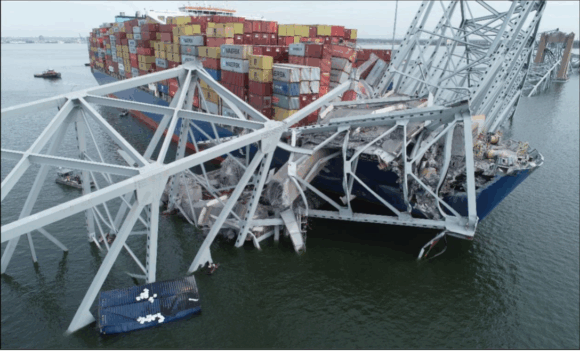
The Francis Scott Key Bridge collapsed in the early morning hours of March 26, 2024, after being struck by the Dali as the vessel departed the Port of Baltimore. The collapse killed six construction workers, obstructed a major shipping channel, disrupted commerce throughout the region, and caused extensive public and private damages.
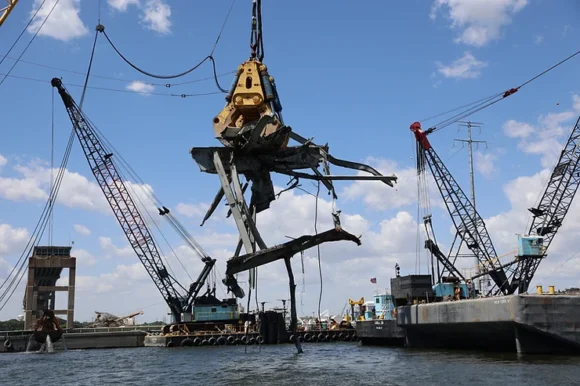
Photo: Crane involved in salvage operation after Baltimore Key Bridge collapse.
Key Bridge Response 2024 Unified Command photo.)
Topics Fraud
Was this article valuable?
Here are more articles you may enjoy.
 Two Past Hurricanes, OIR Data Give Idea of What to Expect From Isaias in Florida
  Sedgwick: Property Claims Face Delays, Are Growing More Complex
  Gronkowski Now Pitchman for eMaxx, a Reciprocal With a Different Playbook
  Viewpoint: The ‘Unbundled’ Insurer Emerges in Age of AI as Value Chain Fragments

