

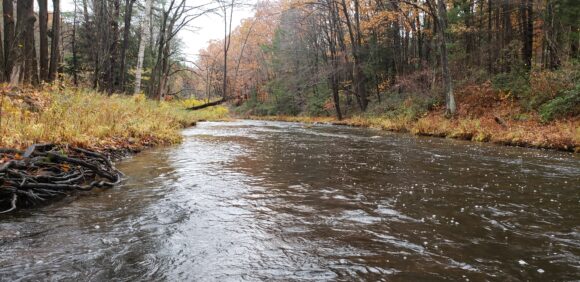
The Old Dutch Mustard Co., a mustard and vinegar manufacturing company, and its owner were sentenced last Friday in federal court for knowingly discharging acidic water into the Souhegan River that runs through southern New Hampshire.
The sentencing came after years of efforts by federal and state environmental officials since the 1980s to halt the illegal pumping by The Old Dutch Mustard Co. in Greenville, New Hampshire. Officials faced a business owner who built a secret pumping system and who lied and had his employees lie to officials to hide his crime.
In February 2025, the owner and company pleaded guilty to knowingly discharging a pollutant without a permit in violation of the Clean Water Act, which prohibits the discharge of any pollutant into navigable waters without a pollutant discharge permit.
U.S. Attorney Erin Creegan reported that owner Charles Santich, of New York, was sentenced to 18 months in federal prison, one year of supervised release, and ordered to pay a $250,000 fine. The court sentenced Old Dutch Mustard Co., Inc., which does business as Pilgrim Foods, Inc., to pay a $1.5 million fine and to establish environmental compliance and ethics programs.
According to the court documents, due to a long history of non-compliance that began in the 1980s, Old Dutch Mustard has been subject to several enforcement actions by federal and state agencies. As a result, the federal Environmental Protection Agency (EPA) and the New Hampshire Department of Environmental Services (DES), along with the New Hampshire attorney general, required continuous monitoring of a stream that flows underneath and in front of the mustard facility and then flows into the Souhegan River.
Officials said Santich and his company sought to purposefully evade this monitoring.
“Throughout years of repeated civil and administrative attempts to encourage Santich and his company to follow the law, Santich lied to state and federal authorities and even purposefully built the illegal infrastructure needed to pump his manufacturing waste into New Hampshire’s waterways, pushing his employees to help him violate the law,” said U.S. Attorney Creegan.
According to Creegan, state and federal agencies repeatedly tried to “help Santich and his company end the pollution that left waterways with fewer fish, and impacted the recreationalists and homeowners who use the Souhegan River.”
Creegan said officials determined that after this years-long scheme of intentional misconduct and deceit, a criminal sanction was necessary to protect the public.
Officials showed the court how Santich executed a plan to elude monitoring of the unnamed stream below his facility and save on shipping costs by secretly pumping his excess wastewater into the river. They found that Santich hired an excavation company in 2017 to extend an underground pipe to the top of a hill several hundred feet behind the facility. He also had the excavation company construct a drainage ditch to direct water from the pipe into the river. To minimize his paper trail, Santich had the owner of the excavation company alter its proposal to remove references to the illegal discharge pipe and drainage ditch, according to court documents.
Prosecutors said that for the next six years, Santich directed his employees to repeatedly pump his acidic wastewater and stormwater through the underground pipe and ultimately into the river. His employees reported that Santich would fire them if they did not assist in the crime.
The wastewater at issue in this case is from the manufacturing process at Old Dutch, not sanitary waste or sewage
Santich submitted false documents that concealed the illegal discharge pipe and obstructed EPA’s efforts to obtain data about the volume of wastewater that flowed through the pump into the river.
The court agreed that the wastewater Santich pumped into the river caused environmental harm. Prior pollution from Old Dutch caused fish kills in the 1990s and the discharges continued to pollute the river and prevent its recovery and the return of acid-sensitive fish and other aquatic life to that area of the river.
An EPA toxicologist also testified at sentencing that Santich’s discharges likely contributed to conditions that resulted in a mercury fish consumption advisory in the area of the discharges.
Prosecutors further showed that in May of 2023, state inspectors discovered wastewater smelling of vinegar flowing from the manmade ditch at the top of the hill on the Old Dutch Mustard property into the river. Santich falsely told inspectors that the residue was the result of a failed attempt to plant mustard seed, a lie he later had employees repeat to criminal investigators.
In August 2023, EPA agents executed a search warrant at the facility where they discovered the pipe actively discharging.
The Souhegan River is one of 19 rivers that New Hampshire has designated as an important natural resource.
Was this article valuable?
Here are more articles you may enjoy.
 AI Bubble Risks Worst S&P 500 Crash Since 2008, Strategist Says
  National Flood Insurance Program’s Authority to Expire in December
  NY City Accuses Law Firm of Running Injury Claims Fraud Operation
  McDonald’s Hit With Class Action Alleging AI-Powered Menu Price-Fixing

