

War has overtaken civil unrest as the political violence exposure that companies fear most, as conflicts in Europe and the Middle East disrupt global trade flows, strain political alliances, embolden adversarial powers and heighten risks to business assets, according to the Allianz Risk Barometer 2026.
War was identified as the political violence exposure most feared by companies, surpassing civil unrest to garner 53% of the votes in the 2026 Allianz Risk Barometer, climbing from 48% in 2025. Allianz noted political risks and violence climbed to number seven in the Risk Barometer, its highest position ever (compared to number 9 in 2025).
Allianz said this finding means that these perils have joined other mainstream business risks as the world faces “one of the most volatile geopolitical periods in our history since the end of World War Two.”
Allianz released its 2026 Risk Barometer in January and published on May 19 a new report, titled “Political violence and civil unrest trends 2026,” which focuses on one section of the January report. The Risk Barometer tracks the most important corporate concerns for the year ahead, as voted for by risk management experts from almost 100 countries and territories.
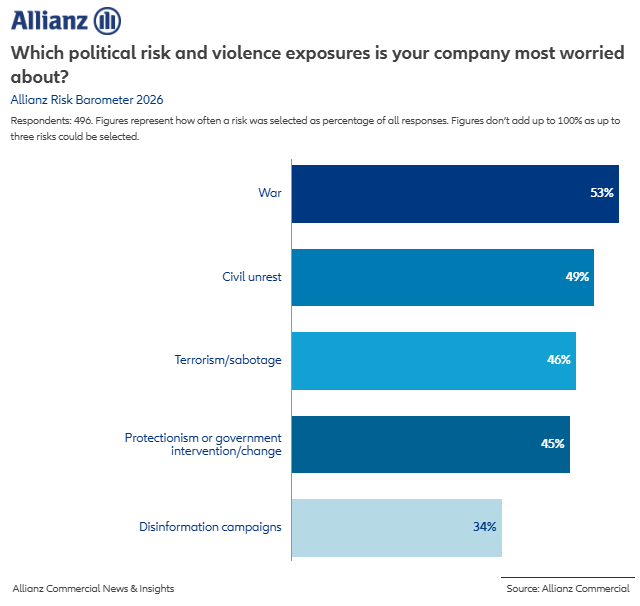
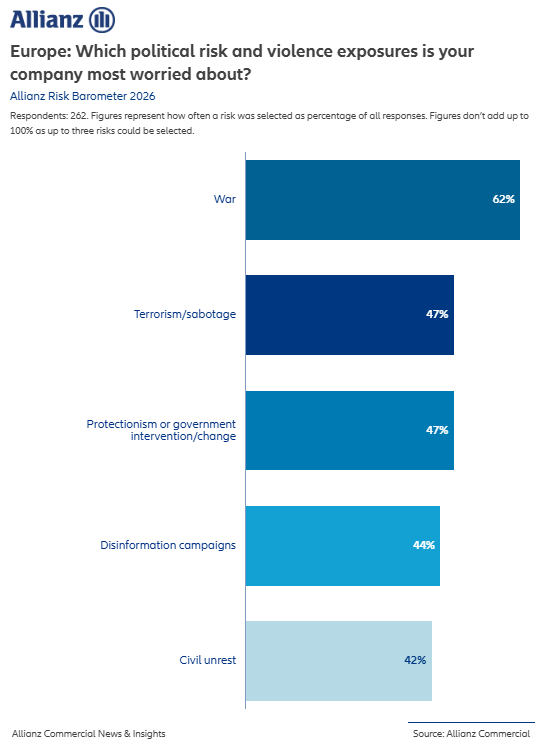
Around 60% of respondents from Europe and Asia-Pacific see war as the top political risk and violence exposure, while civil unrest ranks number two globally (at 49%), and terrorism/sabotage is ranked number three (46%).
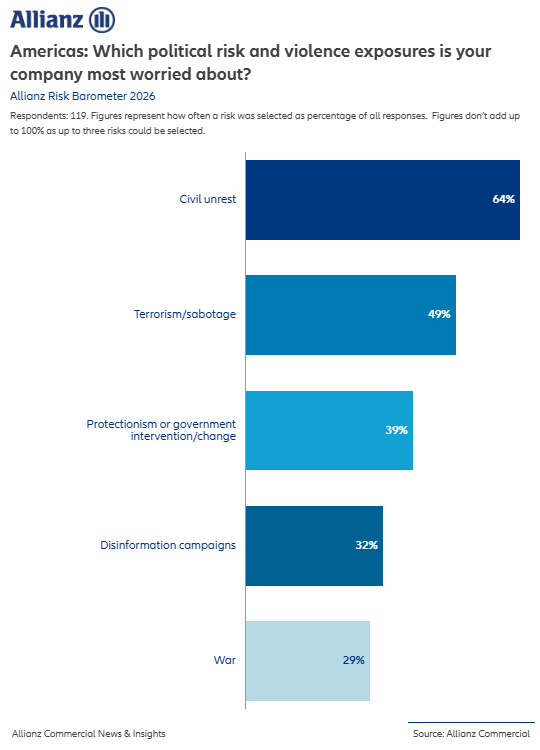
In the Americas, civil unrest is ranked as the top political risk and violence exposure by 64% of survey respondents with war coming in at fifth place (ranked by 29% of respondents). Civil unrest also is a top concern in countries such as India (60%), Colombia (76%), and France (where it has soared to 82%).
In addition, more than half of smaller companies (with less than $100 million of revenue) rated civil unrest as their top political violence concern, Allianz continued.
Allianz Research tracked around 250 reported strikes, riots, and civil commotion (SRCC) events over the past five years with event participation exceeding 1,000 people and lasting for more than one day. The analysis revealed that Pakistan experienced the most events, followed by Indonesia. Allianz noted that other countries with a high number of SRCC events include the US, Greece, Tunisia, Hungary, Iran, and India.
The US-Iran conflict also could lead to heightened risk of strikes, riots, and civil unrest, “particularly in countries heavily reliant on Middle Eastern oil and gas,” Allianz explained. “Nations with robust mechanisms to manage food and fuel price shocks may mitigate these risks, while others face elevated threats of rationing, unrest, and looting.”
“With geopolitical upheaval, economic pressures, and social media all amplifying the threat of political violence, the potential fallout can lead to substantial economic and insured losses, challenging businesses and their insurers,” the report said.
The pattern of protests and violence in recent years has clearly shown that some industries and occupancies are much more vulnerable to the full spectrum of political violence perils, but any organization can be affected, Allianz said in a press release accompanying the report.
Rising Demand for Political Violence Insurance
The US-Iran conflict and rising geopolitical volatility is likely to have a significant impact on risk mitigation going forward, accelerating demand for political violence and terrorism (PVT) insurance as well as coverage for SRCC events, the Allianz report said.
“Demand for political violence insurance continues to grow. We see an elevated level of interest and more buyers than ever in this space. Clients are broadening their coverage to better fit their risk footprint,” commented Srdjan Todorovic, global head of Political Violence and Hostile Environment Solutions at Allianz Commercial, who was quoted in the report.
Businesses also are prioritizing risk management and supply chain mitigation strategies, such as nearshoring, friendshoring and supplier diversification, the report said. (Editor’s note: Friendshoring is defined by the World Economic Forum as limiting supply chains to, or sourcing manufacturing from, nations that share a company’s political, economic, and social values).
Business Interruption Risks
Allianz noted that one of the most severe PVT risks is the threat of business interruption (BI), “which could lead to substantial economic and insured losses, challenging businesses, and their insurers.”
As both war and civil unrest can lead to big business interruption exposures – including supply chain disruptions – respondents to the Allianz Risk Barometer survey ranked BI as their third highest business concern. (See graphic below).
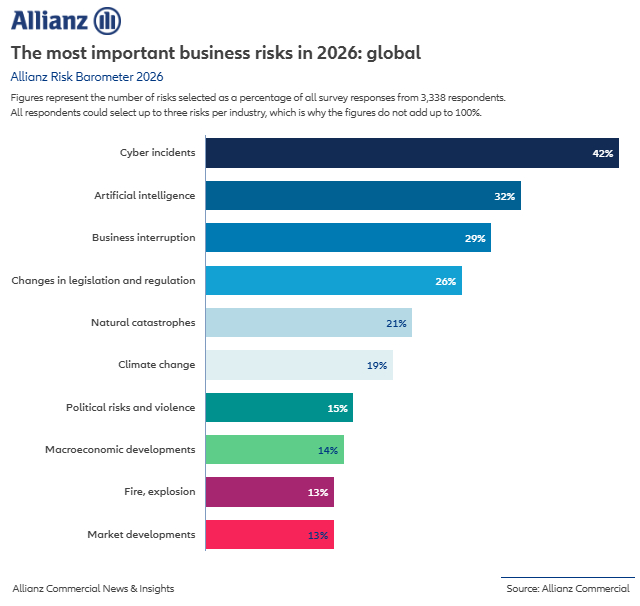
“While the survey was conducted before the US-Iran conflict, many companies were already adopting strategies to adapt to shifting geopolitical risks – measures that will continue to strengthen their resilience during periods of intensifying global upheaval,” Allianz explained.
“Just over a third (35%) were exploring nearshoring and evaluating domestic manufacturing options, while 32% were looking to improve inventory management, including storing inventory in Free Trade zones,” the report added. “Almost half (49%) were looking at renegotiating and diversifying supply chains, while a similar number were streamlining operations to reduce costs and/or investing in advanced analytics and supply chain management software.”
Survey respondents identified the impact of political risks and violence risks that concerns their companies the most as:
- Business interruption, 72%
- Impact on contingent business interruption and/or supply chains, 72%
- Direct physical damage, 43%
- Changes in licensing or regulations, 34%.
Allianz explained that the figures don’t add up to 100% as up to three risks could be selected. The chart can be found on page 11 of the new report on “Political violence and civil unrest trends 2026.”
Types of PVT and SRCC Coverages
Allianz offered an analysis of the types of insurance available to cover various political violence risk scenarios, emphasizing that buyers should review their policies.
“Property policies may cover political violence claims in some cases, but insurers also offer specialist coverage to mitigate the impact of strikes, riots and civil commotion via the specialist political violence market,” the report said.
Allianz noted that “full” political violence insurance typically includes all of the coverages listed below:
1. Property coverage
— Physical damage/losses sustained from an insured peril
2. Business interruption (BI) and contingent business interruption (CBI) coverage
— Reduction to gross/net earnings suffered due to the necessary interruption of a business’ operations; and expenses incurred in attempting to reduce loss or increase operations elsewhere. Denial of access due to civil or military authority; supply chain issues.
3. Standalone terrorism and sabotage insurance
— Act of terrorism: An act or series of acts, including the use of force or violence, by any person or group(s) of persons whether acting alone or on behalf of any organization(s) committed for political, religious or ideological purposes
— Sabotage: Any wilful physical damage or destruction perpetrated for political reasons by known or unknown person(s)
4. Standalone strikes, riots and civil commotion (SRCC) insurance
— Strikes: Any wilful act of any striker/ locked-out worker during a strike; any act of a lawful authority to suppress or minimize the strike’s consequence • Riots, civil commotions: Any political act committed in the course of a disturbance of the public peace by a group of persons; any act of a lawful authority’s act to suppress or minimize a riot
— Malicious damage: Physical loss/damage resulting from a malicious political act committed during a public disturbance
— Organized crime: an extension can be provided on request for Mexico and Latin America to cover SRCC and malicious damage events carried out by organized crime groups such as cartels.
5. War and warlike perils
— Insurrection, revolution and rebellion: Deliberate, organized armed citizen/ subject resistance to a sovereign government’s laws
— Coup d’état and mutiny: Sudden, violent and illegal overthrow of a sovereign government; resistance by members of legally armed or peace-keeping forces to a superior officer
— War and civil war: Conflict between two or more sovereign nations, declared or undeclared; a war carried out between or among opposing citizens of the same country or nation.
Coverage for any of the above could, for example, include physical damage, business interruption, contingent business interruption, denial of access, delay in startup and advanced loss of profit for construction projects, Allianz said, noting that terms of coverage depend on the individual policy.
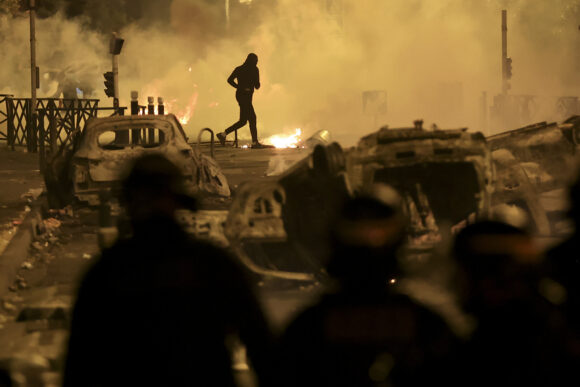
Photograph: A demonstrator runs on the third night of protests sparked by the fatal police shooting of a 17-year-old driver in the Paris suburb of Nanterre, France, on Friday, June 30, 2023. (AP Photo/Aurelien Morissard, File)
Was this article valuable?
Here are more articles you may enjoy.
 McDonald’s Hit With Class Action Alleging AI-Powered Menu Price-Fixing
  Iran Ramps Up Ship Attacks in Hormuz as Oil, Gas Flows Rise
  Industry Reacts to Senators’ Letter for Claims Data and Recent Reports
  Florida Commissioner Suspends A-Cap’s Atlantic Coast Life Over Surplus Issues

