


New York City and the eastern US are set to swelter through the hottest day of the year so far, as a heat wave drives up power prices and strains electric grids.
About 142.7 million people from Kansas to Maine are under extreme heat warnings and 152 warm weather records may be threatened, tied or broken in the eastern half of the US, the Weather Prediction Center said. Through the Fourth of July US holiday, 411 daily records for high temperatures or warm overnight lows are likely to be challenged.
New York’s Central Park is forecast to reach 100F (38C), which would tie a record for the date set in 1966, while Washington’s Reagan National Airport is expected to reach a new high of 103F and Trenton, New Jersey, may see 104F, said David Roth, a senior branch forecaster at the US Weather Prediction Center. The overnight low at LaGuardia may be 80F.
“This is the day when the most records are possible,” Roth said.
Caribou, Maine, is even set to reach 93F, which would break the record for the date first set in 1914, according to the National Weather Service.
The largest US power grid, serving almost a fifth of Americans and businesses, including the so-called data center alley in Northern Virginia, is on track to consume a record 166.2 gigawatts of electricity at about 5 p.m., according to PJM Interconnection LLC, the operator of the 13-state system. That would topple the 20-year record of nearly 165.6 gigawatts.
Stress has been building, with PJM issuing a level 1 emergency — the lowest level — for a third consecutive day to shore up supplies and be able to call on additional back up resources.
PJM also has received emergency authorization from the US Department of Energy to tap on-site generation at data centers and other large consumers as a last resort measure to avoid rolling blackouts.
For data centers, this means they would stop tapping the grid and instead use their on-site fleet of primarily diesel units and potentially gas units or batteries. They could also curtail their usage by shifting data center operations to another geography. Google shifted work from a Virginia data center to the Midwest to reduce grid stress during the severe January storm.
New England’s six-state grid is expecting “exceptionally tight operating conditions” to meet peak demand on Thursday evening because there is little spare generating capacity, according to operator ISO New England Inc.
When humidity is factored in, temperatures will feel closer to 105F to 115F across New York City and throughout the Northeast, the National Weather Service said Thursday.
Hot and humid conditions mean there is increasing uncertainty about being able to import electricity from neighboring grids. Consumers are being asked to voluntarily limit their energy usage from 4 p.m. to 8 p.m., with ISO New England suggesting that residential consumers pre-cool their homes before the peak, close blinds and shift the use of washing machines, dishwashers and other major appliances to off-peak hours.
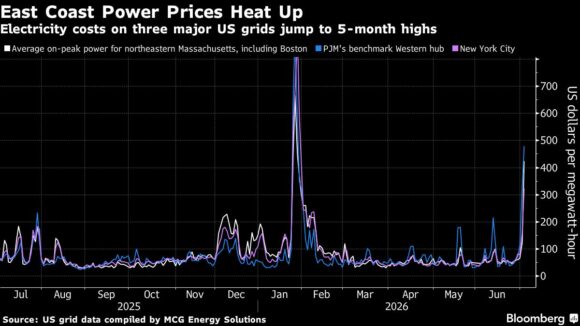
In New England, on-peak power for northeast Massachusetts, including Boston, jumped 244% to $424.64 per megawatt-hour for Thursday. On-peak power prices at PJM’s benchmark Western Hub jumped 150% to average $479.27/MWh, the most since the severe January storm.
In addition to the stress on electric grids and supplies, high heat can buckle highways, swell railroad tracks and make it harder for airplanes to take off. Delta Airlines is waiving change fees for journeys through New York’s LaGuardia Airport this week because of hot weather and operational constraints, according to a service notice posted Wednesday.
“This heat wave is only just beginning,” New York City Mayor Zohran Mamdani said in an X-post. “Please stay prepared and informed as these dangerously high temperatures continue.”
New Jersey Transit and Amtrak have warned passengers that trains may be delayed because of the heat.
The high temperatures are also reaching Toronto, North America’s fourth most-populous city, where orange and yellow heat warnings have been posted across parts of Ontario, Quebec and the Maritimes, Environment and Climate Change Canada said. In a World Cup match, Portugal is set to take on Croatia at 7 p.m. Eastern Daylight Time in Toronto Thursday.
While the high temperatures have spread across the Midwest as well, crops are likely experiencing minor stress because there is plenty of moisture in the region. Conditions should improve after Thursday and it’s “way too early to cause any significant problems,” said Donald Keeney, a meteorologist with Vaisala.
Across the eastern US, Thursday and Friday will be the worst of the heat and then the high-pressure ridge, or heat dome, will start to break down.
By next week, temperatures across most of the eastern US will return to average levels, Roth said.
Top Photo: NEW YORK, NEW YORK – MAY 05: People gather on a lawn at Central Park on an unseasonably warm spring day in Manhattan on May 05, 2026, in New York City. A recent summer forecast from AccuWeather warns of the possibility of historic heat and severe storms, with the number of 90-degree days predicted to be near or above the historical average. (Photo by Spencer Platt/Getty Images)
Topics New York
Was this article valuable?
Here are more articles you may enjoy.
 Alliant Insurance Acquires New Hampshire’s Melcher & Prescott
  Two Past Hurricanes, OIR Data Give Idea of What to Expect From Isaias in Florida
  India Insurance Regulator Eyes 2027 Start for Commission Caps
  Hordes of Teens on E-Bikes Force Suburbs to Rewrite Road Rules

