

In a few short years, US artificial intelligence startups have grown into some of the most powerful and influential businesses in the world, reaching near-trillion-dollar valuations. As two of them, Anthropic and OpenAI, prepare for initial public offerings, there’s a notable absence: The companies haven’t disclosed their greenhouse gas emissions, made net-zero pledges or published sustainability reports. (Anthropic did join a carbon-removal coalition called Frontier.)
Not too long ago, investors would have cried foul. Even fossil-fuel stalwarts like ExxonMobil Holdings Corp. have been voluntarily producing sustainability reports for years. The Big Tech companies scaling up AI infrastructure — Alphabet Inc.’s Google, Meta Platforms Inc., Amazon.com Inc. and Microsoft Corp. — have net-zero goals and report their emissions, which are now spiking due to the data-center boom.
But in an era of climate backlash, many investors have fallen quiet on the issue and US regulators have retreated. So the public is left guessing about how much climate pollution is tied to the large language models of OpenAI, Anthropic and SpaceX’s SpaceXAI, and whether the companies plan to curb it. While they aren’t yet public companies, their scale dwarfs what people associate with startups.
Although precise numbers are lacking, it’s clear that the sector’s emissions are enormous. New gas plants for data centers in the US alone could soon generate as much climate pollution as the entire country of Australia, according to research by the nonprofit Environmental Integrity Project.
“They should absolutely be disclosing,” said Ioannis Ioannou, an associate professor at the London Business School whose research focuses on integrating sustainability into corporate strategy. “We’re talking about the potential environmental impact of a scale that we haven’t seen before.”
Later this year, the AI newcomers will have to. California’s law SB253 begins to go into effect in November, requiring companies with more than $1 billion in revenue doing business in the state to report their Scope 1 and 2 greenhouse gas emissions. These measures account for the planet-warming pollution caused by a company’s operations and energy usage — and California’s regulations apply to activity outside the state.
Anthropic is working with a carbon accounting and emissions disclosure platform, Watershed, to measure its company-wide footprint and to comply with the reporting requirements under the law, according to a company spokesperson.
OpenAI is coordinating with its data center partners ahead of the California reporting deadline, a spokesperson said. The spokesperson added that the company has a sustainability steering committee and pointed to its Stargate Community commitment to develop and construct AI infrastructure in a way that benefits local communities, including by minimizing water usage and protecting local ecosystems.
SpaceX didn’t respond to a request for comment.
The rise of AI has coincided with the decline of environmental, social and governance investing. ESG took off after countries adopted the Paris climate accord in 2015 and reached its zenith in the early 2020s. Back then, BlackRock Chief Executive Officer Larry Fink called climate change a major financial risk, and the US Securities and Exchange Commission was working on rules requiring companies to disclose their carbon emissions and climate vulnerabilities.
Emerging public companies sometimes went to great lengths to demonstrate environmental stewardship. Lyft Inc., for example, purchased carbon offsets and committed to carbon neutrality and 100% renewable energy before its 2019 public listing. The founder of Rivian Automotive Inc., in its S-1 filing in 2021, said humans’ impact on the climate was the inspiration to start the company and was behind “every decision” it made.
When Tesla went public back in 2010, the EV maker favorably cited a regulatory environment that was pushing companies toward lower-carbon operations and discussed “environmental concerns” with gasoline-powered cars as part of its rationale for eliminating tailpipe emissions. CEO Elon Musk also took advantage of clean energy incentives from the US government to help scale the business. Fast forward to this year’s initial public offering of SpaceX, where Musk is also CEO, and environmental concerns are hardly mentioned. In fact, SpaceXAI was carting gas turbines to its data centers as the IPO neared.
Corporate climate efforts have faded under the second Trump presidency. The SEC has moved to scrap climate disclosure rules, over objections from groups like the Union of Concerned Scientists citing “serious financial risk posed by climate change.” Republican lawmakers around the country, meanwhile, have attacked ESG. Wall Street banks, including BlackRock, departed the Net-Zero Banking Alliance in droves, leading it to cease operations.
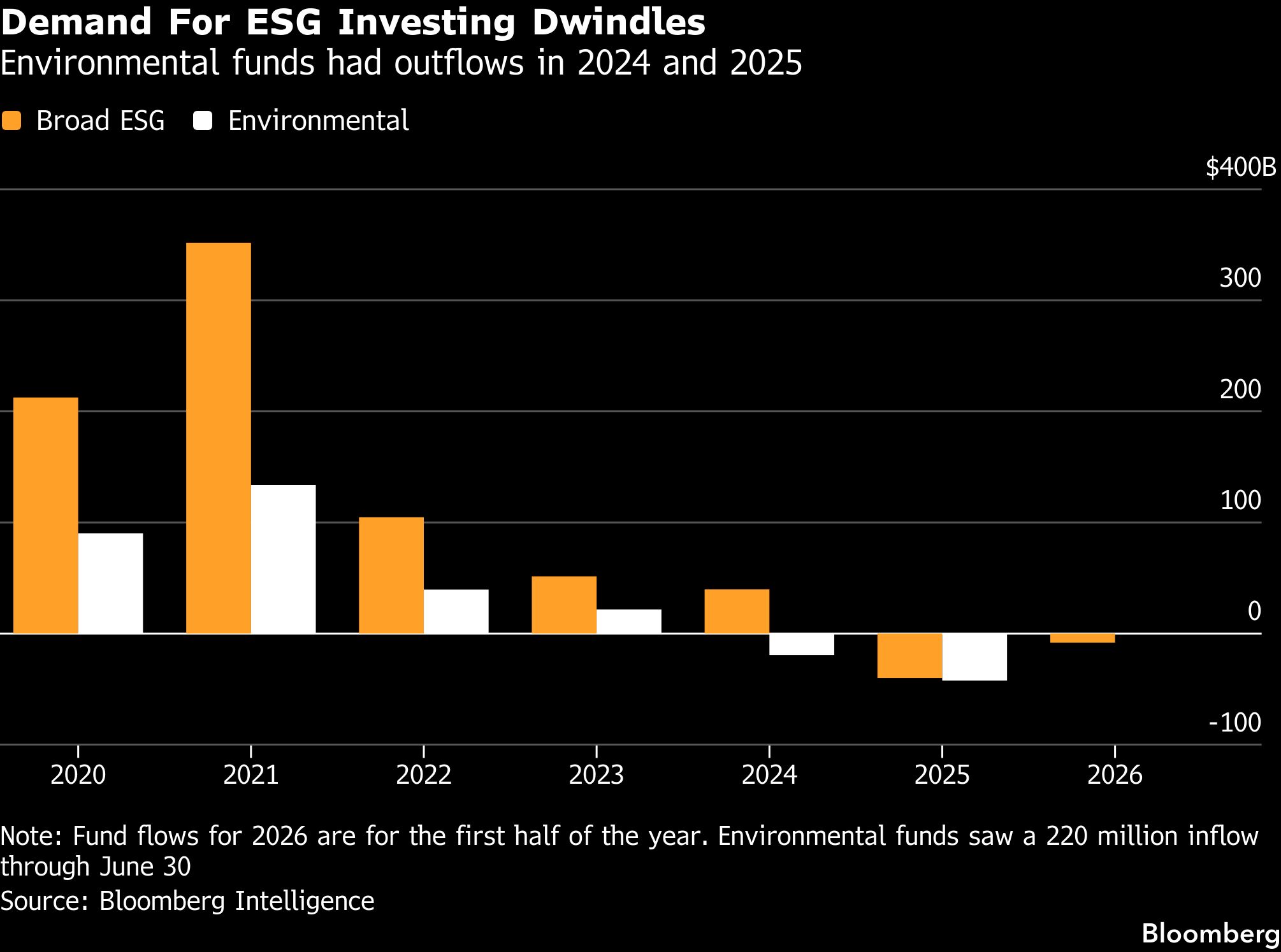
Funds focused on ESG or environmental themes attracted about $485 billion in 2021, according to Bloomberg Intelligence. Those same funds lost $82 billion in 2025.
“Big institutional investors have kind of pulled away from the pressure that they used to put on companies” around sustainability, said Amanda Urquiza, a partner at Wilson Sonsini Goodrich & Rosati, who practices corporate and securities law and advises pre-IPO companies.
SpaceXAI’s massive Colossus data centers in the Memphis area are powered by gas turbines, some of which currently lack clean air permits. (Anthropic pays billions to access their computing capacity; a company spokesperson said the startup is engaging with community members and officials in the city, including the mayor.)
The heavy criticism that SpaceX has drawn for the Colossus project and the minimal disclosures it made in its S-1 filing seem to have had no negative impact on its IPO. The company revised its S-1 to note water scarcity as a risk to its business, while not addressing emissions, sustainability or other possible climate risks that could be material to investors.
“If I don’t have to talk about a potentially large risk that could sit on my balance sheet,” said Todd Cort, a senior lecturer in sustainability at Yale School of Management, “and I’m not required to do it and shareholders are not asking about it — then what incentive do I really have to talk about it?”
But the carbon accounting is still a work in progress. How to allocate the emissions from training a large language model, or for the embodied carbon in AI hardware, isn’t widely agreed on, and measuring them is complex.
“There’s not a standardized way to measure those emissions yet,” said Maura Hodge, sustainability leader for KPMG in the US.
The California Air Resources Board, the agency overseeing the implementation of the state law, didn’t offer details on the reporting process for SB253.
Both Anthropic and OpenAI may be able to delay reporting the bulk of their emissions until next year. Since they rent data capacity from other companies, including Microsoft, Amazon and SpaceX, it’s possible they could choose to classify the related emissions as belonging to their supply chain, or Scope 3. California’s Scope 3 requirements are expected to go into effect in 2027.
By 2029, after phased implementation, the EU’s Corporate Sustainability Reporting Directive would also require the companies to report all their emissions.
But both Europe’s and California’s original deadlines were postponed, and there’s a possibility of further delays or walkbacks. Under pressure from the Trump administration, Europe has already narrowed its directive as well as pushing back the timeline for implementation. Business groups have lobbied against California’s law.
Other countries have adopted similar regulations created by the International Sustainability Standards Board regarding disclosure of sustainability-related risks and, in some cases, greenhouse gas emissions, though some have kept the standards voluntary.
Trillium Asset Management, a US-based sustainable investor, is currently reviewing OpenAI and Anthropic to see if they meet its investment criteria, said Jonas Kron, the firm’s chief advocacy officer. It hasn’t invested in SpaceX.
About a quarter of Big Tech shareholders have recently voted for improved climate disclosures, Kron noted. That’s down from the early 2020s, though still above levels seen before the Paris Agreement.
“It feels like we’re finding a new equilibrium,” said Kron. “It’s certainly down, but it seems to be plateauing at this level.”
Investors in Europe, however, “have not stopped or slowed down or backtracked in their questions about emissions” the way their US peers have, said Kristin Hull, founder and chief investment officer at California-based Nia Impact Capital.
As businesses across the economy embrace AI, the environmental unknowns become their problem too. “They don’t have any idea of the impact” of their usage, said Sasha Luccioni, co-founder and chief scientific officer of the Sustainable AI Group. “It’s really frustrating because I think a lot of folks want to make sustainability-minded decisions when it comes to AI, but then they’re just flying blind.”
Part of what Luccioni’s group does is assess the climate intensity of leading AI models. Since many of those are black boxes, it has to reference open-source models instead. “We’re starting with estimates; we’re starting with proxies,” she said.
Antonio Guterres, secretary-general of the United Nations, in June urged the sector to fully disclose its energy, water and land use and commit to using renewable power.
“It is time to come clean. If AI is to help build a better future, it must be honest about what it costs us now,” Guterres said.
“There needs to be accountability,” said Hull. Investors should be demanding it, but in the US they “are sadly backtracking,” she said “It’s due to fear in the environment that we’re in — the retaliatory environment.”
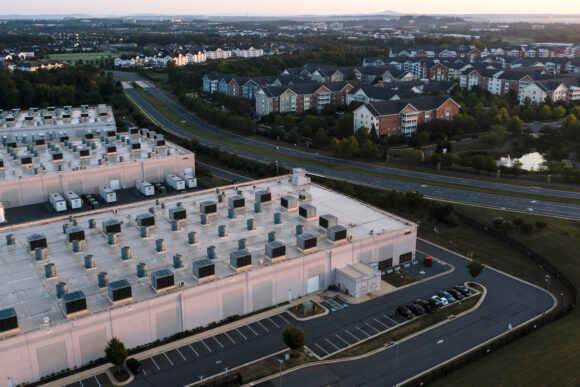
Photo: An Amazon Web Services data center in Ashburn, Virginia. Photographer: Nathan Howard/Bloomberg
Was this article valuable?
Here are more articles you may enjoy.
 Industry Reacts to Senators’ Letter for Claims Data and Recent Reports
  AI’s Water Strain Includes Surging Demand From Electricity Use
  Uninsurable Future: Managing the Climate-Change-Fueled Home Insurance Crisis
  McKinsey Rebukes Partner Who Questioned Challenges Facing Women CEOs

