

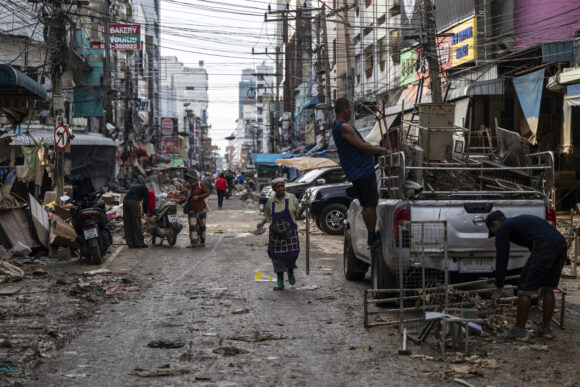
Devastating floods have killed more than 1,300 people and caused at least $20 billion in losses since late last month across parts of South and Southeast Asia, underscoring the increasing risks from climate change and extreme weather for the region’s fast-growing populations and economies.
A sequence of three tropical cyclones coincided with the regular northeast monsoon to deliver rainfall totals unseen in decades in some locations, and triggered a wave of destruction from Sri Lanka to Indonesia — damaged homes, roads and rail lines, decimated crops, slowed factory output and inundated tourist spots.
Scientists and analysts have pointed to the likely aggravating impact of climate change on the flooding, along with exacerbating factors including deforestation, failures in flood defenses and a lack of funding for disaster resilience.
“Climate change is undeniably fueling more severe flooding in Southeast Asia,” said Davide Faranda, research director in climate physics at the French National Center for Scientific Research who led a study on Vietnam’s November floods.
The risk in Southeast Asia is that “compound disasters” — when multiple extreme events strike in close succession — will occur more frequently and inflict greater damage in the coming years, according to research firm BMI, a unit of Fitch Solutions.
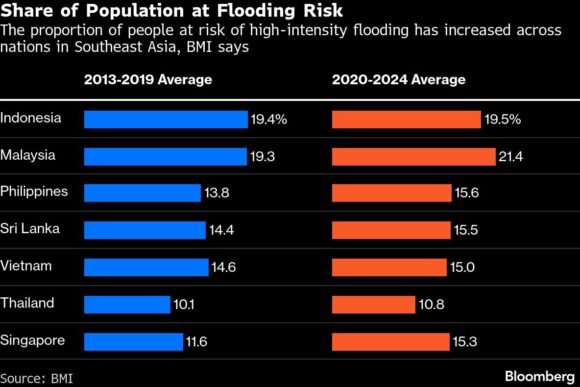
The region also has some of the largest shares of people living in areas at risk of floods: 21% in Malaysia, roughly 20% in Indonesia and around 15% in Singapore, Vietnam, the Philippines and Sri Lanka, BMI analysts wrote in a note this week.
That proportion is higher than in the mid-to-late 2010s, and “will continue to rise as global warming accelerates and populations in vulnerable areas grow,” they wrote.
Read more: Deadly Floods Hit Southeast Asia as More Rain Forecast
Countries in Southeast Asia consistently rank among the most at risk, with the Philippines, Myanmar and Vietnam among the 10 nations most affected by climate change last year, according to Germanwatch, an independent human rights organization.
Despite those risks, progress toward building climate resiliency in many countries lags other parts of the world partly because some authorities in Southeast Asia prioritized growth over planning and adaptation efforts, said Helen Nguyen, an environmental engineering professor with University of Illinois Urbana-Champaign.
“The development went so fast,” said Nguyen. “That came at the expense of the environment.”
That intersection of politics and failed efforts on climate adaptation is most acute in the Philippines, where populist anger is rising over a multibillion corruption scandal involving government funds for flood mitigation projects.
The scandal triggered a pause on infrastructure projects, dented investor confidence, and caused economic growth to tank to its lowest level in four years.
While the impact so far on industrial output from this year’s storms has been limited, the overall damage is still unclear.
The $20 billion total for last month alone is based on government and analyst estimates, which will likely be revised as total damage is assessed. Last year, seasonal floods caused an estimated $25 billion in economic losses across Asia-Pacific, according to a study by insurance broker Aon Plc.
Despite the wide regional impact, “the region’s main commercial and industrial centers appear largely unscathed,” analysts at Capital Economics wrote in a research note Wednesday, comparing the damage to the 2011 Thailand floods that hit the industrial areas around Bangkok and caused a double-digit GDP decline.
The hit to supply chains and manufacturing “is likely to be small and temporary,” though risks remain that crop losses will push up food prices, the analysts wrote. Coffee producers in Vietnam remain on track for higher production and exports, despite delays to the harvest caused by the widespread flooding.
Still, disaster response and the recovery effort will come at a significant cost for nations like Thailand and Indonesia, which have been struggling to stimulate their domestic economies without blowing out their budgets, and for Sri Lanka that’s been recovering since a 2022 default.
“While the region is accustomed to severe weather disruptions, these have increased in scale and frequency in recent years,” said Frederic Neumann, chief Asia economist at HSBC Holdings Plc.
“More and more fiscal outlays need to be diverted to harden infrastructure and build up resilience. Especially for poorer economies, this can entail difficult choices that require reductions in badly needed expenditures elsewhere,” he said.
Cyclone Ditwah in Sri Lanka, which has killed at least 465 people, could cost the economy as much as 500 billion Sri Lankan rupees ($1.6 billion), according to Udeeshan Jonas, chief strategist at CAL, a Colombo-based investment banking group. “This includes an estimated loss of output of 1% of GDP and physical damage,” he said.
In Southern Thailand, Cyclone Senyar has inflicted some of the worst flooding on record, paralyzing a key technology and tourism hub and racking up damage of more than $15 billion so far.
With the flow of high-value exports such as electronics components and auto parts practically paralyzed, the country may face additional losses of up to $400 million a month if conditions persist, Thailand’s Commerce Ministry said. Tourist arrivals will also likely be completely wiped out in the immediate aftermath of the floods, according to the University of the Thai Chamber of Commerce.
In neighboring Indonesia, the storm has killed at least 700 people and triggered flooding and landslides in Sumatra, a major producer of coal, coffee and palm oil.
Jakarta-based think tank Center of Economic and Law Studies estimates losses of over $4 billion or 0.29% of GDP, due to damage to roads and bridges, and the loss of household incomes and agricultural output.
Even prior to the November storms, Thailand and Indonesia both rolled out billions of dollars of stimulus to spur economic growth, lifting risks of straining state finances. Both nations have been battling weakening consumption and a tougher export environment from the US tariffs.
The pressure is also felt in Vietnam, which has been relatively more resilient to the trade war fallout and has become one of the region’s fastest-growing economies. Severe storms last month slowed manufacturing growth, with firms reporting delayed deliveries and faster inflation, which pushed them to raise selling prices.
Storm damage alone has cost the Vietnamese economy about $3.2 billion in losses this year, closing in on the record $3.5 billion in 2024, when the nation was hit by Super Typhoon Yagi.
Research indicates Southeast Asia is the world’s most flood-exposed region, with vast population centers in low-lying and densely built areas, said Andrew Smith, chief operations officer of Bristol, England-based flood risk intelligence firm Fathom. “As climate and demographic pressures continue to intensify, these communities face growing and increasingly unavoidable risks,” he said.
Photograph: Damages following flooding in downtown Hat Yai, Thailand on Nov. 29, 2025. Photo credit: Sirachai Arunrugstichai/Getty Images
Related:
- Vietnam Flood Deaths Reach 90 as Damage Sweeps Central Region
- Vietnam Flood Deaths Climb as Heavy Rain Drenches Coffee Region
- Typhoon Set to Swing Toward Taiwan After Ripping Philippines
- Philippine Typhoon Deaths Climb to 116 as New Storm Looms
- Typhoon Kalmaegi Kills 21 as It Pummels Central Philippines
Topics Trends Flood Climate Change
Was this article valuable?
Here are more articles you may enjoy.
 Warren, Hawley Press Insurers Over Closed, Unpaid Claims
  Agency Network SIAA Acquires MGA Canopy Specialty Insurance
  Uninsurable Future: Managing the Climate-Change-Fueled Home Insurance Crisis
  McKinsey Rebukes Partner Who Questioned Challenges Facing Women CEOs

