
As climate change makes extreme weather events more intense and frequent, “uninsurable areas” are becoming increasingly common. They are a clear demonstration that insurance – the mechanism through which modern societies deal with all kinds of risk – is structurally underprepared for this new climate era.
Uninsurable areas refer to places where property insurance has become either impossible to get or to afford. This can happen because insurers are not offering coverage in a high climate risk area (due to coverage limits or market withdrawal), or because they offer insurance at premiums so high that most residents simply cannot pay them.
One of the clearest examples of an uninsurable area to date comes from California. In 2024, State Farm, one of the largest home insurers in the United States, chose not to renew 72,000 home insurance policies across the state due, in part, to unsustainable wildfire risk.
Read more: State Farm Nonrenewing 30K California Homeowners, Renters
It was not alone, as six of California’s 12 largest insurers had already paused or heavily restricted new policies. Homeowners who can no longer find private coverage are directed to California’s insurer of last resort, the FAIR Plan, which grew from around 271,000 policies in force in 2022 to over 684,000 by March 2026, a 152% increase.
Since it offers less coverage than private insurance policies, the FAIR Plan was never intended to become a primary insurer. It nearly collapsed under the weight of claims from the January 2025 Los Angeles wildfires, and only survived thanks to a $1 billion emergency bailout.
In Europe, concern over the protection gap – meaning the share of disaster losses that insurance does not cover – is rising. According to EIOPA, the EU’s insurance regulator, 75% of economic losses from natural catastrophes in Europe have historically gone uninsured.
In Germany, the national insurance association has warned that premiums could double within a decade due to climate-driven claims. In France, the national natural disaster scheme, known as CatNat, has been running at a deficit since 2016, prompting the government to raise the compulsory surcharge on all property insurance policies from 12% to 20% in January 2025.
In short, traditional insurance is ill-equipped to confront the reality of climate change. There are, however, alternative models that could provide coverage to people most at risk.
What Mechanisms Do We Have?
Beyond conventional insurance, two instruments have emerged as tools for managing climate risk at scale. The first taps financial markets to guarantee funds before disaster strikes. The second removes the need for damage assessment entirely.
Catastrophe bonds: When insurers take on risks that are too large or too unpredictable, they pass them on to reinsurers, companies that essentially insure the insurers. Reinsurers in turn can transfer some of that risk to financial markets through instruments like catastrophe bonds, or “CAT bonds.”
Introduced in the late 1990s after Hurricane Andrew devastated the US state of Florida, CAT bonds allow reinsurers to raise money from investors upfront. This guarantees that funds are already available when a major disaster strikes, and locks in prices for multiple years.
Parametric insurance: This is coverage that pays out automatically once a pre-defined threshold is crossed (e.g. when rainfall exceeds a certain level in a given region). Because it does not require physical inspection of damage, parametric insurance is particularly useful in remote areas or developing countries where traditional insurance has low penetration.
Despite these innovations, there is still a persistent gap between the costs of climate-related disasters and what insurance will actually cover. According to a report by reinsurance company Swiss Re, 57% of global natural catastrophe losses in 2024 went uninsured.
As both insurers and reinsurers struggle to provide enough coverage for climate related events, governments have been under growing pressure to fill the gap.
Growing Role of the State
As private markets struggle to keep pace, governments are stepping in, either by subsidising insurance directly, or by creating public-private schemes that pool risk across geographic areas.
In 2016, the UK government in partnership with the private insurance sector set up Flood Re, a reinsurance pool. By pooling risk across the entire UK insurance market, the programme aims to keep flood insurance both affordable and available in high-risk areas.
However, the scheme is set to expire in 2039. This is based on the premise that the intervening years will be used to invest in flood defences and risk reduction. By the time the scheme closes, the private market will be able to price flood risk accurately without pushing cover out of reach. But there is increasing doubt as to whether that transition will be achievable.
France’s CatNat system works on a similar principle of national solidarity, but goes a step further: natural disaster cover is compulsory and automatically included in every property insurance policy in the country. Every French policyholder contributes to the scheme through a mandatory surcharge, regardless of where they live. The scheme has covered over €50 billion in payouts since 1982, but as climate losses accelerate, the system is showing signs of strain.
Similarly, the proposed EU public-private reinsurance scheme aims to pool climate-related risks together across the EU, leveraging economies of scale across a diversified range of risks and geographic areas. Modeling suggests it could reduce Europe’s protection gap from 75% to around 10%, but it would require up to €65 billion in backstop capacity from public funds to handle the most extreme events.
As these innovative solutions emerge, one thing is clear: uninsurable areas are no longer some distant future prospect. Weather-related damage has always happened, but the mechanisms we built to absorb climate risk were designed for a more stable climate. As that stability erodes, the question is no longer whether or not the public sector will need to play a larger role, but how quickly it can be redesigned to do so.
This article is republished from The Conversation under a Creative Commons license. The Conversation is an independent and nonprofit source of news, analysis and commentary from academic experts. The original article can be accessed here.
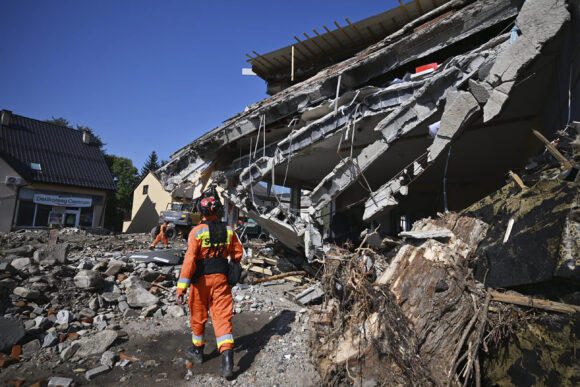
Photograph: On this handout photo provided by the State Fire Service of Poland, firefighters inspecting safety of houses following heavy flooding in the town of Stronie Slaskie, southwestern Poland, Wednesday, Sept. 18, 2024. (Tomasz Fijołek/KG PSP via AP)
Related:
Topics Europe Climate Change
Was this article valuable?
Here are more articles you may enjoy.
 Miami Project Sells $1.7 Billion of Condos Before It’s Built
  Agency Network SIAA Acquires MGA Canopy Specialty Insurance
  Hackers Breached Propulsion System of US-Bound Oil Tanker
  Gronkowski Now Pitchman for eMaxx, a Reciprocal With a Different Playbook