
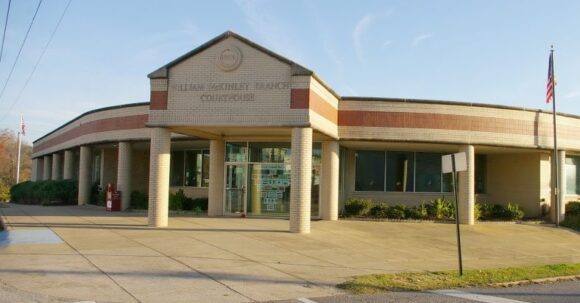
A group of 32 county workers in Greene County, Alabama, became so fed up with what they said were rats, faulty air-conditioning and a leaky roof at the county courthouse that they sued their county commissioners in 2020.
The workers said they were sickened and injured by years of neglect and infestations at the 30-year-old courthouse in the mostly rural western edge of the state.
That lawsuit has ground through the courts since then. It will continue for at least another few months, after the Alabama Supreme Court last week found that a lower-court judge cannot postpone determining if a municipal insurance fund has a duty to defend the county commission.
“…We direct the circuit court to proceed with the declaratory-judgment action to the extent that the (municipal) association seeks a determination regarding its present duty to defend the county commission in the tort action,” the justices wrote in the Aug. 7 opinion.
The Association of County Commissions of Alabama Liability Self-Insurance Fund had asked the Greene County Circuit Court judge to declare that the fund had no duty to defend the local government against the workers’ claims. The policy excludes coverage for claims for injury caused by anything that was expected; or when the insured was aware of a situation that could likely result in a claim and failed to take steps to remedy; or when the claim or lawsuit results from pollution or contamination or hazardous material on the property.
 The trial judge decided against the insurance fund in 2025, citing previous court rulings that he said barred declaratory actions if other issues in the case, such as the underlying tort claim, are already pending.
But the fund appealed, citing other court decisions, including ones involving Alfa Insurance and North River Insurance. Those precedents clearly allow a court to decide if a duty to defend is excluded, before the lawsuit is concluded, the fund’s lawyers argued.
The county commission and the workers countered that the insurance fund had waited four years to ask for a declaratory judgment, that previous court rulings cited by the fund examined only intentional acts by an insured, and that the case hinged partly on the policy’s limits of coverage, not just exclusions.
The high court sided with the insurance fund, finding that in determining an insurance company’s duty to defend, the pertinent inquiry is the nature or character of the claims or suit against the insured at that time and whether claims or suits of that sort are covered under the terms of the insurance agreement, Supreme Court Justice Tommy Bryan wrote for the court.
“A trial court can generally resolve that inquiry based on the circumstances presented without attempting to adjudicate the issue of the insured’s liability to the allegedly injured party,” the opinion noted. A declaratory-judgment action to determine the insurance company’s duty to defend can coexist alongside a pending tort action, the justices agreed.
The high court did not decide on the insurance fund’s request for a declaration that it had no duty to indemnify the county government in the claim.
The opinion is here. Other documents in the case were not available online.
Photo: The courthouse in Eutaw, Alabama, built in 1994. (American Courthouses)
Was this article valuable?
Here are more articles you may enjoy.
 Viewpoint: The ‘Unbundled’ Insurer Emerges in Age of AI as Value Chain Fragments
  Agency Duties – Legal vs. Ethical
  AI’s Water Strain Includes Surging Demand From Electricity Use
  A Timeline of Developments in AI Safety Since the Attack on Hugging Face