
Chinese authorities are urging Nestlé SA to work quickly in recalling baby formula products in the mainland over potential contamination concerns.
The State Administration for Market Regulation said Thursday that Nestlé had an important corporate responsibility to protect the rights and interests of consumers in China — which is the world’s largest formula market.
China’s comments come after the Swiss food group on Wednesday widened a recall of some baby formula products beyond Europe to Asia and the Americas, over concerns they may be contaminated with cereulide, a toxin that can cause food borne illness including vomiting.
Read more: Nestle Infant Formula Recall Widens to Africa, the Americas and Asia
The voluntary recall, which relates to batches of infant nutrition products including the BEBA and Alfamino brands, began in Europe this week after cereulide was detected in an ingredient from one of its oil suppliers. No reports of illnesses have been made, the company said on its website.
Nestlé said it has notified relevant local authorities in nearly 50 countries and it’s up to those bodies to announce public recalls. Countries that have issued public recalls so far include Germany, Australia, Brazil and China.
In a separate statement posted on Nestlé’s China website on Tuesday, the company said it’s voluntarily recalling 41 batches of baby formula products imported from Europe and sold via online channels on the Chinese mainland. It added no report of discomfort has been received but the company urged parents not to feed their children with these products.
Nestlé also recalled affected products in Hong Kong while the city’s Centre for Food Safety has conducted an investigation.
While Nestlé has yet to tally the total cost of the global recall, it does not expect a significant financial impact. The affected batches represent significantly less than 0.5% of annual group sales, Nestlé said. However, some analysts are estimating a potentially heavier impact with Jefferies suggesting the worst-case total sales risk could be as much as 1.3% of group sales, equivalent to about 1.2 billion Swiss francs ($1.5 billion).
The potential reputational risk for Nestlé could be a bigger problem, according to Jean-Philippe Bertschy, an analyst at Vontobel.
“Infant nutrition is a strategically important, high-trust category in which Nestlé holds more than 20% of the global market,” he said. “Reputational risk is our main concern rather than the absolute financial impact.”
Consumer behavior following a recall can vary by market, according to David Hayes, an equity analyst at Jefferies. “The 2013 false alarm contamination recall of Danone’s Dumex brand in China nearly wiped out about €800 million of brand sales,” he said. “When Abbott recalled some of its Similac brand in 2010 and in 2022 in the US, the brand market share recovery was achieved within about a year.”
A large-scale recall will be a further headache for Nestlé’s new Chief Executive Officer Philipp Navratil, who is trying to revamp performance at a company that has been buffeted by scandal in the past year. The executive, appointed after the sacking of Laurent Freixe for failing to disclose a romantic relationship with a subordinate, is already in the midst of cutting thousands of jobs at the company and fighting to drive up volumes and free cash flow.
Shares of Nestlé are down about 6% since news of the recall emerged. The stock rose just over 5% in 2025.
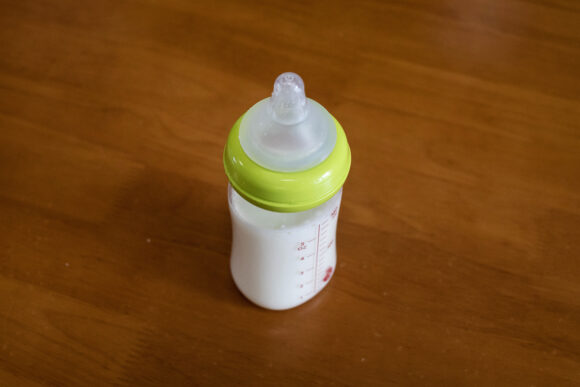
Photograph: A bottle of milk prepared from infant formula. Photo credit: Giulia Marchi/Bloomberg
Related:
Topics China
Was this article valuable?
Here are more articles you may enjoy.
 Oaktree’s Deal to Buy A-Cap Insurer Crumbles, Spawning New Talks
  Reuters: DXC in Advanced Talks to Sell Insurance Software Unit for $2.4 Billion
  Viewpoint: Beware These Commercial Auto Endorsements!
  Former Trident Reciprocal CEO Ordered to Pay $468K in Attorney and Arbitrator Fees

