

Hedge funds, banks and insurers rushed to size up their exposure to the Middle East after weekend attacks on Iran fueled chaos across the region.
Some of Taiwan’s largest life insurers, including Cathay Life Insurance Co. and Nan Shan Life Insurance Co., conducted internal reviews of their exposure to the Middle East over the weekend after news of the attacks broke, according to people familiar with the matter. Barclays Plc redeployed more than 30 people to work Sunday to cover New Zealand’s market open on Monday, which offered an early gauge of sentiment. Traders at Singapore-based Dymon Asia Capital were also awake to cover the Wellington open.
Global funds and banks still have little visibility on what comes next, after a series of missile strikes by the US and Israel over the weekend killed the country’s Supreme Leader and hit defense sites. President Donald Trump called for Iranian citizens to rise up and take over the government, raising the possibility of a prolonged period of political turmoil.
Oil jumped more than 13% at Monday’s open before giving back some of its gains, while risk currencies such as the Australian dollar and the New Zealand dollar slid. Haven assets such as the dollar and Treasuries rose in early trading but soon pared gains. Stocks in most Asian markets fell.
The heightened focus on the Middle East — and the numerous questions about what the conflict could mean for markets — prompted banks to plan a series of client calls to game out next steps.
Goldman Sachs Group Inc. will hold a call later on Monday when US markets open. Geopolitics and trading teams will cover the fallout across oil, risk assets, and emerging markets, the bank said. Speakers include Alex Younger, the former UK intelligence chief and senior leadership across key trading desks.
Chinese brokerages including Guotai Haitong Securities Co. and China Galaxy Securities Co. held conference calls over the weekend to decipher how the situation will impact capital markets and cyclical sectors, according to schedules seen by Bloomberg.
The conflict risks fueling wider questions about doing business in the Middle East, after Iran retaliated by launching its own missiles at US bases and allies around the region, including in the United Arab Emirates, Qatar, Kuwait and Saudi Arabia.
Plumes of black smoke were seen in Dubai, long the go-to venue for global banks and funds looking for a base in the region. Multiple flights were suspended after the main airport was hit by a suspected aerial strike.
“It could be a wake-up call that could have a longer-term impact on where family offices want to put their money,” said Patrick Yip, Asia vice chair at Mishcon de Reya LLP. “Some of our clients can’t even leave Dubai given the airport is closed. They are afraid for their safety. They had never thought that possible in Dubai.”
Barclays didn’t immediately respond to a request for comment. Cathay Life and Nan Shan Life declined to comment.
Buy the Dip
Some investors remain sanguine about the wider fallout, in part because pressure on Iran has long pushed the country to the sidelines of the global trading system.
“My instinct would be to sell anything except oil that goes up too much — gold comes to mind — and buy anything that falls too much,” said Stephen Diggle, a former hedge fund manager whose Artradis Fund Management Pte made billions from the global financial crisis. “This shouldn’t be a big disruption. Iran is a big country but a small economy and one that has been semi-detached from the world for some time.”
The impact could be bigger on Asian markets. Around 80% of oil and gas transported through the Strait of Hormuz goes to Asia, while China was the largest buyer of Iranian oil with a 90% share, Michael Langham, emerging markets economist at Aberdeen Investments, wrote in a note.
“China is obviously most exposed to long-term disruption of Iranian supply,” Diggle said. “It’s also the most exposed to long-term problems in the Strait of Hormuz. So I’d probably reduce my China exposure a little.”
With the greater Asian reliance on Gulf energy, an obvious trade would be betting on increasing volatility of Asian currencies against the dollar, he added.
The long-term impact depends in part on whether the attacks lead to a prolonged spike in oil. That adds another source of uncertainty to a global market that is already muddling through Trump’s shifting tariff agenda and broader questions about the impact of artificial intelligence.
Traders and portfolio managers at Taiwanese insurance firms were cautious ahead of Monday’s open, given the sector’s significant overseas exposure. They are assessing potential swings in oil prices and the knock-on effects for bond yields, according to a person familiar with the matter.
Taiwanese financial holding companies’ exposure to major Middle East countries was about NT$1.6 trillion ($51 billion) as of December, according to the island’s Financial Supervisory Commission. The insurance sector is most exposed to the region due to their bond investments.
On Saturday night, Dymon Asia Capital’s senior executives jumped on a call to work out what to do if the conflict spiraled into full-on war. Deputy Chief Executive Officer and Managing Partner Kenneth Kan, who like most Singaporean men had served in the country’s armed forces, helped draft guidelines that were eventually sent to staff across the region.
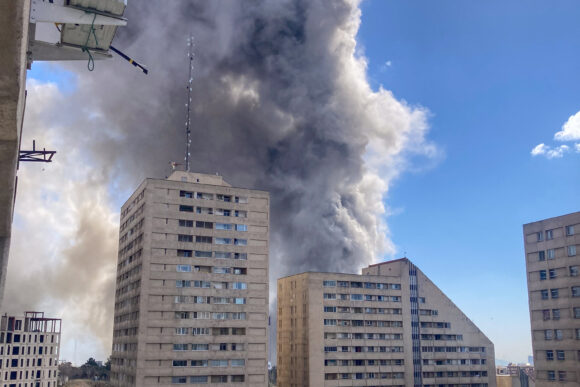
Photograph: Plumes of smoke rise following reported explosions in Tehran on March 1, 2026; photo credit: Fariba/AFP/Getty Images
Topics Carriers
Was this article valuable?
Here are more articles you may enjoy.
 Reuters: DXC in Advanced Talks to Sell Insurance Software Unit for $2.4 Billion
  Florida AG Says His Office Investigating ‘Anti-Public Adjuster’ Endorsements in Policies
  Chubb Q3 Net Income Down Slightly on More Catastrophe Losses
  Report: Auto Insurance Total Loss Frequency Climbs, More Drivers Pay Repairs

