

The Ebola outbreak probably started months ago in central Africa and spread undetected until a super-spreader event in early May, possibly a funeral, World Health Organization officials said.
The rare Bundibugyo strain circulated for “a couple months” before being identified in blood samples on May 15, Anaïs Legand, WHO’s technical lead for viral hemorrhagic fevers, said at a briefing Wednesday. The first confirmed death took place April 20, and experts used social media posts to reconstruct the recent progress of the virus after the super-spreader event on May 5.
Two factors complicated efforts to identify the virus earlier. Authorities used tests for a different Ebola strain, resulting in false negatives, and many symptoms can resemble those of malaria, according to Abdirahman Mahamud of the agency’s Health Emergencies Program.
The delay has complicated efforts to contain the outbreak, especially since there are no specific tests, treatments or vaccines for Bundibugyo. The most promising experimental shot will probably take six to nine months to be available for clinical trials, the agency said.
The WHO has tallied almost 600 suspected cases and 139 deaths linked to the outbreak in the Democratic Republic of Congo and Uganda.
“We expect the numbers to keep increasing given the amount of time the virus was circulating before the outbreak was detected,” WHO Director-General Tedros Adhanom Ghebreyesus said. Tedros has warned of the danger posed by the “scale and speed” of the outbreak so far.
The actual number of cases may exceed 800, according to an analysis by researchers at Imperial College London and the WHO, and could be as high as 1,000 in a worst-case scenario.
A WHO technical advisory group met on Tuesday to discuss which potential vaccines should be prioritized. Two vaccines for Ebola were developed during a years-long outbreak in West Africa a decade ago, one from Merck & Co., and another from Johnson & Johnson. However, both were designed to block the more common and deadly Zaire strain of the virus.
The most promising potential vaccine for the Bundibugyo strain is similar to the Merck shot, said Vasee Moorthy, a WHO senior advisor. Doses will probably take as long as nine months to be available for clinical trials, he said. The International AIDS Vaccine Initiative said in a statement Wednesday that it’s working to raise funds for this investigational rVSV Bundibugyo vaccine candidate. The vaccine candidate did not come from Merck, an IAVI spokesperson said.
Another shot, built on a University of Oxford platform, could be ready within two to three months, but there’s no animal data yet to show how promising it could be, he said.
Serum Institute of India, a vaccine maker, said it’s working with the University of Oxford and the Coalition for Epidemic Preparedness Innovations on the second shot. The Indian company said that thanks to a master sample from Oxford, it would be able to begin producing doses within 20 to 30 days.
Still, because of the battery of tests needed before a new vaccine can be given to humans, getting clinical trials under way will probably take many months, CEPI Chief Executive Officer Richard Hatchett said in an interview.
“We’re back to where we were in 2014 to 2016 with no specific treatment and no specific vaccine,” said Joanne Liu, a professor at McGill University’s School of Population and Global Health. Liu, former president of the humanitarian organization MSF, helped lead the response to the West Africa outbreak.
With so little in health authorities’ toolboxes, it might make sense to offer one of the existing vaccines to health workers, she said. There is some evidence from a study in monkeys that the Merck shot, while not designed around the Bundibugyo strain, might provide at least some degree of protection, she said.
“It’s so much to ask of people,” she said, noting that the Bundibugyo strain has a 30% to 50% case fatality rate. Offering the vaccine might help health workers want to work in the outbreak, she said.
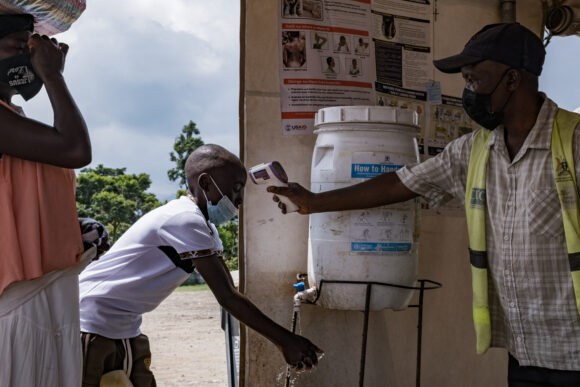
Photograph: A border health officer checks a traveler’s temperature in Bundibugyo, Uganda, on May 18, 2026; photo credit: Badru Katumba/AFP/Getty
Was this article valuable?
Here are more articles you may enjoy.
 Union Pacific Railroad Fined $304K for Firing Employee During Severe Weather
  Industry Reacts to Senators’ Letter for Claims Data and Recent Reports
  Hordes of Teens on E-Bikes Force Suburbs to Rewrite Road Rules
  Agency Network SIAA Acquires MGA Canopy Specialty Insurance

