

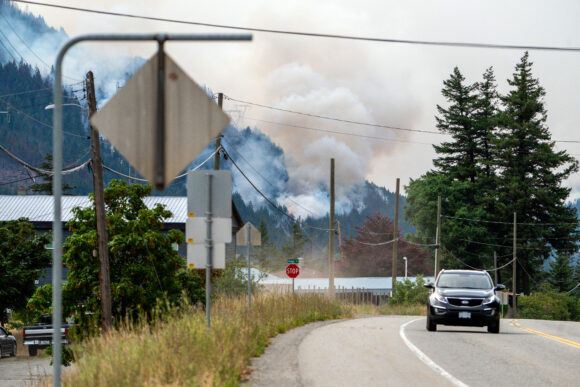
The planet’s warming had a strong influence on destructive wildfires in Canada that have raged across Ontario and the Northwest Territories since late June, making the extreme fire weather that fueled them at least twice as likely, according to a report published Thursday by World Weather Attribution.
With global temperatures roughly 1.4C above pre-industrial levels, Canada is experiencing a notable rise in extremely hot and dry weather — the ingredient required to turn minor ignitions into infernos.
Researchers found that the severe conditions behind the recent blazes in Ontario are now twice as probable as they would be in a world untouched by human-caused greenhouse gas emissions. The change is even more stark in the Northwest Territories: There, a week of fire weather as extreme as this year’s — which would occur once-a-decade without global warming — is now estimated to return every two years.
Doubling of the likelihood is “really bad,” said Friederike Otto, a professor in climate science at Imperial College London and a coauthor of the study. Given the immense challenge of containing wildfires, “even if just a little bit worse, it would mean that everything is even stretched further,” she said.
The findings come as Canada endures another catastrophic burn season. More than 4,000 fires have been recorded nationwide so far this year, scorching a collective area roughly the size of Switzerland — a nearly 45% increase over the 30-year average spanning 1994 to 2023. Ontario and the Northwest Territories have been hit the hardest.
Canada is part of a global pattern. Recent blazes across France, Spain, Portugal and Greece forced hundreds of thousands of people to evacuate, while earlier this year, fires in Chile and Argentina claimed at least 20 lives and devastated wide swaths of Patagonia.
Read more: Global Wildfire Surge Hits US, Propelled by Rising Temperatures
While wildfires play a natural role in forest renewal, the rising frequency and intensity of these outbreaks pose a huge threat. Blazes endanger communities and infrastructure, overwhelm local response capacity and send unhealthy smoke plumes across international borders. In recent weeks, Canadian smoke has drifted deep into the United States, turning skies over New York City a surreal orange and prompting President Donald Trump to threaten tariffs over the air pollution.
As millions of acres of woodland burn, vast stores of carbon dioxide are released back into the atmosphere, accelerating warming.
To quantify the effect of climate change on Canada’s wildfires, the study’s authors leveraged observation data and climate models to compare how the events would have unfolded in a world without warming. They also used an index that reflects how difficult it is to suppress a fire once ignition occurs and examined changes in rainfall, as drought can precede wildfires.
“Our research is yet another piece of evidence for this shift being due to climate change,” said Theodore Keeping, a research associate at Imperial College London and another coauthor of the study. “The geographic spread of these fires is scary and shows that despite preparedness from wildfire governance, adaptation alone is not enough.”
Photograph: The Brunswick Creek Wildfire from Boston Bar, British Columbia, in July 2026; photo credit: James MacDonald/Bloomberg
Topics Canada Climate Change
Was this article valuable?
Here are more articles you may enjoy.
 How One Hacker Used AI Agents, a Few Thousand Dollars to Break Into Websites
  EU Cyber Agency Warns Websites May Go Dark as PHP Prepares Critical Fix
  World’s Largest Retirement Community Set to Borrow $180 Million for More Homes
  Chubb CEO Greenberg: Industry Has to ‘Put Arms Around’ AI Liability

