


Insurers will help maximize their return on AI investments by adopting an enterprise-wide strategy, rather than just focusing on select and segmented areas, which splits the ownership and investment, according to research from Accenture.
“AI capability remains concentrated in small groups, with limited enterprise-wide upskilling across underwriting, claims, actuarial and operations,” said Accenture, the tech consulting firm, in its report titled “How insurers drive revenue by deploying AI with intent.”
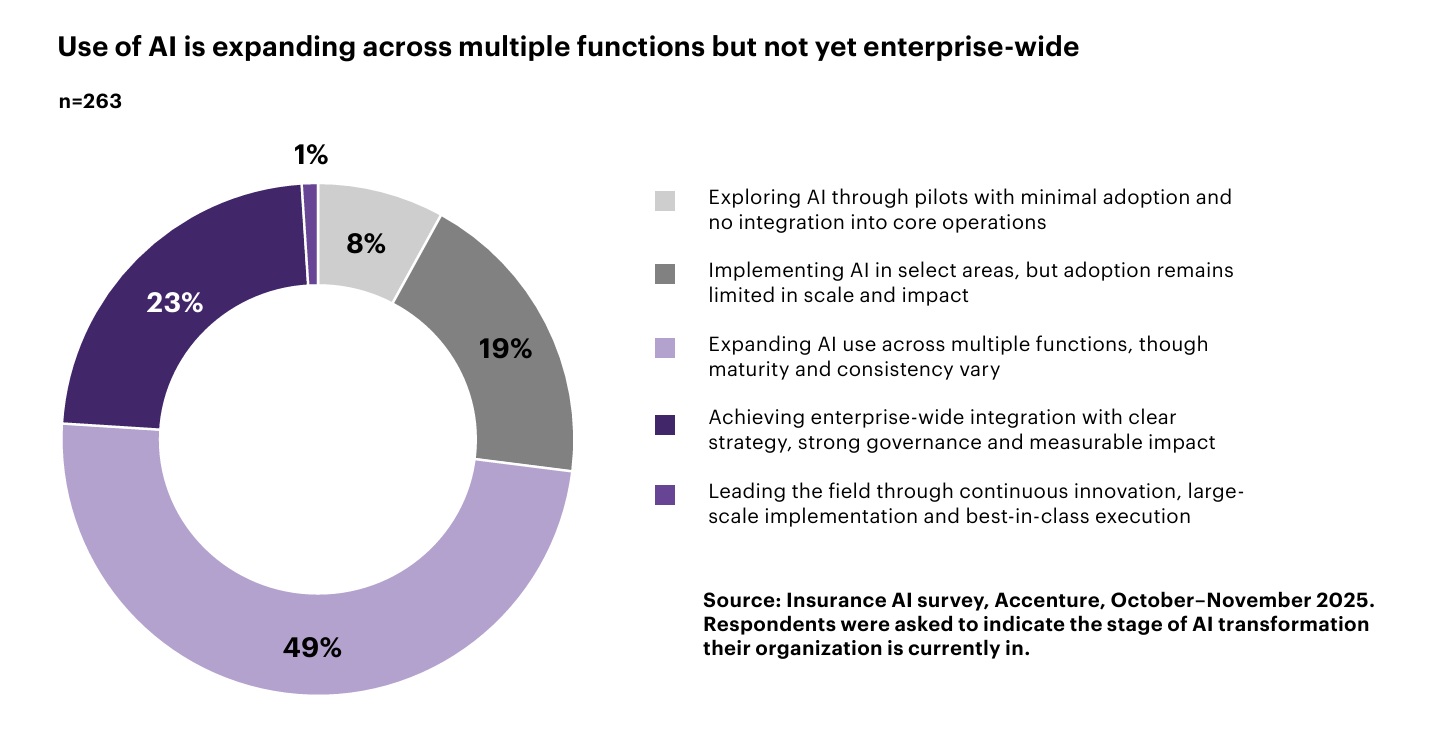
The report noted that fewer than one in four (23%) insurers have achieved enterprise-wide integration of AI deployment. In most cases, the enterprise as a whole is missing out, said the report, suggesting that it’s time for companies to take a more “holistic approach” to their AI investments.
“Doing so would drive revenue growth, business expansion and productivity targets far more purposefully…,” the report found.
“For example, sharpening pricing models or streamlining underwriting improves performance locally—but without feeding those insights into distribution, product design and cross-sell strategies, insurers forgo the compounding growth effect that comes from linking risk intelligence directly to revenue decisions.”
By orchestrating AI across a company, it is possible to find connections among initiatives and anchor “every activity to measurable business outcomes,” the report said.
Accenture explained that organizations that scale AI effectively, aiming to drive enterprise-wide gains, “will bring new products to market faster.”
“They will operate with more productive and AI-literate workforces. They will build capabilities that are embedded across the enterprise, making them harder to replicate,” the report continued. “Ultimately, the advantage will not come from adopting AI, but from how deliberately it is scaled across the business.”
“[I]nsurers need to move away from an ‘AI everywhere’ approach toward one that deploys ‘AI with intent’ to reinvent the business,” the report said.
“Our research shows that while AI is already delivering real revenue gains for insurers, most are leaving value on the table,” said Ravi Malhotra, Global Insurance Industry Lead at Accenture, in comments accompanying the report.
“They need to shift from isolated pilots to enterprise-wide intelligence – treating AI not as a technology program, but as a driver of growth, with clear links from strategy to execution to create measurable P&L impact,” he continued.
Revenue Gains
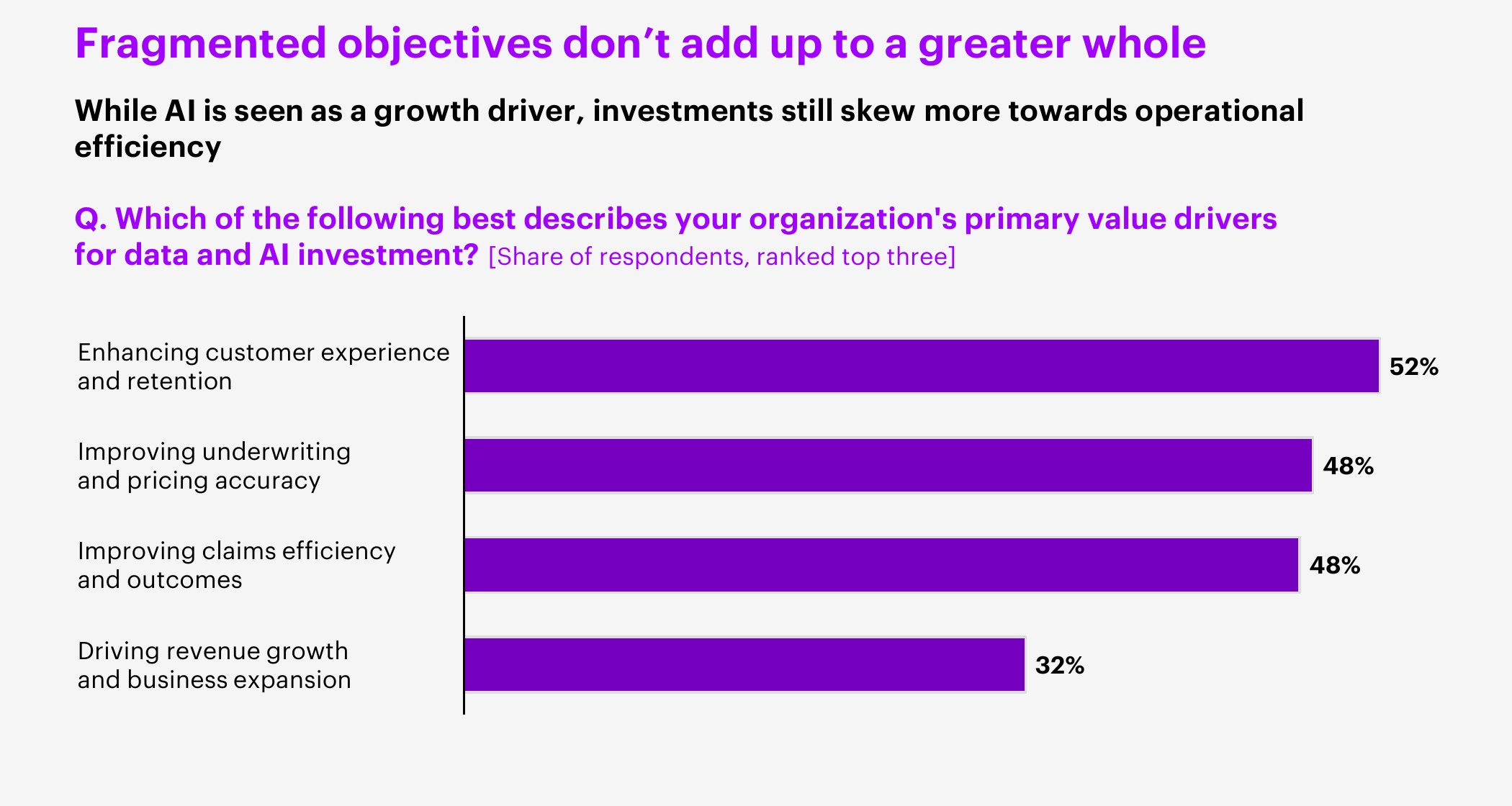
Even with the current, more common, fragmented approach, AI still is providing insurers with improved results, particularly in the area of revenue growth, the report said.
Accenture noted that 81% of insurers surveyed are seeing at least a 5% improvement in gross written premiums from AI and data initiatives, while 7% have achieved improvements of more than 20%, “driven by better pricing, personalization and cross-selling.”
“In fact, 85% of the 218 C-suite leaders we surveyed in the insurance industry across 20 countries now believe revenue growth is becoming a more significant benefit of AI for their organizations, up from 68% two years ago,” the report affirmed.
Accenture went on to suggest five actions that companies can take to improve their AI implementation. (An Accenture infographic containing this section can be viewed here).
- Align AI deployment to the business strategy to ensure it directly supports enterprise-wide goals. Most organizations continue to separate AI strategy from execution. So, while business leaders define and set their AI ambitions, “delivery sits largely within data, AI and technology teams,” Accenture said. “The organization offers abundant training, but not necessarily the training that helps people use AI proactively to meet business goals. Ownership of the technology therefore splits, and so does investment.”
- Expand AI skills across the workforce to combine technical and business knowledge. “AI has captured leadership mindshare faster than any technology in decades, but most organizations haven’t redesigned work, metrics or mindsets to capture the value. As a result, adoption races ahead in some cases, but value creation lags.”
- Evolve the talent ecosystem to include people-led, agent-to-agent workflows. “For insurers, AI agents that act with initiative represent a significant shift, transforming them from reactive service providers into proactive, intelligent enterprises,” Accenture said. “However, the future of insurance does not hand over the reins to AI. It requires people thoughtfully leading agent-to-agent execution. Autonomy without oversight creates risk and the trust challenge remains.”
(Editor’s note: According to AWX, Amazon’s cloud-computing platform, an AI agent is “a software program that can interact with its environment, collect data, and use that data to perform self-directed tasks that meet predetermined goals. Humans set goals, but an AI agent independently chooses the best actions it needs to perform to achieve those goals.”
- Adopt a two-speed data strategy to modernize legacy systems while supporting AI technologies. “Legacy data and fragmented systems still undermine AI ambitions,” which means that scaling requires enterprise-level rewiring. Accenture explained that its research shows that 50% of insurers cite legacy integration as the primary challenge affecting the deployment of AI at scale, followed by access to sufficient high-quality data (45%). “That’s why companies need a two-speed strategy where short-sprint wins unlock growth and deliver immediate efficiency gains while the organization builds enterprisegrade capabilities over the longer-term for sustained value creation.”
- Formalize a proactive compliance mindset to turn ethical design into a competitive advantage. “Regulators are increasing scrutiny of algorithmic bias, explainability, pricing fairness and the use of external data in underwriting and claims. Insurers that formalize governance early—through transparent model documentation, human oversight, auditability and ethical design—can turn trust into a competitive differentiator.”
Methodology
Accenture AI report is based on a survey of 263 senior insurance executives (89 property/casualty, 100 life and annuity, and 74 multi-line companies) who have direct accountability for AI, data, technology and business transformation. In addition, 15 in-depth interviews were conducted with industry executives from Asia Pacific (Dai-ichi), Europe (Admiral, Allianz, AXA, Generali, Munich Re, Zurich) and North America (Liberty Mutual, MetLife, New York Life, Progressive, State Farm, The Hartford, Travelers).
Topics InsurTech Data Driven Artificial Intelligence Carriers
Was this article valuable?
Here are more articles you may enjoy.
 Eastern States’ Grocers Shut Online Systems After Cyberattack
  Banking Watchdogs Ramp Up AI Scrutiny as Stability Fears Mount, Sources Say
  Industry Reacts to Senators’ Letter for Claims Data and Recent Reports
  KCC Says Isaias Insured Losses to Be $3 Billion; AM Best Calls Storm an Earnings Event

