

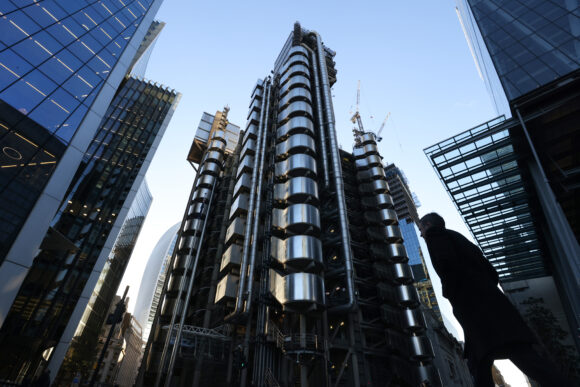
Lloyd’s of London is restructuring the way in which it oversees the insurance market as part of its new chief executive officer’s plan to make the risk hub more efficient.
The firm is bringing all elements of oversight, including governance, performance, reserving and syndicate-level capital setting, into a single performance and oversight function led by Rachel Turk, according to a statement Wednesday. Caroline Sandeman-Allen, chief of market oversight, will be leaving Lloyd’s next year.
“Most of the people that operate in the Lloyd’s ecosystem operate within Lloyd’s and also within another regulated jurisdiction,” Chief Executive Officer Patrick Tiernan said in an interview. “So we’re trying to make it more simple for them to operate across the duality of the oversight regimes.”
The move may lead to a “low-teen” number of roles being eliminated, he said.
The changes are the latest measures by Tiernan, who took over as Lloyd’s CEO last year, to improve the operations and competitiveness of the world’s biggest hub for commercial and specialty risk.
In March, the former Aviva Plc executive revealed a new five-year strategy for the centuries-old institution, which included an ambition to boost its share in the $1 trillion commercial insurance market as well as attracting more third-party capital.
Earlier this year, Lloyd’s scrapped a large-scale digitalization initiative called Blueprint Two, saying the technology its market participants use has become much more advanced since the project kicked off in 2020. The corporation said it will continue to work with underwriters to simplify processes, set common data standards and modernize its technology.
On Wednesday, Lloyd’s said it will introduce a “global functional model” to provide greater consistency in how it works in all its offices around the world. The so-called capital modeling and aggregation teams, which monitor accumulated risks and calculate how much capital Lloyd’s needs, will report to Chief Financial Officer Jim Bichard.
Lloyd’s also hired Jacob Palmer from Boston Consulting Group as chief strategy officer.
Tiernan stressed that it was important that Lloyd’s is making the organizational changes when prices in some commercial insurance lines are falling.
“We’re doing this in order to strengthen our oversight and governance of the managing agencies, not to lighten it,” Tiernan said, referring to businesses that underwrite risks at Lloyd’s on behalf of insurers.
In September, Lloyd’s said it saw losses arising from the Middle East conflict amounting to about £1.4 billion ($1.9 billion), its first estimate of the US-Iran war’s impact. The market reported overall pretax profit of £3.5 billion in the six months through June, a 17% drop from the same period a year earlier.
Read more: Lloyd’s Reports Improved Combined Ratio on H1 Underwriting Profit of £1.9B
Lloyd’s broader push to “let capital meet risk” is very positive for the market, said Richard Watson, founder and CEO of insurer Inigo. “Even if we don’t always welcome increased competition or capital, I’d rather this was going on in London and in Lloyd’s than in Bermuda or somewhere else.”
Photograph: Lloyd’s of London; photo credit: Hollie Adams/Bloomberg
Topics Excess Surplus Lloyd's London
Was this article valuable?
Here are more articles you may enjoy.
 Study: 75% of Ex-NFL Players Who Died Between 2008 and 2023 Had CTE
 Erie CEO NeCastro Steps Down Early; Bolash Named Interim Leader
 FTC, States Allege Toast Software Burns Restaurants and Consumers
 Father and Son Charged With Running ‘Chop-Shop,’ Selling Stolen Cars, Insurance Fraud


