
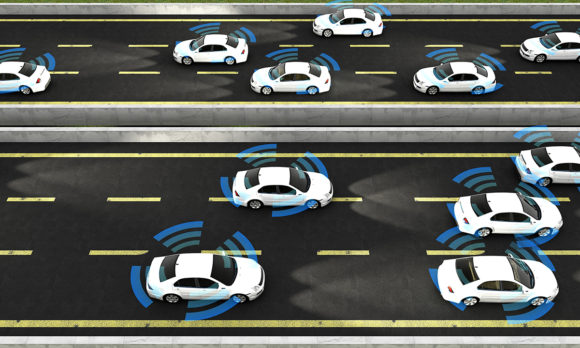
Federal lawmakers have begun to discuss numerous pieces of legislation focusing on the evolving automobile industry, with legislation addressing consumer data rights, parts and repair, pedestrian safety, driver-assistance technology and even catalytic-converter theft.
In preparation for a hearing Jan. 13, insurance industry trade associations sent letters to the U.S. House Committee on Energy and Commerce’s subcommittee on Commerce, Manufacturing, and Trade with comments on each of the proposed bills—all of which appear to have initial support of the industry except one regarding the deployment of autonomous vehicles (AVs).
The bill, known as the SELF DRIVE Act, attempts to establish a federal role in the oversight of safety and data regarding autonomous vehicles, and to ensure the U.S. “successfully compete(s) against communist China,” according to subcommittee chairman Gus Bilirakis, R-Fla.
Bilirakis said China is “seeking to flood the world” with its self-driving technology and, “We cannot let America fall behind.” He said, “AVs are not just a luxury; they can be a lifeline. By reducing human error, which causes the vast majority of crashes, we can prevent tragedies before they happen. AVs can also empower seniors and people with disabilities to be mobile and regain their independence.”
The bill was first introduced in 2017 and is now written as a discussion draft, sponsored by Rep. Bob Latta, a Republican from Ohio, and Rep. Debbie Dingell, a Democrat from Michigan. However, the trade associations are wary of language that may infringe on state insurance requirements or the use of data by some third parties, including insurers.
The American Property Casualty Insurance Association (APCIA) told the subcommittee it opposes the bill’s passage “as currently written” because some language in the SELF DRIVE Act preempts state laws. The National Association of Mutual Insurance Companies (NAMIC) said it is hopeful to work with the bill’s sponsors to avoid potential conflict.
“While the bill makes no direct references to insurance, we are very concerned with the vague and broad nature” of a certain section within the measure that would prohibit “any law, rule, regulation, requirement, standard, or other provision” that limits automated driving systems so long as the manufacturer satisfies other safety provisions.
“This could infringe on authority around legislation, licensing, operation, and even insurance requirements that we believe are most appropriately left with the states,” NAMIC said.
While it supports the protection of rights protecting cybersecurity, privacy, and intellectual property, APCIA said these goals “must be balanced with equally important goals of safety and the insurability of changing risk profiles presented by the technology. Third parties (insurers), need access to vehicle data to meet these goals.”
Legislation supported by APCIA and NAMIC include:
- REPAIR Act (HR 1566) – Guarantees consumer and independent repairer access to vehicle data and tools, fostering a competitive repair market.
- DRIVER Act (HR 6687) – Empowers vehicle owners with control over their data and strengthens privacy protections.
- AV Safety Data Act (HR 4376) – Improves transparency through mandatory reporting on autonomous vehicle safety performance.
- Driver Technology and Pedestrian Safety Act (HR 3360) – Commissions a study on the effects of driver-controlled technology.
- Safe Streets for Everyone Act of 2026– Updates standards for crash avoidance and pedestrian safety technologies.
- ADAS Functionality Act (HR 6688) – Establishes guidelines for advanced driver assistance systems to reduce repair costs and improve safety.
- PART Act (HR 5221) – Addresses catalytic converter theft with traceable identifiers to reduce crime and claims costs.
*list provided by APCIA
Was this article valuable?
Here are more articles you may enjoy.
 EU Cyber Agency Warns Websites May Go Dark as PHP Prepares Critical Fix
  Insurer Rolls Out Policy to Protect Data Centers Against Growing Backlash
  Chubb Q3 Net Income Down Slightly on More Catastrophe Losses
  Chubb CEO Greenberg: Industry Has to ‘Put Arms Around’ AI Liability