
The clock struck midnight on the National Flood Insurance Program—again.
The NFIP is part of the federal funding package, which expired at the end of Jan. 30. Congress did not compromise on several issues, namely funding for the Department of Homeland Security, so the NFIP was among a group of agencies set to lapse.
 A lapse means no new federal flood insurance policies sold or renewed. The Federal Emergency Management Agency (FEMA), administrator of NFIP, will still make payments for claims using available funds.
Editor’s note: Story updated Feb. 2 to reflect the lapse had commenced with the government shutdown, which had yet to end as of late afternoon Feb. 2)
NFIP was reauthorized until the end of this month when federal lawmakers ended a 43-day government shutdown mid-November 2025.
Reports circulated late last week that Republicans and Democrats are possibly moving toward a deal on the federal budget to avoid another shutdown, which would reauthorize NFIP once again. But talks stalled.
The program has been reauthorized more than 30 times since 2017. Prior to its most recent reauthorization, NFIP was reauthorized in March 2025, shortly after FEMA borrowed $2 billion from the U.S. Treasury to cover NFIP claims—many from hurricanes Helene and Milton in 2024. At the time, FEMA said losses from 2024 “depleted the NFIP’s funds generated from premiums to pay claims.”
Related: FEMA to Borrow $2B to Pay Flood Claims After Hurricanes Helene and Milton
Prior to the government shutdown last October, organizations representing insurance and multiple other industries sent a letter to Congress to urge action on NFIP, including a longer-term reauthorization.
“Americans deserve certainty and stability in the flood insurance marketplace so that they can protect their homes, businesses and loved ones,” the organizations said in the letter to leaders of the House and Senate. The American Property Casualty Insurance Association, National Association of Mutual Insurance Companies, The Council of Insurance Agents and Brokers, Independent Insurance Agents & Brokers of America, Reinsurance Association of America, and Wholesale & Specialty Insurance Association signed the letter.
Sam Whitfield, APCIA’s senior vice president of federal government relations and political engagement, said it is pushing for extension until Sept. 30.
“Homeowners can’t afford another lapse in the NFIP,” he said. “When the NFIP expired last year, homebuyers were stuck, real estate deals stalled, and an estimated 1,300 home sales a day were disrupted. Congress must act now to ensure uninterrupted flood coverage for millions of families and keep housing markets stable.”
The Private Insurance Option
After the October 2025 shutdown, insurance industry rating agency AM Best contemplated an opportunity for private flood insurers. According to AM Best, NFIP has about 4.7 million policies covering residential properties, providing about $1.3 trillion in coverage. However, a newer rating plan and improved analytics and modeling have allowed private insurers to underwrite the risk. About a decade ago, private insurers held about 13% of the market, based on direct premiums written. In 2024, private insurers’ share was around 27%, with typically a better loss ratio than NFIP, AM Best noted.

Trevor Burgess, CEO of Neptune Flood, told Insurance Journal that the private company used the last NFIP lapse as “an opportunity for Neptune to serve the needs of the American public.”
“It also was an opportunity for us to meet and onboard a large number of agents who had never really looked into or thought about any alternative other than the NFIP,” Burgess said. Agents need no specialized training or authorization, he added.
Burgess explained that the private flood insurance marketplace is rapidly evolving. It wasn’t until relatively recently that banks could accept private flood insurance as an alternative to NFIP. The insurance is required for homeowners in a designated flood plain with a mortgage. About 1,400 property sales per day are impacted if NFIP lapses, according to the National Association of Realtors (NAR).
“If you’re an agent who maybe doesn’t sell flood insurance as frequently, hey, the NFIP was doing a fine job for you because it’s been there forever and that’s all you needed,” he said. “But more and more agents are questioning whether or not the NFIP is really going to be there for them.”
The last shutdown could have been more of an opportunity for private flood insurers but banking regulators waived the requirement for flood insurance—in the middle of hurricane season. Homeowners were supposed to go back and get the insurance once NFIP reopened, but it’s “up to the banks to enforce and it’s after the closing,” Burgess said.
“I’m not sure why the federal banking regulators waived that, but they really didn’t need to,” he added. “It was just luck that a lot of bad things didn’t happen. The market has evolved enough that private flood is ready, willing, and able to pick up the balance. It tells you that the federal banking regulators maybe don’t yet realize how robust the private flood market is.”
Burgess said Neptune runs 20,000 quotes a day and provides a price to 95%. After starting slowly, today Neptune has more than 275,000 customers, all acquired from the use of artificial intelligence in the company’s underwriting. “We have no human underwriters,” Burgess said. Better policy terms and conditions—such as temporary living expenses—can be offered, with higher limits than NFIP’s $250,000. Neptune goes up to $7 million in limits.
“Every one of those 20,000 quotes a day goes through our algorithms and does the risk selection, the pricing, and ultimately the placement of those risks with one of our global insurers,” he explained. “The technology behind what we’re doing is really what has enabled us to be as successful and serve the marketplace in the way that we can. We’re not just selling flood insurance in low risk areas. We’re selling flood insurance in every state in this country. We’re selling in the high risk flood zones every single day.”
Burgess claims that consumers save money with Neptune 65% of the time. The insurer is more expensive than NFIP 30% of the time and the remainder doesn’t qualify for a Neptune policy.
“My joke is if Neptune says, no, you should move. And I really believe that,” Burgess said.
Related: Americans Are Moving Out of Flood-Prone Neighborhoods
A View From Both Sides
Mark Damico is president and COO of Torrent Technologies, the U.S. flood insurance services unit of Victor Insurance. The business supports carriers that participate in the NFIP, and provides private flood insurance offerings.
“There’s been a share shift going on from NFIP to private for some time,” he told IJ during an interview shortly after the last lapse. “That’s not new. We did see that accelerate a little bit during the lapse.”

Damico said Torrent bills out 90 days in advance when a shutdown looms. They sit with pending applications in “hiatus mode,” and then “there’s a real rush” when the switch is turned back on.
“We do make sure that we’re communicating out to the agents that they can use private—that private is still operating,” Damico said. “[Agents] understand these private products are all still available and we’re seeing a number of them sell. So there’s an acceleration. Did we double volume? No, but there is an acceleration of that share shift.”
Agents drive the behavior of the consumer, and some are “very good at giving [consumers] the best alternative risk management,” he said. Others sell what is maybe more familiar even though NFIP “isn’t the easiest product to sell.”
“It’s more questions. It’s actually more cumbersome, honestly, on the agent to sell the NFIP than it is the private,” Damico said. Still, flood insurance “is not a lead product for them and they’re not going to jeopardize their homeowner sale for the flood.”
Damico also pointed out the product differences—living expenses, cover for basement contents or other structures, and less wait time. Plus, buyers can add private insurance on top of NFIP’s $250,000 limit for residential properties. He said the private option is more cost effective 60% of the time. There are new players in the marketplace and increased capacity from traditional providers, he has observed.
Creativity can be an advantage for the private market. Torrent has launched a new product to combat the rigidness of NFIP to “meet consumers where they are.” It is a “low risk, low limit, low cost solution,” Damico said.
Homeowners in certain flooding areas that aren’t required to get NFIP’s full replacement cost insurance could get what they need at lower cost. Coverage might be purchased for the occasional flooding of a basment, for instance.
“You can create that in the private market,” Damico said. “There hasn’t been a lot of that creativity to date, but this is what we’re starting to push forward.”
“The risk is increasing. It’s not decreasing,” he added. “We see it all the time—inland flooding. It’s not just coastal and hurricanes. They’re way more of the rivers overflowing and major activity happening with climate change where that risk is substantially more. Today, 96% of the homes in the U.S. are not covered, do not have flood coverage.
“The whole idea is close the flood insurance gap so that people are protected better.”
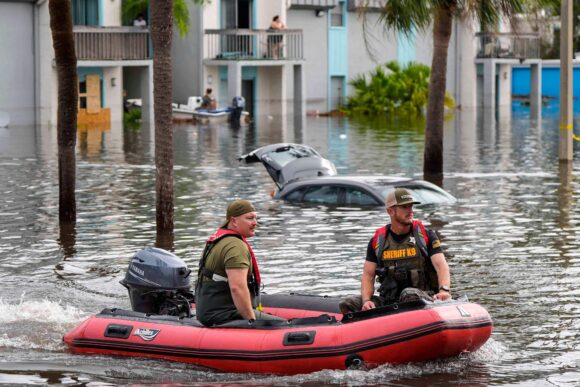
Photo: A water rescue boat moves in floodwaters at an apartment complex in the aftermath of Hurricane Milton, Oct. 10, 2024, in Clearwater, Fla. (AP Photo/Mike Stewart, File)
Was this article valuable?
Here are more articles you may enjoy.
 Reuters: DXC in Advanced Talks to Sell Insurance Software Unit for $2.4 Billion
  Home Insurance Tops Property Taxes in Squeeze for US Households
  How One Hacker Used AI Agents, a Few Thousand Dollars to Break Into Websites
  Florida AG Says His Office Investigating ‘Anti-Public Adjuster’ Endorsements in Policies