

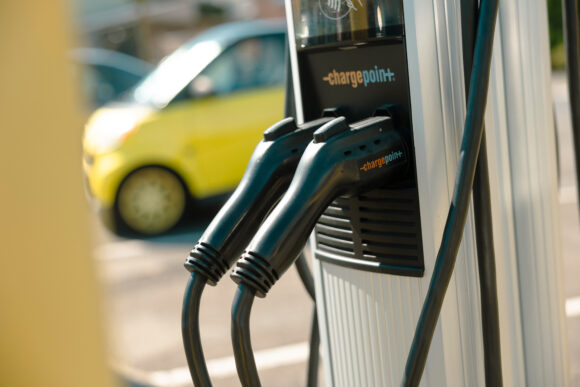
Despite the plunge in US electric vehicle sales, it appears there’s a critical enough mass to sustain the companies building public charging infrastructure.
ChargePoint Holdings Inc. posted a 7% increase in sales in the last quarter of 2025, even as new EV sales fell by nearly 40% compared to the year-earlier quarter.
“A lot of people get fixated on the new EV sales,” ChargePoint Chief Executive Officer Rick Wilmer said. “But what really drives our business is not only new EV sales, but the cumulative number of EVs that are on the road.”
There are now roughly 5.8 million EVs zipping along American roads. With drivers increasingly relying on public charging, companies are racing to install more stations.
EVgo Inc. is another company expanding its network. The firm aims to build up to 1,650 new slots to charge electric cars in the US this year, which would be 38% more than it installed last year.
“We’re actually really excited about this year,” CEO Badar Khan said to investors on Tuesday. “I think it’s a year of really ramping up.”
US chargers have become more reliable and far faster, which encourages more people to use them, according to Paren, a data platform focused on EV infrastructure. Charging networks added about 11,300 ultra-fast cords across the US last year, up 48% from 2024. And the high-speed buildout is only accelerating: In the fourth quarter, nearly one in four new chargers were capable of pumping at rates of 250 kilowatts or more, which can typically add 100 miles of driving range in less than 10 minutes.
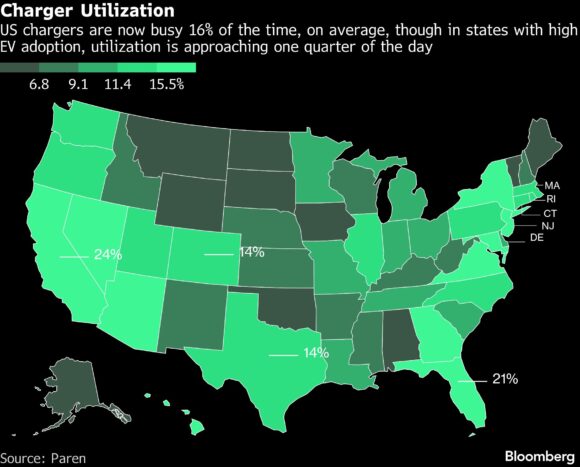
Despite the uptick in the number of chargers and their ability to sling electrons faster, the average US charging station is still fairly busy most of the time.
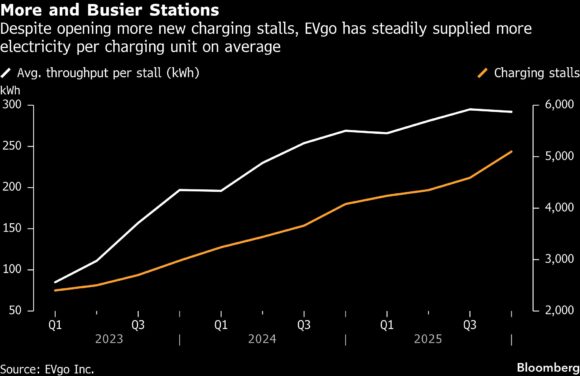
The number of charging cords in the EVgo network has roughly doubled in the past three years. Yet each cord, on average, has steadily pumped more electrons in a given period.
Paren expects the US to add slightly more chargers this year than last. “At some point, you would expect that the infrastructure would be growing so much that the utilization would go down,” said Bill Ferro, Paren co-founder and chief technology officer. “But we obviously aren’t there yet.”
To be sure, swooning EV sales complicate the road ahead for charging companies. Needham analyst Chris Pierce calls it an overhang, the type of bearish signal that drove shares of both ChargePoint and EVgo down this week despite their upbeat earnings calls. Both stocks are wallowing near historic lows.
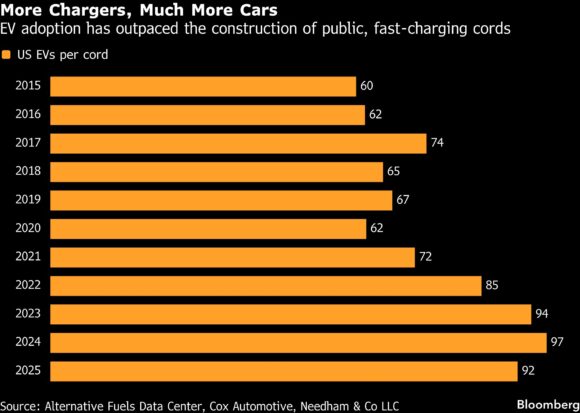
However, Pierce said charging results can continue to improve even with slumping car sales. “There are already too many EVs for too few fast charging stations,” he said.
EVgo expects that only 10% of its revenue this year will come from relatively new electric cars and trucks.
What’s more, EV prices are drifting lower and the used market is booming, including among cost-conscious consumers who don’t have a private driveway or garage for charging. Meanwhile, rideshare drivers and autonomous taxi fleets are still electrifying quickly, a stable and growing source of demand for charging stations.
Ferro, at Paren, is keeping an eye on surging gas prices due to the war in Iran and a suite of new affordable electric SUVs, factors that could yet swing sales away from internal combustion engines.
“There’s room to grow,” he explained. “The [charging companies] we talk to are not building for 2025 or 2026; they’re building for 2035. They may slow down their deployment, but they’re still going to deploy.”
Topics Auto
Was this article valuable?
Here are more articles you may enjoy.
 Isaias: 47,000 Claims and $582M in Losses in Florida So Far, OIR Reports
  Alabama Pharmacy, Not Agent, at Fault for Not Reading Policy Before $5M Judgment
  How One Hacker Used AI Agents, a Few Thousand Dollars to Break Into Websites
  All in the Family: Husband, Wife and Daughter Indicted for Insurance Fraud and Bribery

