

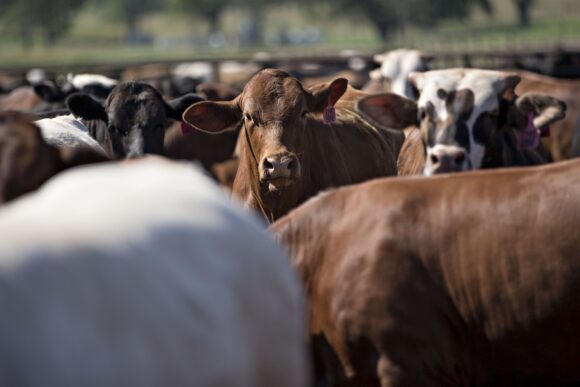
The US Department of Agriculture is racing to contain the deadly New World screwworm after a case was detected in Texas, where a broader outbreak could threaten an already-small domestic cattle herd.
The flesh-eating parasite was confirmed on Wednesday in a three-week-old calf in South Texas, marking the first detection in the US in nearly a decade. The screwworm’s presence in the country has the potential to significantly disrupt the US meat industry, while creating the latest obstacle to the Trump administration’s efforts to tackle record-high beef prices.
The key to preventing a bigger outbreak will depend on fencing in the screwworm fly, which has been gradually spreading north through Mexico over the past year. The agency is implementing quarantines, movement controls and surveillance in a 20-kilometer (12-mile) zone around the detection site in Zavala County.
Agriculture Secretary Brooke Rollins said on a Thursday call with reporters that there were no other infested animals on the ranch where the case was confirmed, and that there is no evidence of recent movement of animals onto or off of the premise.
“This fly typically moves great distances because humans move animals, not because the fly flies to new areas,” Rollins said on a late Wednesday call. “This is a really important point. The only way this spreads is through animal movement. It’s not because the fly flies tens of miles or hundreds of miles on its own.”
Zavala County is close to the US’s southern border and not part of the main cattle-producing areas of Texas, yet it still has a prominent livestock industry with an estimated 37,000 cattle. Texas, the US’s largest cattle producer, had 12.1 million cattle as of January — about 14% of the US herd.
The screwworm disease, while treatable in animals and posing no threat to food safety, still poses a “logistical problem” that could reduce cattle supplies if more movement restrictions and quarantines are put in place, said Ben DiConstanzo, a senior analyst at Walsh Trading Inc. The fly is “like a roach,” he said. “If there’s one, there’s a heck of a lot more.”
The parasitic fly lays its eggs in the wounds of warm-blooded animals. After hatching, the larvae burrow into living tissue causing severe damage and, if untreated, potentially death.
The US has already blocked live cattle shipments from Mexico for much of the past year due to the New World screwworm’s presence, adding to supply tightness for US beef processors and consumers at a time when the domestic herd is already at a 75-year low.
Those companies, including Tyson Foods Inc. and JBS NV, have faced losses in their beef businesses and resorted to closing plants amid high cattle prices that they’ve struggled to pass fully through to consumers. Shares in Tyson, the US’s largest meatpacker, closed down moderately Thursday, while JBS’s US shares gained.
The Meat Institute, the industry group representing meatpackers, said in a statement that it will look to the USDA “to brief industry stakeholders and call on them to consider allowing low-risk terminal movements for slaughter to ensure animals continue to be processed.” That includes animals headed straight to slaughter that don’t come from infested zones or are raised indoors.
Strategy firm Capstone DC said in a note that it expected additional cases to emerge, “putting more upward pressure” on beef prices. The case could prompt import bans on American beef, creating losses for meatpackers, vice president Nicolas Moscoco-Roman and senior associate Grace Feitel said. The US beef industry only recently managed to regain access into China, a key market that had previously suspended licenses for most US beef plants in 2025 amid a trade dispute between the two countries.
The last screwworm cattle outbreak in 1976 affected nearly 1.5 million head in Texas, impacting the state’s economy by as much as $375 million, according to the USDA. That would equate to about a $1.8 billion hit today, though that estimate assumes “a full infestation and that we were going to have to completely stop all movement” of cattle for a long period of time, which the USDA does not currently see any signs of, Rollins said.
The previous outbreak was resolved by sterilizing flies with radiation and distributing them broadly to limit the screwworm’s reproduction. The USDA in Texas has completed a facility to disperse sterile flies and is building the only US-based plant for the production of those flies. It is expected to produce 100 million flies per week by November 2027, adding to existing production from plants in Mexico and Panama. Four million flies are being released to the affected area in Texas per week, according to Thursday’s call.
The US Food and Drug Administration had already issued emergency authorization for several screwworm treatments, including those made by Elanco Animal Health Inc. and Zoetis Inc. The US is flying some of its so-called national veterinary stockpile to Texas, Rollins said.
Elanco Chief Executive Officer Jeff Simmons said in an interview that the company has a “sufficient supply” for an outbreak on par “or even worse” than in Mexico.
With the screwworm case now in the US, ranchers in Texas are gearing up to take on a threat they’ve been told is on the horizon for months.
Donnell Brown, a fifth-generation cattle rancher, has stocked up on aerosol spray to treat screwworm infestations, and is considering shifting his calving season to colder months when the screwworm will have a harder time spreading.
He said if the pest reaches his Throckmorton ranch, which sells about 800 bulls a year and operates 5,000 acres, he will give calves DuraMectin, a deworming medicine, to protect them through the vulnerable newborn stage.
Declining ranch workforces add to the challenge for small cow-calf operations, which will need to increase hands-on surveillance of herds to monitor for infestations.
“We don’t have the labor force that we once had,” said Stephen Diebel, co-owner of Diebel Cattle Co. in Victoria, Texas. Diebel, who is also president of the Texas & Southwestern Cattle Raisers Association, said he has been working on educating ranchers to prevent and respond to screwworm, which he says will be necessary until the USDA’s sterile fly production reaches 500 million to 700 million flies per week.
Photo: Daniel Acker/Bloomberg
Topics USA
Was this article valuable?
Here are more articles you may enjoy.
 AM Best: Social Inflation Drives Surge in Commercial Auto Liability Claims
  Storm Austen Will Be Stronger Than Forecast Along UK Coasts
  Chubb CEO Greenberg: Industry Has to ‘Put Arms Around’ AI Liability
  Reuters: DXC in Advanced Talks to Sell Insurance Software Unit for $2.4 Billion

