

Orbital data centers chasing unlimited solar power and boundless real estate increase the risk of potentially catastrophic conflict in space — just as militaries worldwide embrace artificial intelligence and see computing facilities as critical infrastructure.
On the ground, government server farms are highly protected and can be buried to make them more resilient to attack. Iranian airstrikes targeted data centers across the Middle East, and Ukrainian attacks in recent days destroyed several in Russia, highlighting their perceived value.
In space, the facilities would be vulnerable to missiles, jamming, cyber attacks and directed-energy weapons. Defending them is costly, yet a successful physical attack could choke a crucial orbital band with debris.
“Anything of value that you put up in space increases the potential payoff of attacking space infrastructure,” said Bleddyn Bowen, author of Original Sin: Power, Technology and War in Outer Space and an associate professor of astropolitics at Durham University in the UK. “We’d rather not have a shooting war in space because we’d all lose quite a lot.”
The US Space Force said in a statement it “maintains a range of capabilities to protect and defend U.S. space interests, if directed by appropriate decision-makers and consistent with applicable law, policy, and established authorities.”
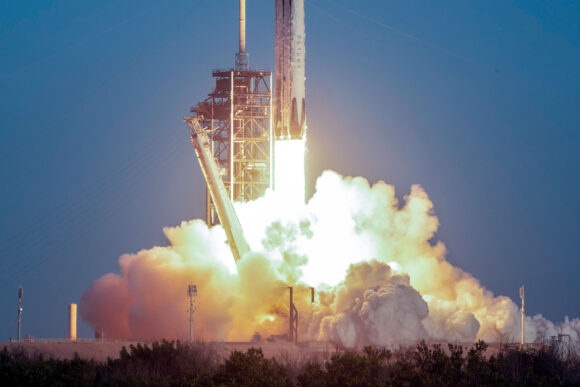
On Oct. 2, a SpaceX rocket carried a data center test satellite for Alphabet Inc.’s Google into orbit as operators on the ground hunt ever-increasing levels of computing power to fuel AI development. Blue Origin LLC founder Jeff Bezos also expressed enthusiasm about the idea, with his company filing paperwork with the US Federal Communications Commission to operate more than 50,000 such satellites.
SpaceX Chief Executive Officer Elon Musk, whose company has been getting an increasing share of US national security and defense contracts, has said he envisions as many as 1 million orbital data centers.
Although that number might not be realistic — given that operating data centers in orbit presents plenty of more prosaic challenges, such as cooling — even putting a fraction of those in the skies would pose a military defense problem, said former Harvard University astrophysicist Jonathan McDowell, who tracks launches and orbital debris.
The US, China, Russia and India have tested ground-based anti-satellite weapons. The Space Force said last month it placed an operational weapon in orbit but declined to say what it was.
“If you outsource a lot of your missile defense targeting to these data centers, for instance, then that makes them very much military targets,” McDowell said. “Kinetic anti-satellite weapons could directly target a data center. The other possibility is the vulnerability to jamming.”
The worst-case scenario, he said, would be missile attacks against space-based centers that create enough debris to make those orbital areas unusable.
Data centers would most likely use a sun—synchronous orbit over the Earth’s poles to stay constantly in sunlight, said Victoria Samson, chief director for space security and stability at the nonprofit Secure World Foundation. That type of orbit is also used by many imaging satellites.
Axiom Space Inc., a US startup that’s designing orbital data centers, said its systems were built around the assumption they’d be military targets, and “security is a design requirement for orbital compute, not an add-on.”
Philip Johnston, chief executive officer of Starcloud Inc., which also aims to develop data center satellites, said he saw them being less at risk in space than on the ground. The sheer number would distribute operations enough where destroying a few would have little effect, he said.
Although the risk of orbital debris and escalation would be enough to dissuade major space powers from a kinetic attack, a nation with less to lose in orbit might not have such qualms.
“If all this seems a little half-baked and not very well thought through, that’s because it’s completely half-baked and no one has thought about it at all,” said Jeffrey Lewis, a distinguished fellow at the Foreign Policy Research Institute based in Philadelphia.
Photo: A SpaceX Falcon rocket launch. Photographer: Joel Kowsky/NASA/Getty Images
Was this article valuable?
Here are more articles you may enjoy.
 Alliant Insurance Acquires New Hampshire’s Melcher & Prescott
  A Timeline of Developments in AI Safety Since the Attack on Hugging Face
  Two Past Hurricanes, OIR Data Give Idea of What to Expect From Isaias in Florida
  Gulf Coast on Alert for First Hurricane of 2026

