

In late 2024, Gretchen Holloway was approved for a new federally funded program that promised to cut her $900 utility bills by helping repair her nearly century-old home.
For years, the retired teacher in Valley, Alabama, had been trying to hold together the house where she’s lived her entire life, but her pension and Social Security income weren’t enough. Floors had collapsed. One bathroom no longer worked. Gaps around doors and windows let air pour in and out, sending her heating and cooling costs soaring.
The program offered a way out. It was going to “help me get my home in order,” she said.
Within months, it was gone.
A Biden-era initiative known as Community Change Grants steered funding from the Inflation Reduction Act into struggling communities. But after President Donald Trump returned to office in 2025, his Environmental Protection Agency moved to cancel roughly $1.6 billion in previously awarded grants, including the one Holloway was counting on.
The decision has implications far beyond one Alabama town, halting projects across the country meant to help communities stem pollution and be prepared for climate impacts — just as energy costs are rising sharply.
For those who helped shape the program, the impact is clear.
“Millions of people today should be living in safer, healthier, more resilient and more economically prosperous communities,” said Matthew Tejada, a former environmental justice official at the EPA. “And they’re not.”
“Since day one, President Trump has made American energy dominance a top priority,” EPA Press Secretary Brigit Hirsch said in a statement. “That agenda is helping drive down the cost of living for American families. EPA is proud to be delivering on this in a way that is accountable to American taxpayers and delivers real results.”
Hirsch said that the cancelled grants represented “a radical agenda of wasteful DEI programs and ‘environmental justice’ preferencing” that President Joe Biden’s administration had imposed on the agency.
Like Holloway, many Americans contend with the challenges of living in aging or inadequate housing. Roughly 50% of the country’s homes were built before 1980, according to the National Association of Home Builders, before energy-efficiency construction codes were widespread, while millions live in much older or substandard dwellings. The energy demands are a burden on low-income homeowners, who struggle to afford repairs to roofs and windows that would make their homes more airtight and moderate their bills.
Those bills are increasingly hard to pay. US utilities disconnected residential electric and gas service about 15 million times in 2024 and issued over 100 million shutoff warnings, according to the U.S. Energy Information Administration. The problem, the agency said, is particularly acute in the South.
Read More: Soaring Electric Bills Stoke Voter Fury Ahead of Midterms
And it may get worse soon. Analysts predict that cooling costs will rise again this summer, pushing the average seasonal bill to $778, an 8.5% increase over last year. Forecasters say an El Niño weather pattern is likely to form this summer, a shift that tends to push global temperatures higher in the months that follow.
The Community Change Grants were designed as a long-term solution.
Launched by the EPA in 2023 through its Office of Environmental Justice and External Civil Rights, the program encouraged local governments, nonprofits and community groups to apply together for projects that could deliver multiple benefits at once.
Demand quickly overwhelmed the available funding. By the time applications closed in 2024, roughly 2,700 groups had requested more than $40 billion. The EPA selected just over 100 projects around the country.
In western Alaska, Native villages proposed replacing costly diesel generators with solar-and-battery microgrids. In Evansville, Indiana, which has persistent air-quality problems, officials wanted to expand electric bike sharing and EV charging to reduce pollution. And in Gullah Geechee communities in Brunswick County, North Carolina, there were plans to remove lead pipes, restore wetlands and invest in nature-based solutions to improve water quality and reduce flooding.
Valley and neighboring Lanett are just the kind of communities the grants were meant for. Lanett is named for the founders of the textile mill that anchored the local economy for more than a century before closing in 2006. When the jobs disappeared, many younger residents left as well, said city councilman and lifelong resident Charles Bagley. What remains is an aging population living in houses built for mill workers generations ago. “Ever since the mill closed, it left our area in a pretty deplorable condition as it relates to finance,” Bagley said.
The area’s winning proposal was the work of a 12-organization coalition led by Groundswell, a nonprofit that builds local clean power projects, and partners including Circle of Care, which assists families with jobs and housing. For Michael Lowe Weiss, development director at Circle of Care, it took months of outreach to convince residents the opportunity was real.
“There’s a lot of skepticism,” he said. “You’re asking people to believe that something is finally going to reach them.”
In late 2024, the coalition was awarded a $20 million grant to repair roughly 500 homes in Alabama and West Georgia — replacing windows and doors, sealing gaps and upgrading systems to bring down energy bills that many residents could no longer afford.
The plan also called for installing solar and battery systems to create 10 “resiliency hubs,” including one at a senior center in Lanett, so residents could gather there and tap backup power during outages after storms — which are increasingly common with extreme weather juiced by climate change.
With funds fully obligated, practical work began in early 2025. The greatest concern was finding enough local contractors, according to Michelle Moore, the chief executive officer of Groundswell.
As with many federal grants, the funding was structured so recipients would spend money first and then be reimbursed. Even after Trump was elected, organizers expected the federal government to honor its commitments.
Instead, the EPA, with Elon Musk’s Department of Government Efficiency, announced plans to cancel the grants in March 2025 as part of a rollback of environmental justice programs, saying it was reviewing spending and eliminating initiatives it viewed as unnecessary and corrupt. The move was one of many in the administration’s broad assault on climate-related work and science, with mass firings, regulatory reversals and program closures across agencies.
Read More: How Trump’s War on Climate Science Impacts All Americans
“It is our commitment at EPA to be exceptional stewards of tax dollars,” EPA Administrator Lee Zeldin said at the time.
A subsequent review by the EPA’s Office of Inspector General found no problems with how Community Change Grants had been awarded, concluding the agency had followed required procedures.
Legal challenges to the cancellations of individual Community Change Grants are underway, with some plaintiffs arguing they are unconstitutional because they violate Congress’s authority over federal spending. In most cases so far, courts have not ruled on the merits of that argument, directing plaintiffs instead to seek monetary relief from the U.S. Court of Federal Claims. However, at least one judge has ordered some grants reinstated.
Moore says her group is still weighing whether to sue. When she first got the termination letter, she thought she could change minds through the EPA’s administrative appeals process. Trump promised to cut energy bills by 50% and her program would help with that, she reasoned.
But now the group has exhausted that process without anything to show for it, a fact Moore finds dispiriting.
“Breaking a contract is an enormous breach of trust,” she said. “But the loss might be greater than that — it might be the loss of the one thing these families still own, the roof over their heads.”
Karen Hill, a former medical administrator in Lanett, had dismissed the energy efficiency program at first, but research and local meetings convinced her it was real. In person and on Facebook, she urged others to sign up. “I started beating the drum: ‘Hey, this is available to us,'” she said.
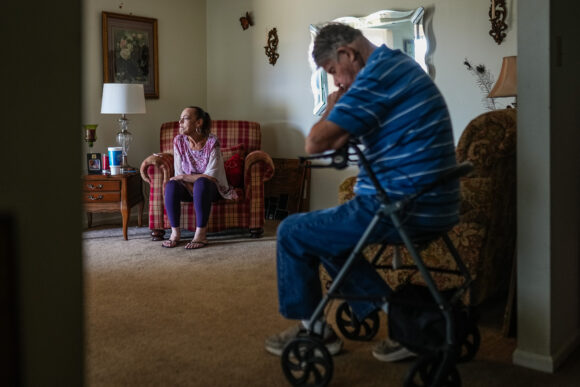
Hill and her husband, who has dementia, live on about $1,200 a month in Social Security, in a home that is slowly separating at the foundation. Repairs are far beyond what they could afford. So, frequently, are their utility bills. With air sneaking through the cracks in the foundation and just about everywhere else, the cost came to $800 for one month after a cold spell earlier this year.
When the program was halted, Hill was upset and felt she had let others down by promoting it: “They’re looking at me, saying, ‘See, I knew that would fall through.'”
The repairs Holloway hoped for never materialized, either. Her bills remain high. Now she’s trying to fix her house piece by piece, with whatever she can manage.
Photo: Karen Hill and her husband at home in Lanett, Alabama.(Elijah Nouvelage/Bloomberg)
Topics Homeowners
Was this article valuable?
Here are more articles you may enjoy.
 Florida Injury Lawyer Suspended After Murder-for-Hire Arrest in 2021 Case
  Large Commercial Property Rates Drop 14.5% in Q2 to Highlight Latest Willis Report
  Zurich Insurance Completes Acquisition of Beazley, Names New Beazley CEO
  No Lights, No Radio: Getting Oil Through Strait of Hormuz Is a Risky Job

