

Joseph McCue came to Florida expecting to do even better than he was in New York City working as an electrician.
He had a job lined up at a hospital construction site in Orlando, and the combination of zero state income tax and nice weather made the move seem worthwhile. The 45-year-old New York native figured once he got settled in, he could buy a house and bring his wife and three children to the Sunshine State.
But the job fell through. Three months later, Mc Cue — who was making nearly $250,000 in New York — hasn’t even been able to land work in a lower-paid position at Walmart Inc.
“I think I gave it enough time,” he said. “Instead of being with my family every night, I’m down here in this rat race where everybody is just trying to make ends meet.”
McCue’s experience offers a cautionary tale for the once red-hot Florida economy, even as the likes of billionaire Ken Griffin’s Citadel, Wells Fargo & Co. and Palantir Technologies Inc. continue to grab headlines with high-profile corporate relocations to the state.
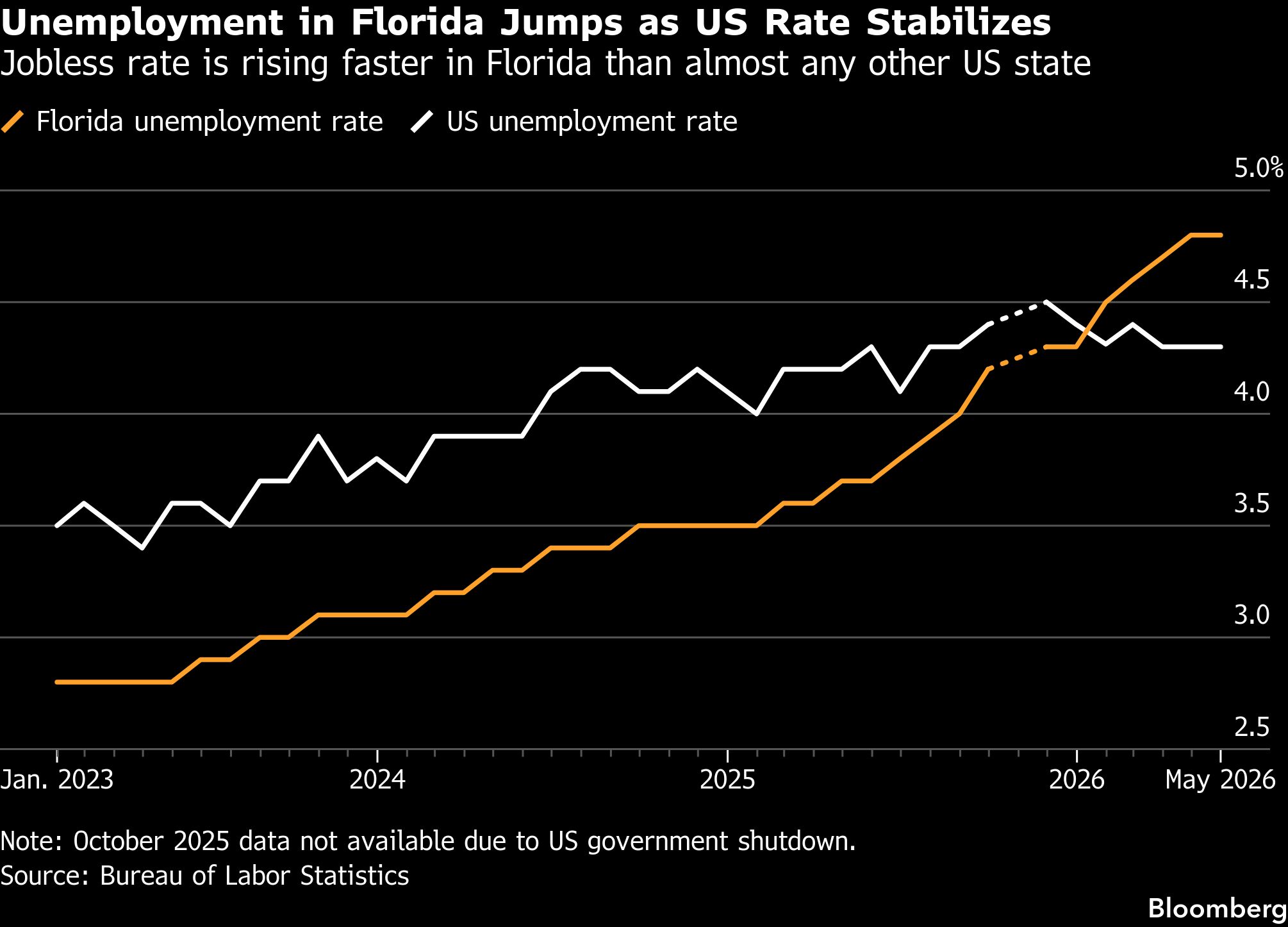
While the US unemployment rate has seen little change over the past year, joblessness in Florida has surged. It’s climbed more than a percentage point to 4.8%, faster than nearly any other state, and is now among the highest nationwide. Job growth has slowed to a crawl amid a pullback in key industries like real estate, retail and tourism, all of which are highly sensitive to interest rates and consumer demand.
That marks a reversal from Florida’s run as a magnet for workers and retirees coming out of the pandemic, when its economy was one of the hottest in the US. It also raises questions about the viability of the state’s growth model as a rising cost of living starts to send would-be Floridians elsewhere.
“By the way its economy is set up, Florida just tends to be more cyclical than the US economy as a whole,” said Jesse Wheeler, a senior macroeconomic analyst at Revelio Labs. “It shares the trends of the US but it tends to exacerbate them.”
Rapid population growth in the wake of the pandemic led to a surge in new construction and sent home sales soaring, stoking demand at everything from furniture stores to restaurants. That’s helped fuel almost a million new jobs in Florida since 2019, making it second only to Texas.
But the tide has turned amid worsening affordability problems, a surge in immigration enforcement and a slowdown in tourism. Net domestic migration to Florida totaled just 22,517 people in the year through July 1, 2025, according to Census Bureau figures, less than a tenth of the peak recorded in 2022. And Visit Florida, the state’s official tourism bureau, says the number of visitors fell 1% in the first quarter of 2026 from a year earlier.
“We’re highly dependent on tourism and retail,” said Howard Frank, a professor of public policy and administration at Florida International University. “If people aren’t going out to eat, if people aren’t going to Disney, if people are cutting back on discretionary expenses, well, Florida will be hit quite hard.”
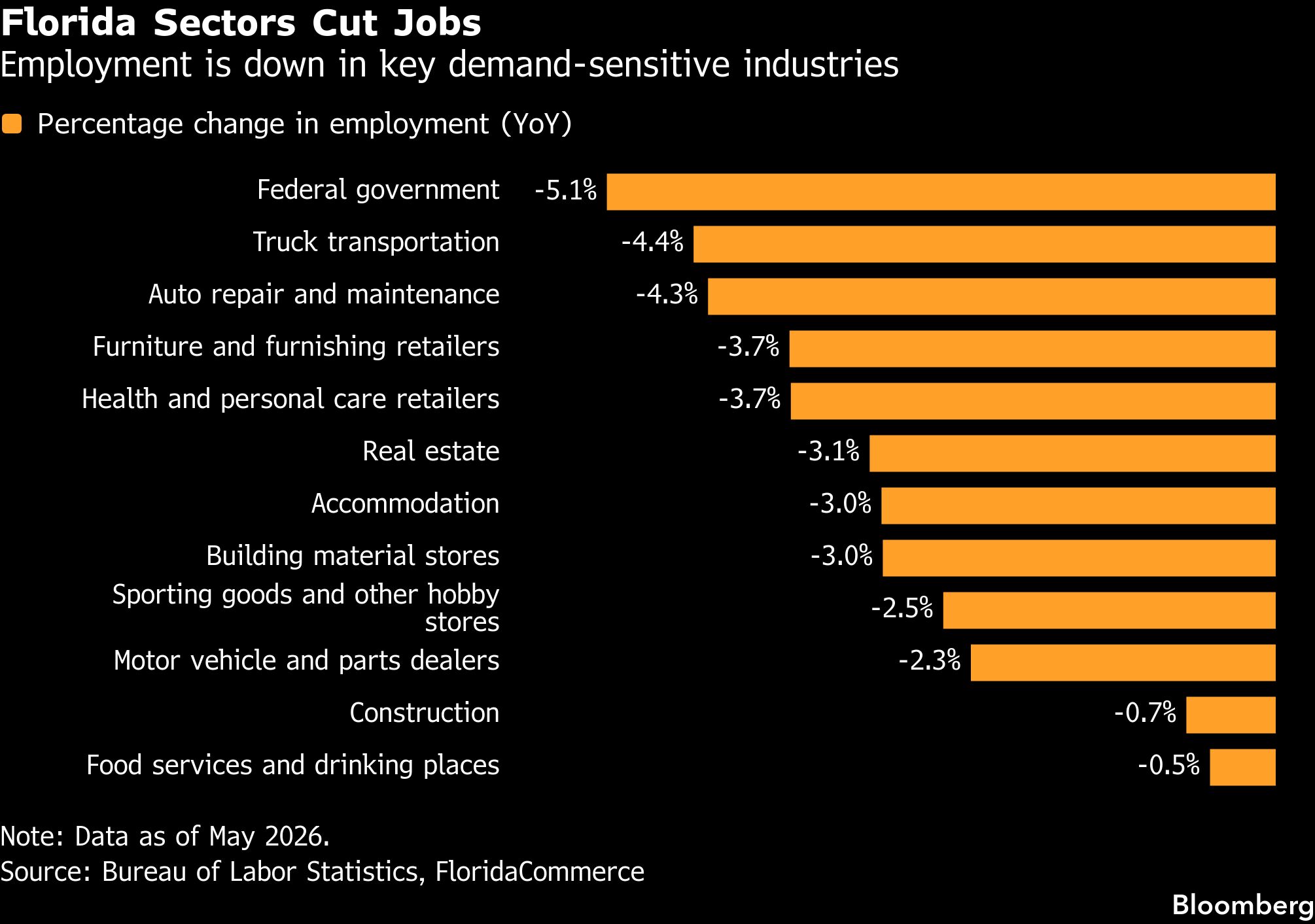
Some of the most consumer-facing sectors have been among those recording the biggest job losses over the last year: Employment at furniture stores fell 3.7%, while real estate employment was down 3.1% and headcount in accommodations declined 3%.
At the Spanish restaurant La Tremenda in the Miami area, Sharell Ledezma has cut staffing levels by about a third since 2024. Ledezma — who operates in an area with a large immigrant population — said that in addition to rising prices, stricter immigration enforcement is also keeping some customers away.
“When there’s uncertainty, the first thing you take out of your budget is going out to restaurants,” said Ledezma, who currently has 15 employees.
With the money she’s saving on labor costs, Ledezma is investing in other aspects of the business that she hopes will ultimately help boost demand. One example: She bought two big screens in a bid to attract soccer fans during the FIFA World Cup, an investment she says is paying off so far.
The lack of job opportunities in the Sunshine State is likely to become front-and-center ahead of this year’s midterm elections, especially as it threatens to exacerbate what was already one of the worst cost-of-living crises in the nation.
Top Republicans like Senator Rick Scott have begun sounding the alarm on the labor market, especially after Democrats made gains in recent special elections in the state. Floridians will elect Ron DeSantis’ successor as governor in the November vote and choose representatives in several open House races following a state-wide redistricting push meant to help Republicans.
Scott, who also served as governor from 2011 to 2019, said additional tax benefits could encourage business formation and put job creation back on track.
“We are competing against other states and other countries every day,” he said in an interview. “If you’re not constantly getting better, you’re going to lose ground.”
While US hiring trends seem to have regained some momentum in recent months, job growth in Florida has remained stagnant. Payrolls in the state were up only 0.1% in May from a year earlier versus a 0.3% increase nationwide.
To be sure, some parts of the state remain resilient. Miami’s unemployment rate has also risen, but by a smaller amount, as South Florida has continued to attract finance and technology firms like Citadel, Palantir and BNP Paribas SA. Global events such as Formula 1 and the World Cup have helped reinforce its status as one of the top tourist destinations in the US.
The so-called Space Coast outside of Orlando is also growing fast, in part due to the rapid expansion of Jeff Bezos’ Blue Origin.
Efforts to attract more white-collar jobs and diversify away from demand-sensitive sectors like tourism and retail are propelling parts of the Florida economy, but it will take a while for such a push to meaningfully pay off for the state as a whole, said Guy Berger, the chief economist at Homebase.
“It’s a hard boat to turn around, and it would not happen in five years,” he said.
Topics Florida
Was this article valuable?
Here are more articles you may enjoy.
 Chubb Q3 Net Income Down Slightly on More Catastrophe Losses
  Oaktree’s Deal to Buy A-Cap Insurer Crumbles, Spawning New Talks
  Chubb CEO Greenberg: Industry Has to ‘Put Arms Around’ AI Liability
  Isaias: 47,000 Claims and $582M in Losses in Florida So Far, OIR Reports

