

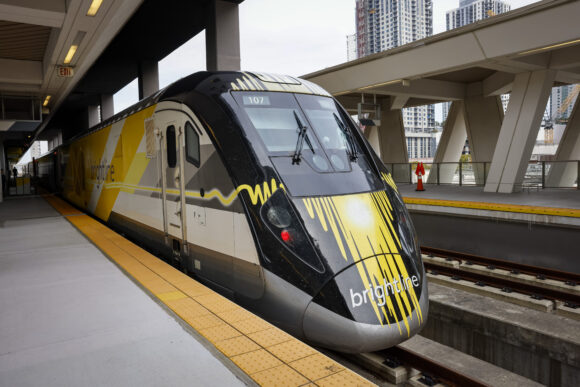
Florida’s Brightline has filed for bankruptcy protection after years of lower-than-expected revenue left it unable to repay billions it borrowed to finance the Miami-to-Orlando private railroad.
Brightline Holdings LLC and certain other parent entities filed for Chapter 11 on Thursday in New Jersey, listing assets and liabilities of between $1 billion and $10 billion in the petition. The filing excludes Brightline’s operating company, allowing it to continue running trains during the restructuring process.
The Fortress Investment Group-backed company has been skipping interest payments and huddling with creditors for much of the year, looking to garner support across various groups for a plan to restructure its complex $5.5 billion debt stack.
Brightline will get $258 million of post-petition funding from bond insurer Assured Guaranty Ltd. and other investors to see it through bankruptcy. Assured said in a statement that it and other stakeholders had also agreed to provide $490 million of new debt once the company exits the process.
“This new capital will be used to support Brightline Florida’s ongoing operations and help position it for long-term stability and success, in addition to repaying the post-petition financing,” according to Assured, which insures a majority of the existing senior tax-exempt bonds issued by the operating company, BrightLine Trains Florida LLC.
Brightline’s collapse into bankruptcy, while seen as virtually inevitable in recent months, is a setback for billionaire Fortress co-founder Wes Edens, who conceived of the railroad in 2012 with a vision of creating transformative infrastructure.
But even as he pushed ahead with a similar project between Nevada and California, the Florida high-speed passenger system has been on a slow-motion journey to insolvency. It’s a saga that has captivated the municipal-bond market, where Brightline borrowed heavily and where bankruptcies are few and far between.
When it tapped the muni market in 2019 for $1.5 billion to help finance the expansion to Orlando, the company was still loss-making. Months after the 2023 launch of its service between Miami and the Orlando airport, Brightline began slashing ridership forecasts.
In 2024, when the company asked Wall Street for $1.2 billion in junk debt, it opened the door to hedge funds that later sought to seize control of the business through their own restructuring plan.
Brightline made last-ditch efforts at a sale process in recent months under a new slate of management while fielding bankruptcy-loan proposals from the dueling creditor groups.
Under the Chapter 11 plan, Brightline Trains Florida’s $2.2 billion Series 2024 bonds will remain in place during the restructuring, according to a statement from the company. A further $2.2 billion in bonds issued by other associated entities will remain outstanding, with no cut to their principal amounts.
“Today’s agreement brings $490 million in new long-term capital to Brightline from the stakeholders who know this business, and it comes at a time of real momentum,” said Patrick Goddard, chief executive officer of Brightline Florida. “This transaction will be a catalyst for further growth in ridership and revenue.”
Photo: A Brightline train in Miami. Photographer: Eva Marie Uzcategui/Bloomberg
Topics Florida
Was this article valuable?
Here are more articles you may enjoy.
 AI Models May Soon Self-Replicate Across Smart-Home Devices, Anthropic Warns
  NYC Restaurants Shut Off Air Conditioning, Close on Sundays as Costs Surge
  Industry Reacts to Senators’ Letter for Claims Data and Recent Reports
  ‘Unusual’ Isaias Brings Winds, Downed Trees But Fewer Claims Than Expected

