


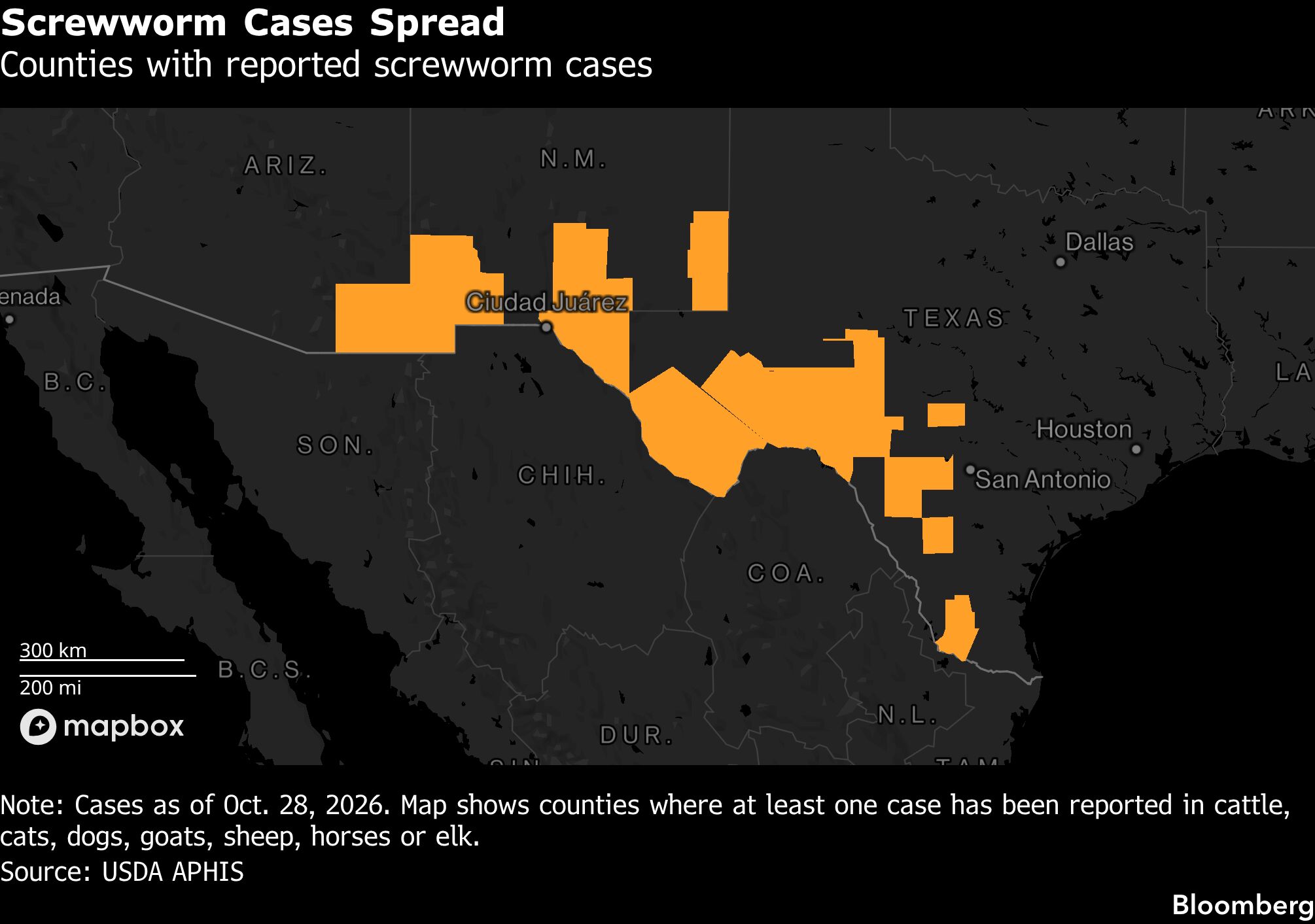
New World screwworm was found in Arizona for the first time, as cases of the deadly parasite threatening the US cattle herd spread west into a third state.
The US Department of Agriculture confirmed the infection late Wednesday in a dog in Cochise County, Arizona. A local veterinarian examined the animal earlier this week and found a wound “heavily infested” with maggots consistent with the New World screwworm, according to the Arizona Department of Agriculture.
The spread of the parasitic fly, whose larvae burrow into the wounds of animals, has increased this month, particularly in New Mexico. There have been a total of 71 cases of screwworm in the US since the outbreak began, according to the USDA. Eighteen are still active, with 10 located in New Mexico.
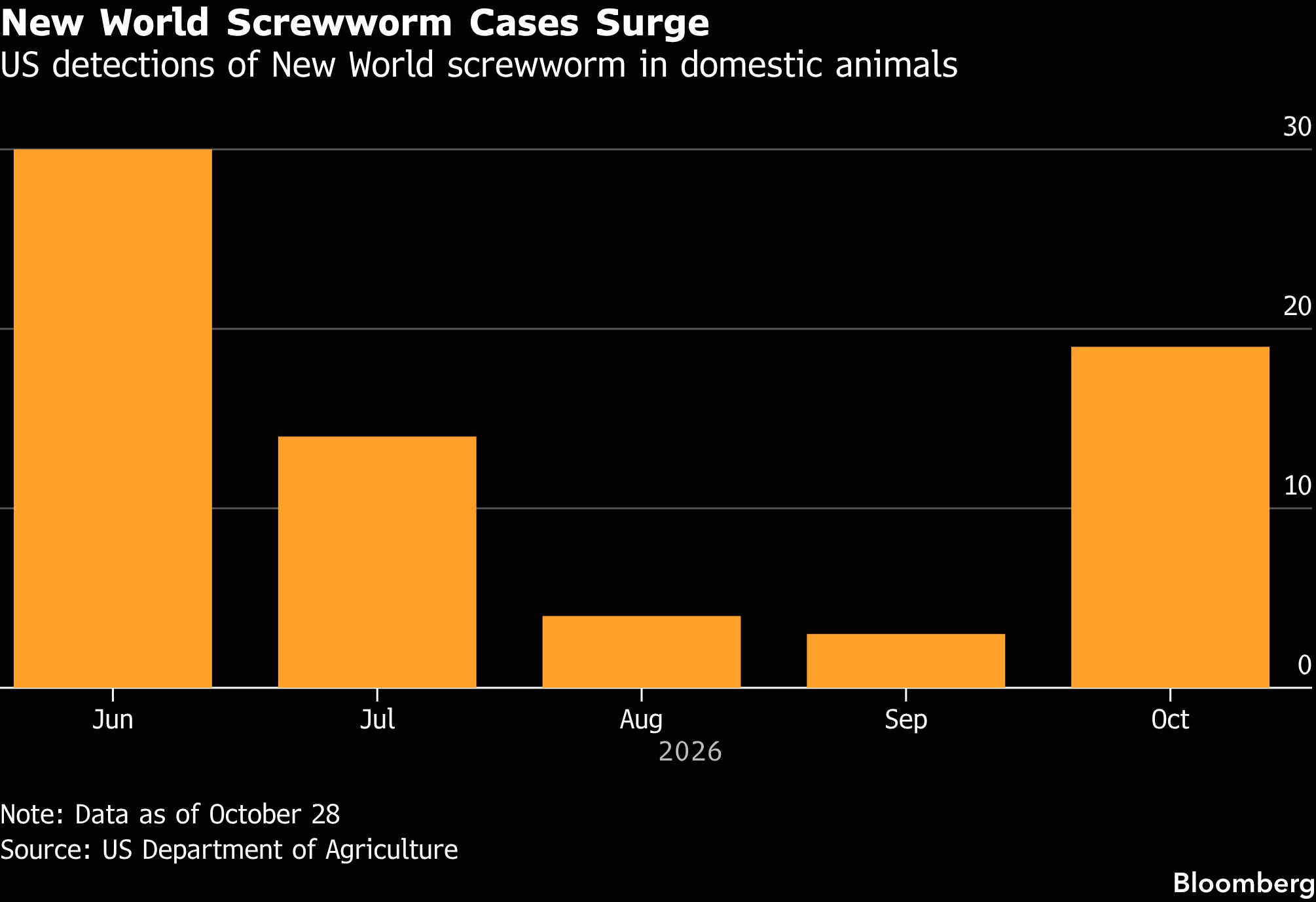
That makes October the second-busiest month for screwworm cases since the pest was first detected in the US in June. Most of those early instances were limited to Texas, and government authorities and ranchers quickly banded together to quarantine affected areas. The fly does not travel far on its own, so its spread tends to be facilitated by the movement of animals.
Spread among wildlife has been a concern for cattle ranchers since the animals travel through the same terrain as their herds, and an infection was detected in a wild elk for the first time last week. The case in Texas was spotted by a hunter, as the hunting season provides more proximity to wildlife that are harder to monitor.
Meanwhile, livestock movement has also ticked up as the USDA reopened ports in Arizona and New Mexico to shipments of cattle from Mexico.
Those shipments had been largely halted since late 2024 to prevent the New World screwworm spreading from Mexico, until the USDA began a phased reopening of ports in late August. More than 30,000 cattle have entered the US through a port in Douglas, Arizona, according to USDA data through Oct. 16. An additional 9,000 animals have gone through a more recently opened entry point in Santa Teresa, New Mexico.
The USDA has inspection protocols in place and has been dispersing sterile male flies into affected areas to curb the pest’s reproduction, a method that had seemed largely effective over the past few months. But targeted sterile fly dispersals depend, in part, on a relatively slow spread of the screwworm. A larger Texas facility for producing sterile flies, which will be crucial to eradicating the pest, isn’t slated to start operating until next year.
The US and a coalition of South American countries had previously eradicated screwworm, pushing the pest south of Panama. But the fly began spreading north again after the pandemic, reaching Mexico in late 2024. There are still over 2,000 active cases in the country.
Screwworm poses the largest threat to cattle, which in the early stages of their lives usually graze on vast pastures, but the parasite has also infected animals from goats to horses. The most recent five cases involved four dogs and one cat. The pest is not a food safety issue. Severely infested animals do not enter the food supply chain, and recovered animals can if they pass inspections before and after slaughter, according to the USDA.
Was this article valuable?
Here are more articles you may enjoy.
 Yellow Furball Mascot Liberty Biberty Sparks ‘Beautiful’ Protest. Seriously?
 Phoenix Hit by Hail and Strong Winds, Damaging Vehicles Across Valley
 FEMA Launches Online Purchasing for Flood Insurance Policies
 AM Best: Social Inflation Drives Surge in Commercial Auto Liability Claims


