

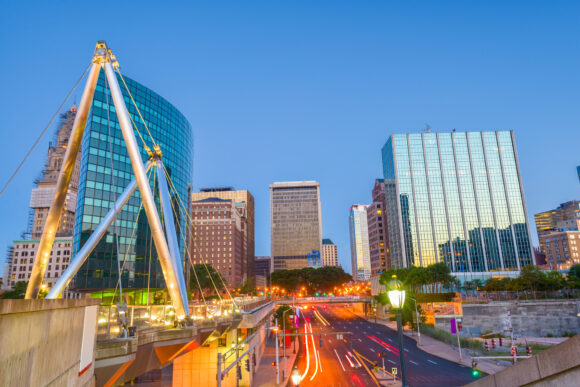
The Hartford Chairman and CEO Christopher Swift has convened a group of corporate and community leaders in greater Hartford to develop a unifying vision for the city.
According to the announcement from the namesake insurer based in the city, the Vision Committee will work with a range of stakeholders on a plan that Swift hopes might serve as a “North Star” for advancing existing initiatives, and other options, to “help transform Hartford and its downtown into a more vibrant business, residential and cultural destination.”
The process will include analyzing current conditions and discussing Hartford’s economic competitiveness, cultural identity, livability and connected infrastructure.
The membership of the Vision Committee includes leaders from the cities of Hartford and East Hartford, Stanley Black & Decker, Hartford Steam Boiler, RTX, The Bushnell Center for the Performing Arts, Nassau Financial Group, Hartford HealthCare, the Connecticut Department of Economic and Community Development, Aetna, the Capital Region Development Authority, Travelers and The Hartford.
“Connecticut’s capital city is at a crucial point in its history, marked by significant challenges and opportunities,” Swift said. “This is a galvanizing moment to bring together leaders from the business community to collaborate with public and nonprofit sectors on a path forward. This effort builds on The Hartford’s longstanding tradition of volunteerism, support and dedication to improve quality of life and vibrancy in our namesake city and home since 1810.”
According to the Hartford Business Journal, the group has actually been meeting for months but is now going public.
The committee has hired Streetsense, a firm that woks with cities and civic partners to strengthen local economies and communities. Streetsense’s clients have included the Cleveland Downtown Plan, Palo Alto Economic Development Strategy, Hoboken Business Alliance Strategic Plan and Downtown Denver Analysis.
Streetsense will prepare an assessment of market dynamics, regulatory conditions, spatial and infrastructure considerations, and identify barriers to growth and opportunities for reinvestment.
The Vision Committee aims to formulate a vision and execution plan for the city by late spring.
Hartford Mayor Arunan Arulampalam welcomed Swift’s initiative. “The future of Hartford hinges on our ability to work collaboratively and harness the immense talent and resources we have right here in our capital city,” Arulampalam said.
2035 Plan
The Vision Committee is not the first attempt to shape the Hartford of the future. In May 2020, the city government adopted a vision of what the city could be like in 2035 when it celebrates its 400th anniversary. Based on a survey of nearly 2,200 citizens and more than 50 meetings, the final plan centers around five action areas: Green-Grow-Live-Move-Play. The 75-page document identifies 10 key recommendations and 10 key real estate projects.
Its summary of overall priorities reads:
“To become more equitable and prosperous, we need to grow. To grow we need to attract new businesses and create jobs. To attract investment and talent, we need to create exceptional quality of place. To enhance quality of place, we must make the city and valley more sustainable, mobile and vibrant. This calls for a unifying vision.”
In relation to growing the city’s economy, the 2035 plan calls for steps that connect residents to career paths in the city’s core industries, help the city become a global center of innovation, and foster local entrepreneurship.
Among the 2035 plan’s recommendations are: reconnect Hartford to the Connecticut River; cut gun violence in half; complete 100% of the city’s bike plan; complete 100% of the city’s parks plan; protect, repair, and expand the city’s tree canopy; market Hartford to the region and beyond; make “No More Slumlords” a reality and invest in existing housing stock; expand bus and rail service throughout the region’ and become the state’s live music capital.
The 2035 plan also calls for completing 10 proposed “transformative” real estate projects to help “knit parts of the city back together physically,” while helping to “catalyze growth and foster a sense of unity and pride.” These real estate projects include the Albany Avenue Gateway, North End Wellness District; Downtown North; North Main Culture Corridor; Union Station Relocation; Parkville Arts & Innovation District; South Meadows; South End Health & Innovation District; Bushnell South and the Coltsville Historic Area.
Topics Trends
Was this article valuable?
Here are more articles you may enjoy.
 Surplus Lines Leaders Remain Bullish on Outlook in a Shifting Market
  Friend of Suspected FBI Data Thief: ‘Crazy’ Teen Warned Not to Hack Bureau
  NYC Restaurants Shut Off Air Conditioning, Close on Sundays as Costs Surge
  AI Models May Soon Self-Replicate Across Smart-Home Devices, Anthropic Warns

