

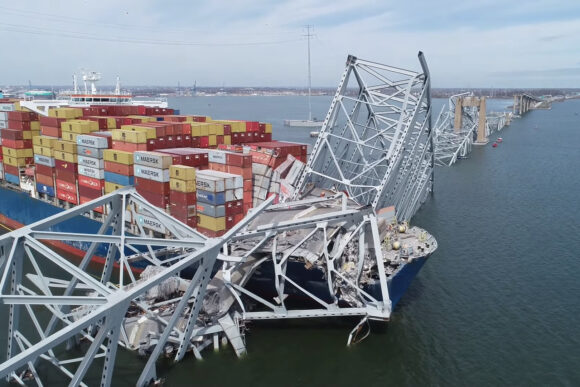
A federal judge has allowed the manager of the cargo ship Dali involved in the tragic collapse of Baltimore’s Francis Scott Key Bridge in March 2024 to proceed for now with its claims under an 1851 maritime law that limits liability for shipowners.
The state of Maryland and wrongful death claimants had sought to prevent Synergy Marine from invoking the Shipowners’ Limitation of Liability Act on the basis that Synergy does not meet the requirements as an owner of the ship and thus is not entitled to limited liability protection granted by the law.
Under the maritime law, a shipowner’s liability for a maritime loss or mishap is limited to the value of the ship and her pending freight if the mishap occurred without the privity of knowledge of the owner. The stipulated value of the Dali is $43.7 million.
The state and attorneys for wrongful death claimants argued that the law applies only to actual owners of vessels and that Grace Ocean Private Limited was and is the owner of the cargo ship Dali, while Synergy was only the manager and thus not eligible under the law.
The filing sought dismissal of Synergy’s petition only; it did not address Grace Ocean’s petition for protection under the act to limit its liability.
U.S. District Court judge James K. Bredar rejected the state’s bid to have Synergy’s claim dismissed at this point and will allow proceedings to continue. He found that while there are facts to indicate Synergy is not an owner, there are also facts that suggest it could be considered an owner and thus dismissal would not be appropriate at this time.
Maryland Moves to Deny Liability Limit Sought by Ship Manager in Key Bridge Collapse
According to the state’s filing, Synergy was not an owner because there was never a “complete transfer of possession, command, and navigation of the vessel” by owner Grace Ocean to Synergy.
The state contends that Synergy was not responsible for the vessel’s navigation, did not employ the crew, was subject to daily oversight by the owner, had no financial responsibility for the vessel’s operation, had no financial exposure for claims and does not provide insurance for the vessel.
For its part, Synergy maintains that its documents show that it had assumed all responsibility for the ship from the owner Grace Ocean and that Grace Ocean relied solely on it for the daily oversight and control of the ship.
The fact that it is an additional insured on Grace Ocean’s insurance policies supports its position that its control over the ship was sufficiently substantial to expose it to a shipowner’s risk of liability, according to the manager.
The court found that there are competing and undisputed facts surrounding Synergy’s financial responsibility, relationship with the crew, and how much operational control Synergy had over the ship. These factual disputes are material and thus the court refused to rule against Synergy at this point.
Grace Ocean and Synergy have claimed that the collapse of the bridge was “not due to any fault, neglect, or want of care” on their part or on the part of the vessel or any parties for whose acts they may be responsible.
Owners of Ship That Crashed Into Baltimore Bridge Sue Vessel’s Builder Hyundai
Grace Ocean and Synergy maintain that they shouldn’t be held liable for any loss or damage from the disaster. But if they are held liable, their liability should be limited under the maritime law to no more than the value of the ship and its cargo after the crash, or $43.7 million. Before the crash, the value of the ship was about $90 million.
The state and wrongful death claimants want the court to hold both Grace Ocean and Synergy fully accountable for alleged negligence, mismanagement, and incompetence.
Grace Ocean Private and Synergy Marine have themselves sued Hyundai Heavy Industries, the company that built their vessel, alleging negligence in the design of a critical switchboard on the ship.
In the early morning hours of March 26, the 984-foot-long containership Dali crashed into the Francis Scott Key Bridge, causing its catastrophic collapse, the death of six men, and injuries to others. The wreckage from the bridge fell into the Patapsco River, blocked access to most of the Port of Baltimore, and caused disruptions and other “significant harms to the state and its residents that will be felt for decades to come,” the state has claimed.
Single Loose Wire Led to Blackout That Caused Dali Crash Into Baltimore Bridge
In November, the National Transportation Safety Board (NTSB) issued a report finding that a loose wire in the ship’s electrical system caused a breaker to unexpectedly open. That in turn triggered a sequence of events that led to two vessel blackouts and a loss of both propulsion and steering near the 2.37-mile-long Key Bridge.
Photo: Collapsed Francis Scott Key Bridge in Maryland with Cargo Ship Dali. NTSB photo.
Topics Legislation Liability
Was this article valuable?
Here are more articles you may enjoy.
 All in the Family: Husband, Wife and Daughter Indicted for Insurance Fraud and Bribery
  ‘Unusual’ Isaias Brings Winds, Downed Trees But Fewer Claims Than Expected
  NYC Restaurants Shut Off Air Conditioning, Close on Sundays as Costs Surge
  Broad AI Exclusions in Insurance Policies Could Create Uncertainty, Marsh CEO Says

