

The Third Circuit Court of Appeals has dismissed a proposed class action against New Jersey government officials on behalf of families of nursing home residents who died early in the COVID-19 pandemic.
Approximately 10,000 elderly residents of New Jersey nursing homes and veterans’ homes died during the COVID-19 pandemic. Eventually, New Jersey reached a $53 million settlement with the families of 119 seniors who died in state-run veterans’ homes.
Plaintiffs who brought the suit are the daughters and estate administrators of three private-nursing-home residents who died in April and May 2020 after contracting COVID-19. They blame the deaths on policies promulgated by the New Jersey Department of Health including a policy intended to keep hospital beds available by prohibiting nursing homes from denying admissions to patients who tested positive for COVID-19. They also say the state failed to supply enough personal protective equipment (PPE) for patients and staff.
The estates sued the governor, health commissioner, and other New Jersey officials, attributing the deaths to a flawed public health policy that deliberately under-prioritized the safety of nursing homes.
The families’ complaint alleged violations of statutory rights and constitutional rights to life, safe conditions, bodily integrity, freedom from state-created danger, and freedom from cruel, unhuman, or degrading treatment.
But a three-judge panel of the federal appeals court has disallowed the class action, concluding that the families failed to offer enough evidence to pierce the qualified immunity that protects government officials for their actions and policies during the epidemic.
The federal appeals court upheld the federal district court that also dismissed the class action on qualified immunity grounds.
The families alleged that two weeks before the state issued its policy, the Centers for Disease Control and Prevention advised that substantial mortality might be averted if long-term care facilities acted quickly to prevent exposure of their residents to COVID-19. Medical professionals and other experts warned the state health department against the policy and nursing homes warned that separation of residents was not feasible, contamination was almost certain, and the directive would lead to unnecessary deaths, according to the complaint.
The state issued the policy anyway. By the waning of the pandemic, New Jersey’s nursing homes had a per-capita COVID-19 death rate of 16%, the worst in the country.
The appeals court explained why overcoming the immunity granted to state officials is a tall order and why the plaintiffs fell short.
“Qualified immunity shields government officials from civil damages liability unless the official violated a statutory or constitutional right that was clearly established at the time of the challenged conduct,” the appeals court noted, adding that the doctrine seeks to “give government officials breathing room to make reasonable but mistaken judgments about open legal questions.”
Therefore, “officials do not get stripped of qualified immunity every time a judge, with the clarity afforded by hindsight, believes that an official has committed a wrong.”
The judges also noted that qualified immunity “protects even those officials who exercise extraordinarily poor judgment” from liability for civil damages unless a plaintiff can satisfy the requirements for overcoming it.
To overcome the immunity, a plaintiff must make two showings. One is that the state’s conduct violated a statutory or constitutional right. The other is that the right at issue was clearly established when the conduct took place.
The appellate judges found that the plaintiffs failed to show how the state’s conduct violated their statutory or constitutional rights and failed to cite cases or evidence that might have put public officials on notice that their policy violated certain rights. For example, the families argued that because the nursing homes were locked down with all visitation prohibited, the residents were involuntarily committed patients and thus the state had a responsibility for their safety and well-being. But the court found that the decedents were voluntary residents of private nursing homes, not involuntarily institutionalized, and the state did not compel them to reside there against their will.
“We do not doubt the pain of plaintiffs’ losses during the pandemic or the imperfection of New Jersey’s response to it,” the court stated. “But qualified immunity gives state officials reasonable doubt in the exercise of their professional duties. To overcome qualified immunity, the law requires certain showings, and plaintiffs fall far short of making those showings.”
The Third Circuit affirmed the district court’s determination that the state officials are entitled to qualified immunity and its dismissal of the claims against them.
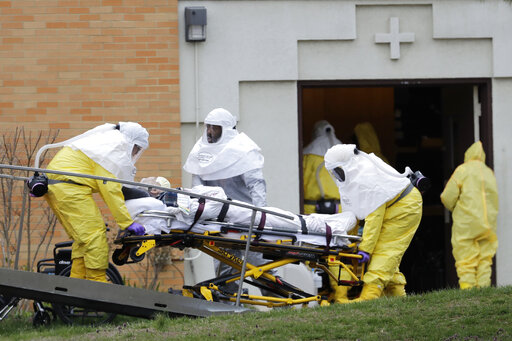
Top Photo: A resident from St. Joseph’s Senior Home is loaded into a bus in Woodbridge, N.J., Wednesday, March 25, 2020. More than 90 residents of the nursing home in Woodbridge were transferred to a facility in Whippany after several tested positive for COVID-19, according to a spokeswoman for CareOne, which operates the Whippany facility. The facility has moved its residents to other facilities to accommodate the new arrivals. (AP Photo/Seth Wenig)
Was this article valuable?
Here are more articles you may enjoy.
 World’s Largest Retirement Community Set to Borrow $180 Million for More Homes
  Broad AI Exclusions in Insurance Policies Could Create Uncertainty, Marsh CEO Says
  Viewpoint: Beware These Commercial Auto Endorsements!
  Travelers Reports Solid Underwriting, Record Investment Income for Q3

