

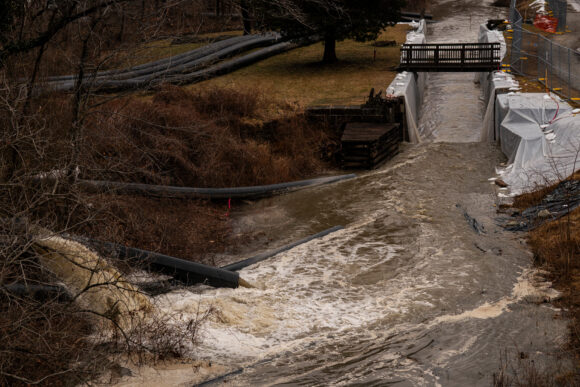
After a massive sewage spill in the Potomac River outside Washington, DC attracted the ire of President Donald Trump, federal officials are taking on a larger role in the disaster response — a job that could last months.
The spill began on Jan. 19, when a section of DC Water’s Potomac Interceptor sewer line in Maryland broke. That sent more than 200 million gallons of raw sewage rushing into the river over several days, an amount larger than the oil spilled in the 2010 Deepwater Horizon disaster.
While emergency repairs to the broken line could be completed by mid-March, there’s no timeline for how long it will take to clean up the environmental damage caused by the spill, which threatens human health and local industries reliant on the river, such as boating and fishing.
“We are exploring opportunities to do some environmental mitigations in the interim, but the full remediation can’t begin until the emergency repair is completed,” Sherri Lewis, spokesperson for the utility DC Water, wrote in an email. The restoration and remediation efforts will extend beyond the immediate area of broken line, covering affected areas along the river’s shoreline and beyond, she added.
DC Water has estimated this disaster response will cost about $20 million. The utility had previously identified the collapsed sewer line as being in need of rehabilitation and committed $625 million to update it, according to a Feb. 11 open letter by David Gadis, DC Water’s chief executive officer and general manager.
The spill is indicative of the risks posed by aging infrastructure nationwide. Over the past decade, the US wastewater sector’s renewal and replacement rate for large capital projects has slightly decreased while the average number of system failures has slightly increased, according to the American Society of Civil Engineer’s 2025 Report Card for America’s Infrastructure.
“There are challenges in terms of timely investment, timely maintenance and rehabilitation to address these issues before they become crises of the magnitude that we’ve seen with this Potomac Interceptor,” said Marccus Hendricks, a University of Maryland associate professor of urban studies and planning.
Washington, DC’s drinking water system — which relies on the Potomac — was unaffected by the spill because its water is collected upstream of the rupture, city officials said at a Feb. 20 press conference. DC Water constructed a temporary bypass to redirect wastewater back into the system within days. The last sewage release into the river occurred on Feb. 8.
Trump last week called the spill “a massive Ecological Disaster” in a Truth Social post and accused Maryland Governor Wes Moore, a Democrat, of mismanaging the response, even though his state isn’t leading it.
After the post, DC Mayor Muriel Bowser declared a public emergency and asked the president for federal assistance. Trump approved an emergency declaration, triggering greater involvement from the Environmental Protection Agency and Federal Emergency Management Agency.
“Cleanup is going to take a while,” EPA Administrator Lee Zeldin said on Fox Business Wednesday. The emergency repairs are “in the home stretch,” he added, but “as far as the remediation of the environmental damage that its caused to environmental quality and more — that’s something that’s going to take a while.”
Local environmentalists welcomed greater federal involvement. “Hopefully this will provide oversight and some accountability in what happened here,” said Betsy Nicholas, president of the environmental group Potomac Riverkeeper Network.
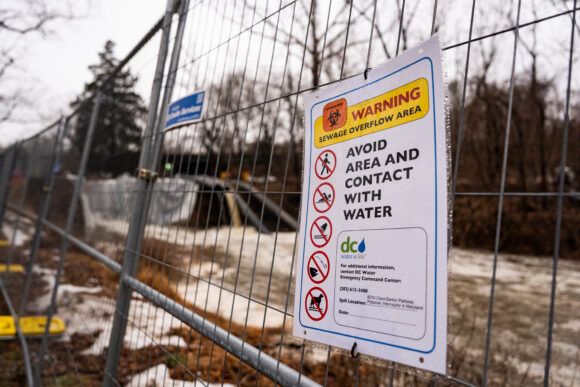
DC Water has been doing daily water quality sampling to detect E.coli bacteria, which can cause gastrointestinal problems. While E.coli levels remain higher than the EPA’s recreational standards limit near the spill site, other spots along the river in Maryland and DC are now mostly below those limits.
Independent sampling by the University of Maryland has similarly found high E.coli levels near the spill site, including exceeding EPA standards by more than 10,000 times in the days just after the spill was identified.
“Over time, we have seen the concentration of E.coli decrease, which is encouraging,” said University of Maryland associate professor Rachel Rosenberg Goldstein, who is co-leading the sampling effort. “But we’re still seeing, based on last week’s results, that the E.coli concentrations are still above EPA’s recreational water quality standards.” Her team’s sampling has also detected the bacteria that can cause staph infections.
Top Photo: Pumps and pipes divert raw sewage into the C&O Canal and around a broken section of the Potomac Interceptor, a six-foot-wide sewage pipe between the Clara Barton Parkway and the C&O Canal, in Cabin John, Maryland, US, on Friday, Feb. 20, 2026. DC Mayor Muriel Bowser on Wednesday declared a public emergency regarding the massive discharge of raw sewage into the Potomac River after a section of sewer line collapsed in January.
Was this article valuable?
Here are more articles you may enjoy.
 Reuters: DXC in Advanced Talks to Sell Insurance Software Unit for $2.4 Billion
  World’s Largest Retirement Community Set to Borrow $180 Million for More Homes
  EU Cyber Agency Warns Websites May Go Dark as PHP Prepares Critical Fix
  Home Insurance Tops Property Taxes in Squeeze for US Households

