

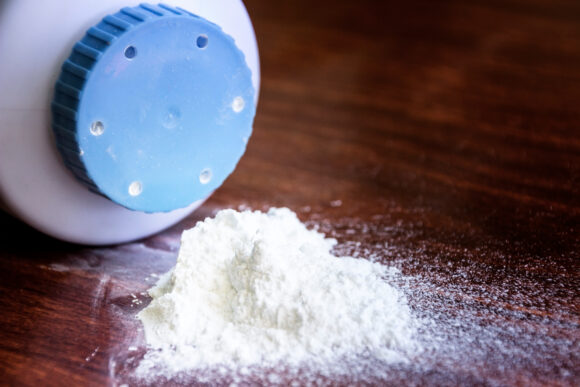
Johnson & Johnson’s baby talcum powder caused a woman’s mesothelioma but not her death, a Massachusetts jury recently found in a split decision.
In their lawsuit, Winifred Haddad’s husband and family maintained that Johnson & Johnson’s (J&J) baby powder contained asbestos that caused her mesothelioma and her death. They maintained J&J and the talcum industry knew about the risks of asbestos but did not warn users. They sought damages for personal injury and wrongful death.
The Middlesex County Superior Court jury on November 9 found that J&J’s baby powder was a substantial contributing factor to Haddad’s mesothelioma and awarded $1.9 damages (plus $1.4 million interest) for personal injury for the pain, suffering and medical care she experienced after she was diagnosed.
However, the jury rejected the wrongful death claim, reflecting some testimony that her death might have been caused by a pre-existing heart condition, not mesothelioma. The jury also declined to award punitive damages which under Massachusetts law would have required a finding that J&J’s conduct amounted to “gross negligence” or was otherwise “malicious.”
The family alleged that Haddad contracted mesothelioma and died as a direct and proximate result of the negligence of J&J in its product design and inadequate warning. According to the lawsuit, Haddad was exposed to J&J’s asbestos materials during the course of her personal life and her occupation as a nurse. She used talc products on her body and was exposed through her work as a nurse’s aide and nurse. She also used asbestos-containing talc products on her children and was exposed as a child to her own mother’s use of talcum powders.
The Haddad family maintained that she “suffered serious personal injuries, endured great pain of body and mind, suffered severe mental anguish and distress, was required to undergo medical treatment, care and expense, and, ultimately, died as a result of her asbestos-related injury.”
J&J Defense
In answering the negligent design and warnings claims, J&J argued that its products were manufactured in accordance with federal government specifications and in keeping with the states of medical and scientific knowledge at the time. The company maintained that it neither knew nor should have known that its products presented a minimal risk of harm, if any risk at all.
J&J also maintained that Haddad’s mesothelioma was an occupational disease which her employer’s workers’ compensation coverage should cover and for which J&J was not liable.
On the wrongful death claim, the jury heard some testimony that Haddad was diagnosed with serious heart problems about a year and a half before her mesothelioma diagnosis. She passed away on November 30, 2020, about six months after her initial cancer diagnosis. J&J attempted to cast doubt on the claim that mesothelioma caused her death rather than her heart condition. The Haddads characterized these attempts as speculative and lacking medical certainty.
In the end, the jury found that J&J was negligent in its baby powder product design and in inadequate warning and these were substantial contributing factors to her mesothelioma. However, the jury found that they were not substantial contributing factors to her death.
The verdict for $1,914, 990 compensatory damages broke down: $500,000 for conscious pain and suffering, $750,000. loss of service, companionship care and affection, and $664,990 for medical expenses. Plus about $1,410,641 in interest for a total of $3,325,631.
Was this article valuable?
Here are more articles you may enjoy.
 Hours-Long Microsoft Outage Disrupts Businesses, Governments Globally
 El Niño’s Odds of Being Worst Ever Edge Lower, US Climate Prediction Center Says
 Impersonation Top Scam Handled by Allstate
 SpaceX Plans $24 Billion Data Center and Gas Plant in Texas


