

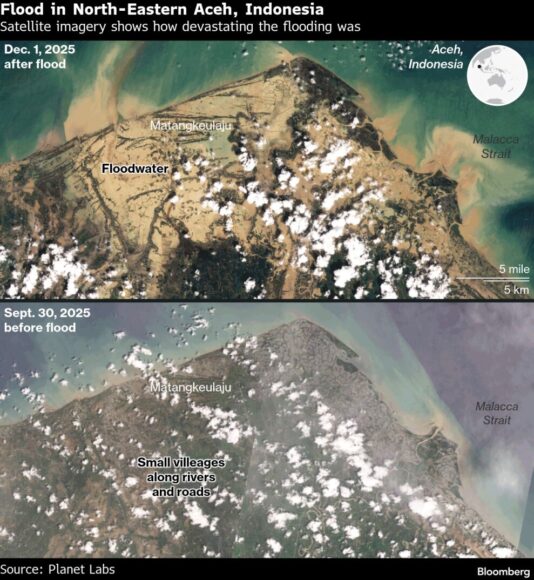
Indonesia will need 51.8 trillion rupiah ($3.2 billion) to rebuild areas devastated by recent floods and landslides in Sumatra, according to the national disaster agency.
More than 900 people have died as a result of monsoon rainfall that was intensified by a rare cyclone last week; nearly 400 remain missing and almost a million residents have been displaced, the agency said on Sunday. The central government has expanded fiscal support for local administrations in Aceh, North Sumatra and West Sumatra provinces, according to local media.
The disaster is among a series of extreme weather events that has highlighted Southeast Asia’s vulnerability to climate change, and that’s left several countries grappling with mounting damage to communities, agriculture, infrastructure, and national finances. More than 1,300 people have died across the region, and nations including Indonesia, Philippines, Thailand and Vietnam are expected to have racked up at least $20 billion in losses.
Read more: Deadly Floods’ $20 Billion Toll Shows Asia’s Rising Climate Risk
Indonesian authorities were trying to expand relief efforts as floodwaters receded from hundreds of villages that remain cut off due to damaged roads and bridges. The disaster agency said 167 tons of supplies have been distributed in the western-most province of Aceh, while temporary Starlink Wi-Fi has been deployed to reconnect several districts where telecommunications remain severed.
President Prabowo Subianto, who visited the affected region on Sunday, said the three provinces would receive assistance of up to 20 billion rupiah, depending on the severity of the damage. Funds worth 4 billion rupiah have been approved for each of the 52 affected districts and cities whose contingency bugets have been depleted, according to local media.
Finance Minister Purbaya Yudhi Sadewa said the disaster will likely weigh on national GDP in the fourth quarter, with losses in agriculture and infrastructure still being assessed.
Sumatra is home to vast palm and coffee plantations. The Indonesian Palm Oil Association, Gapki, said it did not expect the floods to significantly impact production for 2025.
Still, the mounting human and economic toll has prompted authorities to probe resource companies for any role they may have played in exacerbating the disaster, including through deforestation.
The environment ministry has suspended the operations of four companies in Sumatra after an aerial inspection revealed massive land clearing upstream from where the companies operate.
Mining services company PT Agincourt Resources, state-owned plantation firm PT Perkebunan Nusantara III and hydro power developer PT North Sumatera Hydro Energy were among the companies summoned for questioning on Monday.
Separately, Forestry Minister Raja Juli Antoni told parliament on Thursday that the ministry will investigate 12 companies, saying that mismanagement of forests appeared to have contributed to the disaster. The ministry also plans to revoke forest-concession permits held by 20 companies for a combined 750,000 hectares of land in Sumatra and elsewhere in the country, pending approval from Prabowo.
Topics Flood
Was this article valuable?
Here are more articles you may enjoy.
 ‘Unusual’ Isaias Brings Winds, Downed Trees But Fewer Claims Than Expected
  AI’s Water Strain Includes Surging Demand From Electricity Use
  All in the Family: Husband, Wife and Daughter Indicted for Insurance Fraud and Bribery
  KCC Says Isaias Insured Losses to Be $3 Billion; AM Best Calls Storm an Earnings Event

