

French insurer AXA SA said it’s exercising greater caution on the artificial intelligence build-out when backing financing for the sector, amid growing awareness of emerging risks in private markets.
“We are convinced of the medium-term trend, but we want to avoid financing technological gambles,” AXA Group Chief Investment Officer Jean-Baptiste Tricot said in an interview in Paris. AI infrastructure has seen “astronomical volumes allocated in recent months.”
Data centers — the huge real estate developments housing equipment generating AI computing power — are emerging as a new worry spot given the hundreds of billions of dollars being invested in as-yet unproven technology. Norway’s $2.1 trillion wealth fund said this week that they won’t form a major part of its investment approach over the next three years.
“We are trying to avoid overly specialized data centers and data centers that are dedicated or customized for a single player or a single technology, because we don’t know yet which actor or technology will ultimately win the AI race,” Tricot said. AXA is “more interested in financing data centers that have inference and general-purpose capabilities,” he said.
At the same time, the collapse of US auto parts supplier First Brands earlier this year has sparked heightened attention to the potential pitfalls in the $1.7 trillion private credit market and the transmission of losses to financial firms like banks and insurers. AXA is one of the world’s largest insurers, and deploys around €65 billion in private and structured credit.
With First Brands, a downturn in certain parts of the auto-industry led to a bankruptcy filing in September which ensnared major firms including Jefferies Financial Group Inc. and the asset management arm of UBS Group AG. It came weeks after the demise of used car seller Tricolor, raising concerns that troubled loans could emerge in other sectors.
Tricot said that regulators are now also pushing for a better view of firms’ asset portfolios.
“When this type of event occurs or other kinds of hit in the private credit sphere, we review our entire book one by one, line by line, to ensure that we have nothing similar,” Tricot said. “Our investment guidelines would not have allowed to get material exposures to First Brands or Tricolor.”
“The sector is essential, as is the quality of the documentation, and we also focus on relatively short maturities,” Tricot added. “We have accelerated these reviews of our portfolio in recent months.”
AXA’s private and structured credit allocation represents around 14% of the insurer’s total deployment, with more than half consisting of senior tranches of collateralized loan obligations or mortgages in European countries such as the Netherlands, Switzerland and Germany, according to Tricot. About 84% of the private credit portfolio is investment grade, he said. The firm is working with around twenty European and US asset managers in the private credit sphere.
“Our philosophy in general in private and structured credit is not to buy all of an asset manager’s production, we tend to go instead for single managed accounts or funds of one structure with strict investment guidelines,” he said, adding that AXA wants to avoid investing without covenants or in covenant-lite arrangements.
“What we will continue to avoid in private credit are technological bets and exposure to subprime consumers,” Tricot said. “The economy is somewhat two-tiered, particularly in the US, where well-off consumers are increasingly driving the market.”
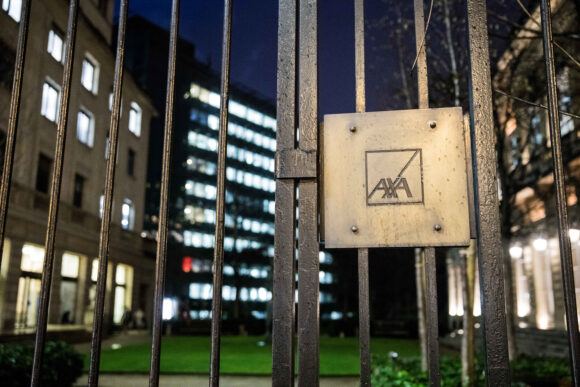
Photograph: AXA SA’s headquarters in Paris. Photo credit: Christophe Morin/Bloomberg
Related:
- Bank of England Sees Rising Financial Risks From AI and Lending
- Australia Banking Regulator Warns on Elevated Risks From Abroad
- Europe’s Banks Face ‘Unprecedentedly High’ Risk of Shocks, ECB Warns
- European Central Bank’s Guindos Says Financial-Stability Risks Remain Elevated
- Australia Watchdog Warns Private Credit With Tougher Action
- Bain Capital Private Credit Executive Brushes off Systemic Concerns, Eyes Asia Growth
- Global Funds Add to Warnings of Risks in Private Credit
- UBS Warns of Systemic Risk From Weak US Insurance Regulation
Topics Trends
Was this article valuable?
Here are more articles you may enjoy.
 Storm Austen Will Be Stronger Than Forecast Along UK Coasts
  KCC Says Isaias Insured Losses to Be $3 Billion; AM Best Calls Storm an Earnings Event
  Oaktree’s Deal to Buy A-Cap Insurer Crumbles, Spawning New Talks
  Reuters: DXC in Advanced Talks to Sell Insurance Software Unit for $2.4 Billion

